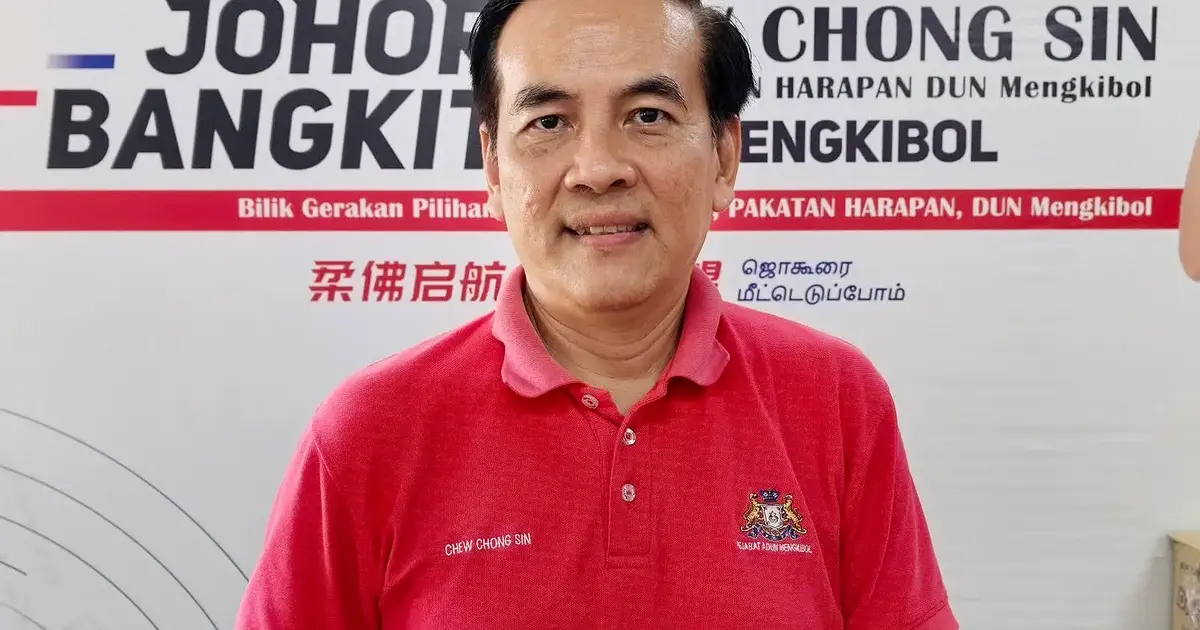
An ex-DAP representative has publicly alleged that Barisan Nasional and Perikatan Nasional share an undisclosed understanding to jointly form the Johor state government, raising fresh concerns about coalition arrangements in Malaysia's largest state economy. Chew Chong Sin made the assertion in recent statements, suggesting that such an alliance would shift the state's policy direction sharply toward more conservative positions on governance and social issues.
The claim touches on a persistent feature of Malaysian politics—unwritten arrangements between competing parties that fall short of formal coalitions yet fundamentally shape political outcomes. Such "tacit understandings" typically emerge from back-channel negotiations and shared ideological or strategic interests, allowing parties to cooperate without the transparency and accountability that formal coalition agreements impose. In Johor's case, where BN has traditionally dominated state politics whilst PN has strengthened its presence in recent years, such an arrangement would represent a significant reconfiguration of the political landscape.
The implications for Johor governance warrant careful examination. A BN-PN administration could introduce policy frameworks distinctly different from those pursued under DAP influence in states like Penang or Selangor. Conservative governance typically encompasses stricter enforcement of existing regulations, more cautious approaches to social liberalisation, and greater alignment with religious institutional interests. For a state like Johor, which maintains significant economic weight within Malaysia and serves as a gateway to Southeast Asia through its port facilities and manufacturing sectors, such shifts could affect regulatory environments, investor confidence, and regional competitiveness.
The strategic logic behind potential BN-PN cooperation reflects broader political dynamics across Malaysia. BN, whilst still formidable in peninsular state politics, has lost its former supermajority status and must navigate increasingly fragmented electoral landscapes. PN, having emerged from the 2018 political upheaval and consolidated itself as a distinct political force, possesses significant bargaining power in states where neither BN nor Pakatan Harapan commands outright majorities. Johor represents precisely the type of contested terrain where such partnerships become operationally attractive to both parties.
Chew Chong Sin's background as a DAP representative positions him as an observer of Johor's political architecture, though his current institutional position shapes how his claims are received. DAP has sought to maintain influence in Johor despite limited representation compared to its strongholds elsewhere, making statements about competitor alliances part of a broader positioning strategy. Nevertheless, such allegations, even from opposition figures, merit scrutiny given the importance of political transparency in Malaysia's democratic processes.
The concept of tacit understandings differs meaningfully from formal coalition agreements in Malaysian politics. Formal coalitions require public declarations, written protocols, and shared ministerial portfolios—elements that invite public debate and journalistic scrutiny. Tacit arrangements, by contrast, operate through selective cooperation on key votes, implicit agreements to avoid direct competition in certain constituencies, and coordinated positioning on major policy questions. This obscurity creates governance challenges, as voters cannot fully assess which parties will actually cooperate and on what terms.
For Malaysian and Southeast Asian observers, the Johor situation exemplifies broader questions about coalition governance in the region. Thailand, Indonesia, and the Philippines have all grappled with fluid political alignments where parties form unexpected partnerships without clear ideological coherence. Malaysia's experience demonstrates both the flexibility and the opacity that such arrangements introduce. In Johor specifically, any BN-PN understanding would affect not merely state-level administration but also the state's relationship with federal governance and its role within broader Malaysian economic strategy.
The potential policy conservatism that Chew identified carries particular relevance for Johor's diverse population and multicultural economy. The state attracts workers and investors from across Southeast Asia and beyond, and governance frameworks that appear ideologically restrictive could influence that region's openness to external talent and investment. Additionally, Johor's manufacturing sectors, including automotive and petrochemicals, operate within supply chains sensitive to regulatory consistency and perceived political stability—factors that cloudy coalition arrangements may complicate.
Conservative governance need not inherently handicap Johor's development, but the process through which such policies emerge matters substantially. Governance achieved through transparent democratic processes and public deliberation carries greater legitimacy and predictability than that emerging from undisclosed understandings. Malaysian voters across all political affiliations have expressed concern about non-transparent political dealings, and allegations of tacit arrangements between major parties speak to ongoing anxieties about whether electoral choices meaningfully determine governmental direction.
Moving forward, clarity regarding BN and PN's actual relationship in Johor serves multiple constituencies. Investors require certainty about regulatory environments and governance continuity. Opposition parties need to understand which coalitions actually govern decision-making to mount effective scrutiny. Most fundamentally, Johor voters deserve transparent information about which parties are cooperating and on what policy grounds. Whether Chew Chong Sin's allegations prove accurate or exaggerated, they highlight the persistent tension between Malaysia's formal democratic institutions and the informal political processes that significantly shape outcomes across the country's states.

