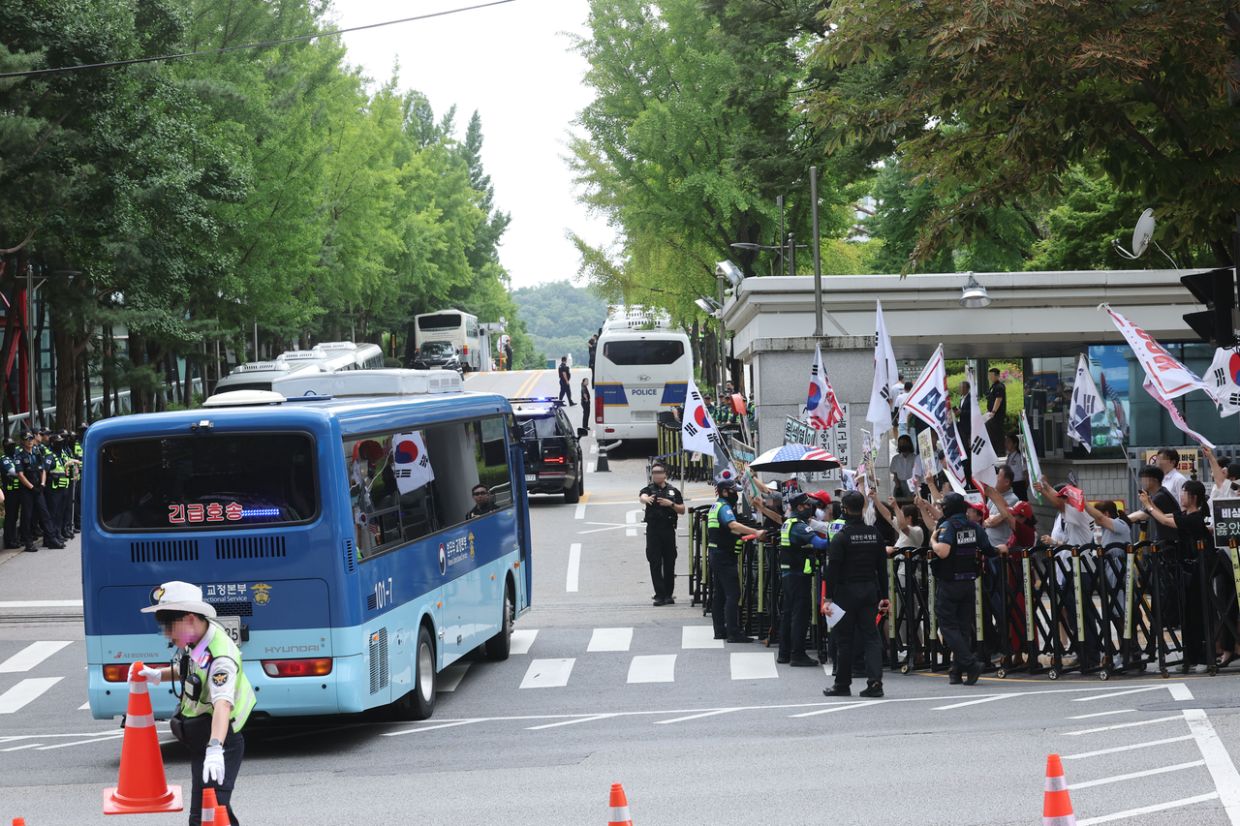
Former South Korean President Yoon Suk Yeol has been sentenced to two years in prison after Seoul Central District Court found him guilty of violating the Political Funds Act by receiving unpaid political polling services. The court determined that Yoon accepted 14 surveys valued at 27.92 million won from political broker Myung Tae-kyun, in what constitutes one of South Korea's most significant political finance scandals involving a sitting or former head of state.
The conviction centres on Yoon's receipt of opinion polling services that were never properly disclosed or paid for under South Korea's strict campaign finance regulations. The Seoul Central District Court identified that between June 2021 and March 2022, during Yoon's presidential campaign period, the arrangement allowed him to obtain valuable electoral intelligence without proper documentation or payment. Prosecutors had initially charged Yoon with conspiring alongside his wife, former first lady Kim Keon Hee, to receive 58 surveys valued at over 270 million won from Myung during this timeframe.
Presiding Judge Lee Jin-gwan emphasized the gravity of the violation, noting that opinion polls carry substantial weight in shaping voter preferences and establishing democratic legitimacy. The court reasoned that when political actors receive undisclosed contributions outside the framework established by the Political Funds Act, democratic principles face genuine threat. The judge articulated that such arrangements risk manipulating public opinion formation and compromising the fairness that must underpin electoral contests.
Beyond the financial irregularities, the court identified a quid pro quo arrangement that deepened the breach. Evidence demonstrated that Yoon had promised Myung the People Power Party's presidential nomination for former lawmaker Kim Young-sun in exchange for the polling services. Following Yoon's electoral victory, he exerted influence through Chang Je-won, then chief of staff to the president-elect, to facilitate Kim Young-sun's nomination securing, fulfilling what the court characterized as a tacit understanding among all three parties.
The judicial reasoning emphasised that former first lady Kim Keon Hee had authorized Myung to manage every aspect of the polling operations, including determining when polls would be conducted, what questions they would contain, which methodologies would be employed, and whether and how results would be publicized. Critically, the court found that Yoon possessed full knowledge of this arrangement and implicitly consented to it through his continued acceptance of the survey results and his later actions to honour the nomination pledge. This successive and tacit agreement among Yoon, Kim, and Myung constituted the violation at the heart of the conviction.
Interestingly, the court determined that proving a direct quid pro quo exchange was unnecessary to establish culpability under the Political Funds Act. This legal determination carries significant implications for how South Korean authorities may prosecute future campaign finance violations, as it suggests that the provision of unreported services itself constitutes sufficient grounds for prosecution, regardless of whether explicit reciprocal promises can be demonstrated.
The conviction's implications extend beyond Yoon's individual circumstances. Political broker Myung Tae-kyun was simultaneously sentenced to 18 months in prison and taken into custody immediately following the court proceeding, underscoring that facilitators of campaign finance irregularities face serious consequences alongside the politicians who benefit from such arrangements. The dual sentencing reinforces South Korea's commitment to enforcing political finance transparency across all participants in electoral processes.
A striking divergence emerged regarding the treatment of former first lady Kim Keon Hee in her own separate legal proceeding involving the identical polling services. South Korea's lower courts acquitted Kim at both trial and appellate stages of the related Political Funds Act charge. The courts in Kim's case found that prosecutors had failed to demonstrate she received a quantifiable financial benefit equivalent to the surveys' actual costs, nor could they conclusively establish that Myung provided the polling services specifically in return for securing the Kim Young-sun nomination.
Judge Lee explained the differing outcomes by noting that the allegations regarding the opinion polls in Kim's case and those in Yoon's case could not be regarded as factually identical, despite involving the same polling services and the same political broker. This distinction highlights the complexities of South Korean criminal procedure and the evidentiary standards required to prove campaign finance violations. The Supreme Court is scheduled to deliver its final ruling in Kim's case Thursday, which could either affirm or overturn the lower court acquittals and potentially reshape the legal analysis of the entire scandal.
For Southeast Asian observers, the Yoon scandal underscores persistent challenges that democracies across the region face in enforcing campaign finance regulations and maintaining public confidence in electoral integrity. South Korea's rigorous prosecution of a former president, despite the political costs involved, demonstrates institutional commitment to accountability that remains aspirational in many neighbouring democracies. The case illustrates how informal arrangements and tacit understandings can violate formal legal structures, and how courts must navigate complex evidentiary questions when political figures attempt to exploit grey areas in campaign finance law.
The two-year prison sentence positions Yoon among the most severely punished former heads of state in recent Asian democratic history for campaign finance offences. The conviction arrives amid broader questions about political stability in South Korea, where presidential administrations frequently face legal challenges following the conclusion of their terms. The ruling establishes important precedent regarding the liability of former presidents for electoral misconduct and may influence how subsequent administrations approach campaign financing and vendor relationships during electoral contests.

