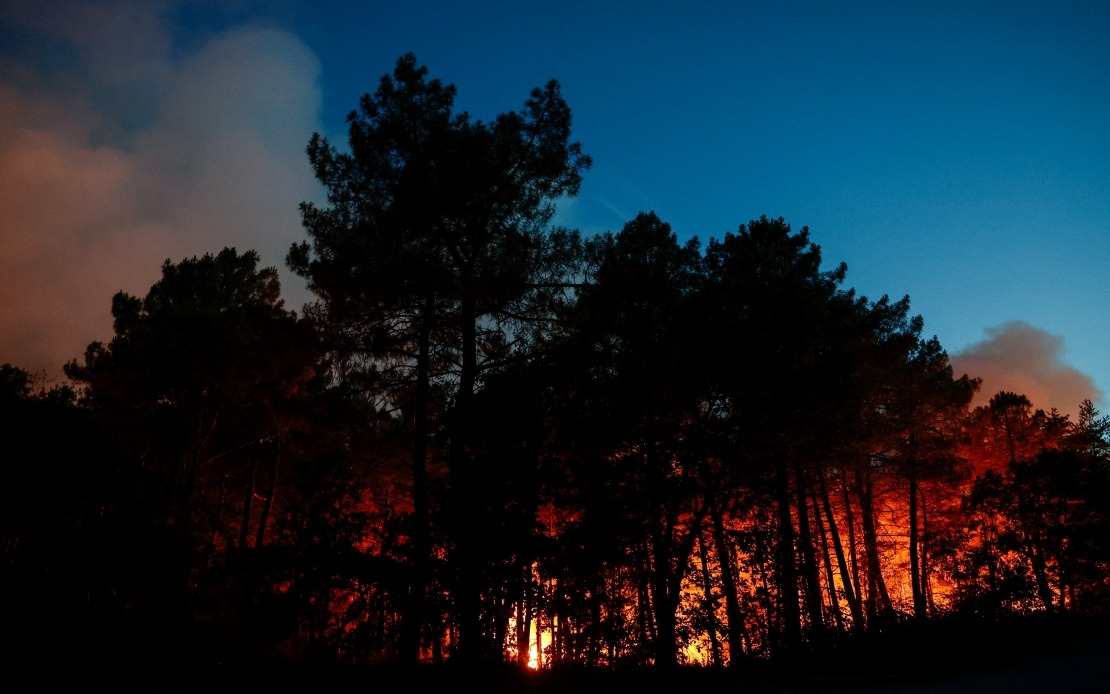
France is confronting what authorities are describing as an exceptionally severe wildfire season, with Interior Minister Laurent Nunez revealing that blazes across the country have consumed 119,000 hectares of forest and vegetation since January. The scale of destruction underscores the mounting environmental and security challenges facing the nation as climate-related weather patterns intensify across Europe.
The cumulative toll reflects the frequency and ferocity of fire activity this year. Nunez detailed that the country has experienced 14,320 individual wildfire incidents since the start of January, with particularly intense activity on Friday when alone, 25 major fires erupted simultaneously, each demanding substantial coordinated firefighting interventions. This concentration of major incidents in a single day illustrates how rapidly conditions can deteriorate and the strain placed on emergency response infrastructure.
Despite marginal improvements in humidity across certain areas, Nunez cautioned that dangerous conditions persist nationwide. The combination of persistently elevated temperatures, soil moisture depletion, and the desiccation of vegetation creates ideal conditions for fire propagation and intensity. These meteorological factors have become characteristic features of summer across much of southern France, raising questions about seasonal patterns and longer-term climate implications for the region.
Geographically, the wildfire threat remains concentrated in France's most vulnerable zones. The Mediterranean coastline, the Rhone Valley corridor, and portions of western France all face elevated risk levels. Two regions have been designated as facing the most critical danger classification: the Var department in southeastern France and southern Corsica, both designated at the "very severe" warning level. This distinction highlights how vulnerability clusters in specific territories with particular topographical and climatic characteristics.
The Var department exemplifies the persistence of these threats. A significant fire that authorities believed had been contained reignited on Friday, destroying an additional 1,500 hectares despite prior suppression efforts. Such reignitions demonstrate how challenging wildfire management becomes when underlying conditions remain favourable for combustion, and illustrate the psychological and operational toll on firefighting personnel who face fires that can unexpectedly resurge.
Responding to the escalating crisis, French authorities mobilized substantial additional resources overnight. Approximately 1,500 extra firefighters were deployed to the Var region to protect inhabited communities, supported by intensive aerial firefighting operations that continued until darkness made further operations untenable. The coordination between ground and air assets reflects the complexity of modern wildfire suppression in densely populated regions where infrastructure and homes lie in proximity to fire-prone terrain.
Civil protection infrastructure nationwide remains on heightened alert. France maintains all available aerial firefighting assets in active deployment, while 65 interdepartmental firefighter reinforcement columns are currently mobilized—though this represents a modest decrease from the peak of 72 columns deployed during the most intense phase of the crisis. Strategically, authorities have permitted limited units to stand down temporarily, prioritizing crew rest and preventing burnout among exhausted personnel, though with explicit acknowledgment that rapid reactivation protocols remain in place should conditions deteriorate further.
Law enforcement has played a secondary but important role in the crisis response. Security forces have completed 328 arrests connected to wildfire investigations, suggesting that a proportion of fires may have resulted from human negligence or intentional action. This dimension adds a governance and public behaviour component to what is fundamentally an environmental emergency, raising awareness about the consequences of carelessness during high-risk periods.
The implications for Southeast Asia merit consideration. Regional nations, including Malaysia, face similar seasonal wildfire challenges, particularly during dry seasons when transboundary smoke haze becomes a persistent public health and diplomatic concern. France's experience demonstrates that even wealthy, technologically advanced nations with substantial emergency resources struggle to contain large-scale wildfire events when atmospheric and soil conditions align unfavourably. The scale of France's mobilization—involving thousands of firefighters and full deployment of aerial assets—underscores resource requirements that developing nations may find difficult to sustain.
For Malaysian policymakers and environmental managers, the French situation offers cautionary lessons. Investment in early warning systems, fuel management through controlled burning and vegetation management, and pre-positioned emergency resources can mitigate but cannot eliminate wildfire risk when climate conditions turn severe. The 119,000 hectares destroyed in France represents an area roughly equivalent to Luxembourg, illustrating the landscape-scale consequences of cumulative fire activity.
Looking forward, French authorities face dual challenges: immediate suppression of active fires while managing the longer-term question of whether current climate patterns represent temporary volatility or permanent shifts in seasonal fire regimes. Nunez's language—describing the season as demonstrating "exceptional nature"—suggests official recognition that current conditions exceed historical norms and may presage recurring crises. European nations will likely conduct comprehensive reviews of fire management protocols and resource allocation in the aftermath of this season.

