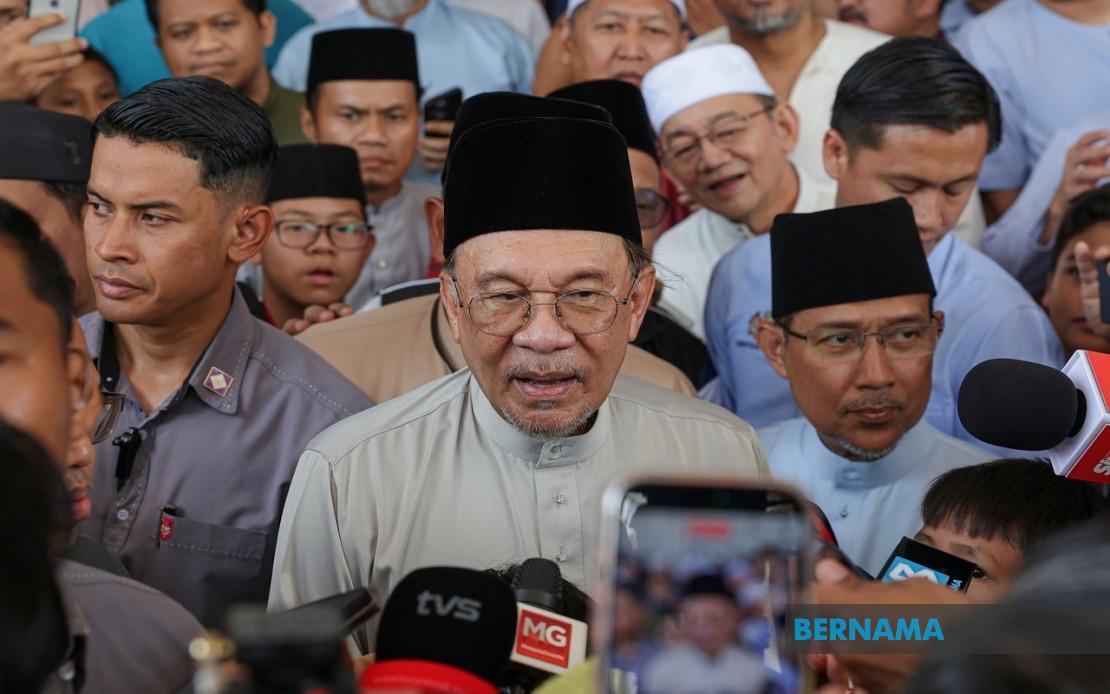
Prime Minister Datuk Seri Anwar Ibrahim has reaffirmed the government's commitment to transparency by confirming that the complete Royal Commission of Inquiry report examining Lembaga Tabung Haji's management has been made public without any removals or redactions. Speaking to journalists after Friday prayers at Masjid Kariah Paroi Jaya in Seremban on July 31, Anwar stressed that the decision to release the 211-page document in its entirety reflects the administration's dedication to accountability and institutional reform in one of Malaysia's most important Islamic financial institutions.
The Prime Minister's explicit assurance that neither his office nor any government department had excised material from the commission's findings underscores the political significance of the disclosure. By making the entire report available to the public, including detailed recommendations and procedural documentation, the government is enabling Muslims and all Malaysians to independently evaluate the findings and draw their own conclusions about governance failures within Tabung Haji. This open approach stands in contrast to historical practices where sensitive institutional reviews were circulated only among select officials, limiting public scrutiny and informed discourse.
Anwar's emphasis on extracting lessons from the inquiry reflects a broader governance philosophy aimed at preventing institutional failures from recurring. The release of the commission's work product serves multiple objectives: it provides a comprehensive record of what transpired during the 2014 to 2020 period under examination, identifies systemic vulnerabilities that enabled mismanagement, and establishes a factual foundation for subsequent corrective measures. The government's willingness to expose institutional shortcomings in an entity that manages retirement savings for millions of Muslim pilgrims signals a departure from defensive institutional posturing toward constructive reform.
The Prime Minister indicated during Cabinet deliberations that there was consensus support for expanding the inquiry's temporal scope beyond 2020, reflecting recognition that understanding recent developments and evaluating the effectiveness of remedial actions by various oversight committees remained essential. This forward-looking element ensures that the report's value extends beyond historical documentation to assess whether institutional changes implemented since the inquiry period have genuinely addressed root causes. By examining both the original problems and subsequent responses, stakeholders gain clarity on whether Tabung Haji's governance architecture has been meaningfully strengthened.
Anwar, who concurrently serves as Finance Minister, emphasised that accountability must extend to legal consequences for individuals found culpable for wrongdoing. His declaration that those responsible will face investigation and prosecution according to proper legal procedures signals that the report's findings will translate into concrete enforcement action rather than remaining an administrative document. This commitment to the rule of law and prosecutorial integrity is particularly important given public concern about institutional accountability and whether powerful figures connected to governance failures will face meaningful consequences.
When questioned about potential strains on the Unity Government coalition following the report's release, Anwar highlighted that Deputy Prime Minister Datuk Seri Dr Ahmad Zahid Hamidi and other Cabinet members had actively supported the publication decision. The explicit acknowledgement of Zahid's backing demonstrates that despite potential sensitivities around Tabung Haji's troubled history, coalition partners agreed that transparency and accountability supersede narrower political calculations. This consensus reflects an understanding that the legitimacy of the Unity Government framework depends on demonstrating institutional reform and good governance, even when investigations implicate individuals with political connections.
The question of whether the report's release could influence voter sentiment ahead of the 16th Negeri Sembilan state election prompted a revealing response from Anwar. Rather than deflecting the inquiry, he reframed the issue by arguing that the magnitude of Tabung Haji's institutional challenges transcends electoral considerations. His assertion that the matter is too significant to subordinate to short-term political advantage, and his statement that accountability must proceed regardless of electoral outcomes, projects an image of principled governance that prioritises institutional integrity over vote-seeking. Whether this framing resonates with voters facing complex financial system issues remains to be assessed, but the messaging emphasises that reforms proceed from constitutional obligations rather than campaign strategy.
The Department of Islamic Development Malaysia published the RCI report through its website on July 26, making it immediately accessible to journalists, civil society organisations, academic researchers, and concerned citizens. This digital distribution methodology ensures broad availability without gatekeeping by traditional media filters, enabling independent analysis and informed public discussion. The choice to house the report on JAKIM's platform also symbolically anchors the document within the Islamic development ecosystem, reinforcing that institutional reform serves religious community interests.
For Malaysian stakeholders, particularly the millions of Tabung Haji depositors who entrust their savings to the institution, the report's full disclosure offers essential transparency about how their funds were managed and what systemic failures occurred. The 2014 to 2020 examination period encompasses significant financial stress and investment decisions that affected pilgrim savings, making the commission's comprehensive analysis directly relevant to financial security concerns. Access to the complete record enables depositors and their representatives to evaluate whether remedial measures address their interests and whether governance reforms adequately protect future retirement savings.
The broader significance of this transparency initiative extends to regional governance standards. Malaysia's willingness to comprehensively examine institutional failures within a major Islamic financial entity and publish findings without redaction contributes to international perceptions of institutional accountability and rule of law. In a Southeast Asian context where institutional reform and transparency remain contested issues, the Malaysian government's approach potentially influences regional standards and expectations regarding how countries address governance failures in strategic institutions.
The commitment to prosecute those found responsible through proper legal channels adds another dimension to the reform agenda. Rather than allowing the report to function merely as a diagnostic document, its findings will feed into prosecutorial processes where evidence standards and legal procedures determine accountability outcomes. This integration of institutional inquiry with criminal enforcement distinguishes the current approach from previous episodes where reports catalogued problems without triggering meaningful legal consequences.
Looking forward, the public availability of the complete RCI report creates ongoing reference points for monitoring whether Tabung Haji's governance architecture has genuinely transformed. Stakeholders can evaluate whether subsequent board decisions, investment strategies, and administrative practices reflect lessons articulated in the commission's recommendations. The report thus becomes a benchmark against which institutional progress can be measured, enabling civil society watchdogs and academic observers to track whether reform commitments translate into sustained institutional change.

