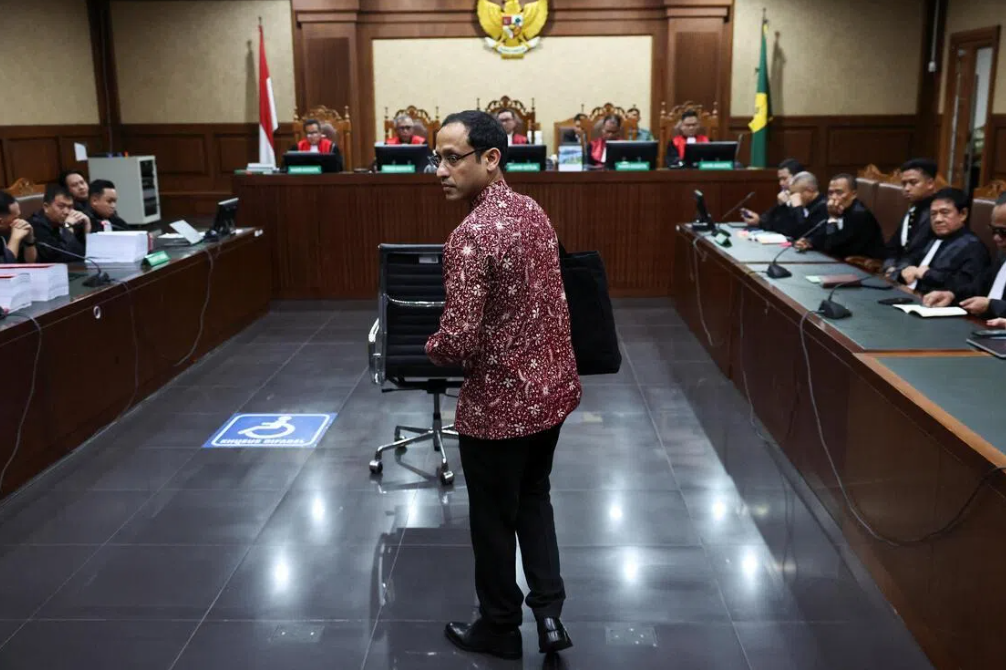
Indonesia's most celebrated technology entrepreneur has been dealt a stunning blow to his reputation and freedom. On Tuesday, June 30, the Jakarta Corruption Court sentenced Nadiem Makarim, founder of ride-hailing giant Gojek and former education minister, to 10 years in prison for corruption related to a massive school laptop acquisition scheme launched during the Covid-19 pandemic. The verdict concludes one of Indonesia's most closely watched legal proceedings, transforming the narrative surrounding a figure once lauded as emblematic of a new breed of reform-minded Indonesian leadership.
Beyond the decade-long custodial sentence, Makarim was ordered to pay a fine of 1 billion rupiah (approximately US$56,000) and to provide restitution of 809.6 billion rupiah (about US$45 million). The court imposed an additional five-year prison term should he fail to discharge the restitution obligation, effectively multiplying his potential time behind bars. Chief judge Purwanto declared the verdict with particular emphasis on the prosecution's core allegation: that Makarim had abused his ministerial authority with deliberate intent to benefit specific parties unlawfully.
The judicial panel's reasoning struck at the heart of Makarim's actions as education minister. The five-judge tribunal found that he had knowingly and deliberately championed a Chromebook procurement initiative while harbouring motives that benefited the strategic business relationship between Google and Gojek, his technology company. The judges characterised such conduct as fundamentally contemptible, representing a flagrant breach of the oath of office that Indonesia's cabinet ministers take upon appointment. This finding underscores the court's view that ministerial responsibility extends beyond formal decision-making to encompass the underlying motivations driving state policy.
Makarim's trajectory from celebrated innovator to convicted felon represents a dramatic reversal of fortune for the Harvard-educated technologist. Before entering former president Joko Widodo's cabinet as education minister in 2019, the then-41-year-old had built Gojek into Indonesia's first unicorn startup, establishing a diverse super-app ecosystem spanning motorcycle taxis, food delivery, and the GoPay digital payment platform. By the time of his ministerial appointment, Gojek's valuation had climbed to roughly US$10 billion, positioning Makarim as a standard-bearer for Indonesia's digital economy and attracting interest from young Indonesians contemplating careers in public service or entrepreneurship.
The corruption allegations centred on a procurement programme designed to distribute approximately 1.1 million Chromebook laptops across Indonesian schools between 2020 and 2022, a period when educational institutions nationwide were compelled to transition to online teaching due to pandemic-related lockdowns. Prosecutors alleged that this initiative resulted in estimated state losses of 2.18 trillion rupiah and that Makarim personally reaped financial benefits of around 809 billion rupiah through transactions channelled via PT Aplikasi Karya Anak Bangsa (PT AKAB), Gojek's parent holding company. The state's legal team contended that prior ministry studies conducted in 2018 had already identified significant vulnerabilities in Chromebook deployment, particularly in Indonesia's remote and rural areas where internet connectivity remained inadequate.
The prosecution pursued an aggressive strategy, seeking 18 years imprisonment, a matching fine, and restitution exceeding 5.6 trillion rupiah. Prosecutors presented evidence including an August 2019 group chat discussion about a Chromebook-centric digitalisation blueprint that allegedly occurred before Makarim's formal cabinet induction, suggesting premeditation. Nonetheless, Makarim and his defence counsel maintained throughout the trial that the allegations were baseless, ultimately requesting a complete acquittal when presenting their case in early June 2026. The defendant maintained that he received no personal financial compensation from the procurement process and highlighted that approximately 97 percent of the 1.1 million Chromebooks had reached 77,000 schools by 2023, suggesting substantive educational benefit regardless of procurement irregularities.
The legal proceedings attracted unprecedented public engagement for an Indonesian corruption trial, with livestreamed court sessions spawning social media campaigns for public viewing parties. Dozens of Gojek drivers attended hearings to demonstrate solidarity with their company's founder, creating scenes that captured the complicated relationship many Indonesians felt toward the defendant. At one hearing, Makarim arrived dressed in Gojek driver attire before changing into traditional blue batik, a symbolic gesture aimed at reconnecting with his entrepreneurial roots rather than his ministerial persona. The court additionally received multiple amicus curiae briefs from third parties advocating for Makarim's acquittal, underscoring the case's significance beyond judicial mechanics.
Family background and social standing initially seemed protective factors in Makarim's favour. His father, Nono Anwar Makarim, ranks among Indonesia's prominent legal practitioners, while his maternal grandfather participated in Indonesia's independence struggle, establishing a lineage of national service and professional accomplishment. Yet such connections proved insufficient to shield him from conviction, suggesting that Indonesian courts have begun holding even elite-connected defendants to rigorous accountability standards. This development carries implications for how future technology entrepreneurs and business leaders assess the risks of accepting high-level government positions, a concern Makarim himself raised.
As proceedings advanced toward their conclusion, Makarim shifted tactical emphasis toward the broader societal dimensions of the case. In his defence statement delivered on June 23, weeks before sentencing, he appealed to the judges' sense of national responsibility, arguing that the verdict would shape how Indonesia's youth perceived public service and whether accomplished professionals outside traditional politics would volunteer for government roles. Speaking directly to the bench, Makarim posed a rhetorical question that transcended his personal circumstances: "Youth across all of Indonesia, and the diaspora in every corner of the world, await your answer to the question echoing in their hearts: 'Is this country still safe for us to serve?'" This framing attempted to position his case as a referendum on Indonesia's commitment to attracting reformist talent from the private sector.
The conviction carries broader ramifications for Indonesia's technology ecosystem and governance innovation. Many Southeast Asian countries have recruited successful entrepreneurs into ministerial roles to accelerate digital transformation and institutional modernisation. The Makarim verdict creates significant disincentives for future transitions from business to government, potentially depriving state institutions of technical expertise at precisely the moment when digital advancement demands it most. Malaysia, which has similarly recruited business leaders into government in recent years, faces potential talent drain implications should Indonesian precedent discourage such crossovers.
Makarim expressed qualified faith in Indonesia's judicial machinery despite the conviction, issuing a statement through his legal team's LinkedIn account thanking supporters and reiterating belief in justice processes. His assertion that "after five months on trial, I still believe in justice" suggests he may pursue appeals, which would extend this consequential case through the Indonesian appellate hierarchy. The sentencing represents a punctuation mark in an institutional drama that has exposed tensions within Indonesia's dual commitment to governance modernisation and anti-corruption enforcement, tensions that will reverberate throughout the region's business and political communities.

