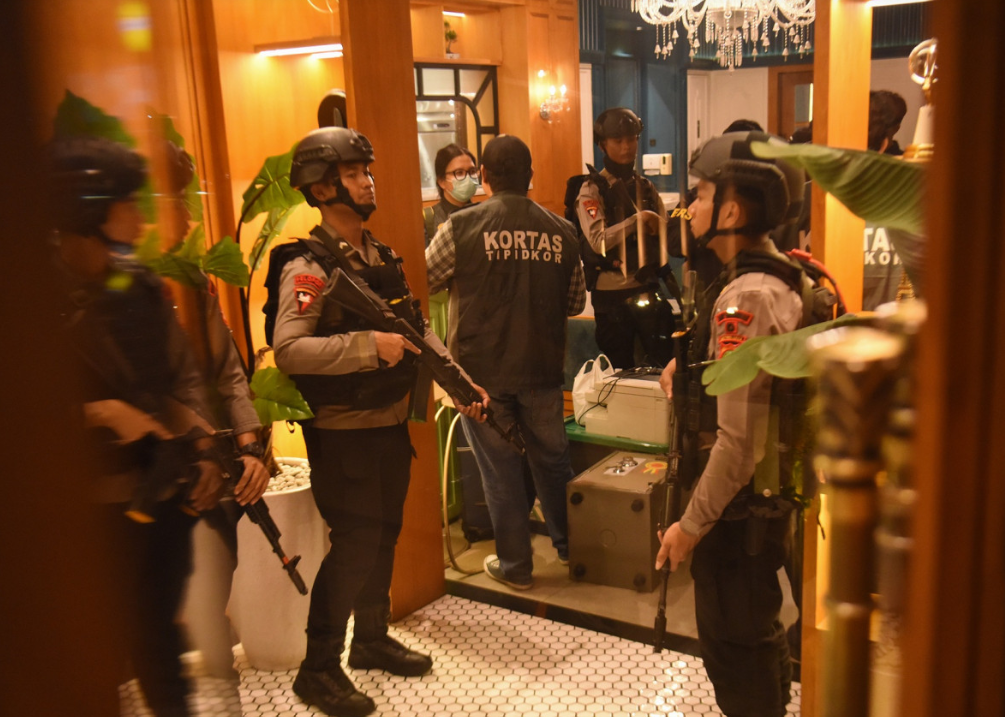
The afternoon of July 8 brought an extraordinary show of state force to an upmarket Jakarta eatery when heavily armed police units descended on de'Clan Signature, a restaurant nestled in the leafy Cipete district of South Jakarta. Diners watching from their tables suddenly found themselves witnessing what would become the opening act of one of Indonesia's most dramatic corruption investigations in recent memory. Officers from the capital's police department, joined by specialists from the National Police's anti-corruption division and Mobile Brigade personnel outfitted in full tactical equipment, methodically made their way through the establishment toward a specific target: a roughly two-metre-high safe concealed discreetly behind cabinetry.
When authorities opened the safe, the contents immediately signaled the scale of what they had uncovered. Inside lay documents and currency in multiple denominations totalling millions of dollars. The operation did not stop there. Within minutes, police moved to an adjoining location, Koin Money Changer, where another secure storage unit yielded additional stacks of rupiah notes valued in the hundreds of thousands of dollars. These parallel discoveries at connected businesses suggested a coordinated financial operation that had been operating largely outside conventional banking channels.
What unfolded over the following hours, however, would dwarf these initial findings. As night fell on Jakarta, police fanned out across the capital and its surrounding suburbs, conducting simultaneous raids on at least a dozen locations. Officers seized mobile phones, documented photographs, and extensive paper records. The systematic nature of the operation indicated meticulous advance preparation and coordination among multiple law-enforcement agencies. By the time dawn broke on Thursday, the true magnitude of the investigation had become apparent.
The most significant discovery came at a residential property in Sentul, an upscale hillside community situated approximately an hour's drive south of central Jakarta. Within this high-end home, police found seven suitcases that contained 74 kilogrammes of gold bullion. Alongside the precious metal lay substantial quantities of cash denominated in various international currencies. When authorities calculated the total value of assets seized across all raided locations, the figure reached US$26.3 million—a sum that immediately captured public attention and media focus. The visual spectacle of gleaming gold bars and bundled foreign currency being paraded before cameras and displayed by authorities created indelible imagery that would define the scandal.
The property in Sentul belonged to Febrie Adriansyah, who until the previous weekend had served as Indonesia's deputy attorney general responsible for special crimes prosecution. Adriansyah's position had granted him significant authority within the country's legal establishment for over four years. His abrupt resignation on the weekend preceding the raids, however, anticipated the storm about to break. Though subsequent investigation named him as a suspect in both corruption and money-laundering cases, authorities did not formally detain him. When confronted about the seized assets, Adriansyah acknowledged his ownership of the Sentul residence but denied that the discovered valuables belonged to him. He suggested that the origin and legitimacy of the funds would emerge through proper legal proceedings.
The investigation's reach extended well beyond Febrie's holdings. Police conducted searches at numerous additional properties, including an apartment at Pacific Place, a prestigious residential complex located near Jakarta's stock exchange district. The raids encompassed company offices distributed throughout the city and extended to private residences in various neighbourhoods. One such property in the Gandaria area of South Jakarta connected to the investigation through Don Ritto, a lawyer who had been named as a co-suspect in the case. Unlike Febrie, Ritto was taken into custody. Local media investigations revealed that Ritto maintained business interests in companies with connections to both the raided restaurant and the money-changer operation, suggesting a coordinated financial network rather than isolated incidents of illicit activity.
By Monday afternoon, Jakarta's political and legal circles buzzed with speculation about implications and next steps. The sheer size of the discovered assets prompted broader questions about the effectiveness of Indonesia's anti-corruption machinery. Some observers viewed the raids as evidence that institutional safeguards were functioning appropriately, with law enforcement successfully identifying and disrupting significant illicit financial operations. Others, however, interpreted the scandal as symptomatic of deeper, more pervasive corruption within the establishment itself. The fact that such massive sums could be concealed and moved outside formal banking systems without detection raised troubling questions about oversight and institutional integrity at the highest levels of the justice system.
The procedural handling of the investigation itself became a subject of intense scrutiny among legal experts. Mahfud MD, a distinguished constitutional law scholar who had previously served as chief justice of Indonesia's Constitutional Court and as coordinating minister for political, legal and security affairs, publicly raised significant concerns about the legality of transferring oversight of the investigation from the police to the Attorney General's Office. Speaking via his YouTube channel and dressed in traditional Batik formal wear, Mahfud argued that the transfer lacked foundation in Indonesia's criminal procedure code. Such procedural irregularities, he warned, could expose the entire prosecution to successful pretrial challenges that might ultimately derail the case. Mahfud called for the Corruption Eradication Commission, Indonesia's independent anti-corruption body, to assume control of the investigation to ensure both substantive justice and procedural integrity.
For Malaysian observers and Southeast Asian readers more broadly, the Jakarta scandal offers crucial lessons about institutional vulnerability within the region's justice systems. Indonesia's experience demonstrates how financial networks operating outside traditional banking channels can accumulate extraordinary wealth while evading detection, even when the individuals involved occupy positions of significant governmental authority. The case also illustrates fundamental tensions between investigative effectiveness and procedural propriety in anti-corruption work. Whether prosecutors can successfully navigate these competing pressures while maintaining public confidence in the integrity of the legal process remains an open question with implications far beyond Indonesia's borders.

