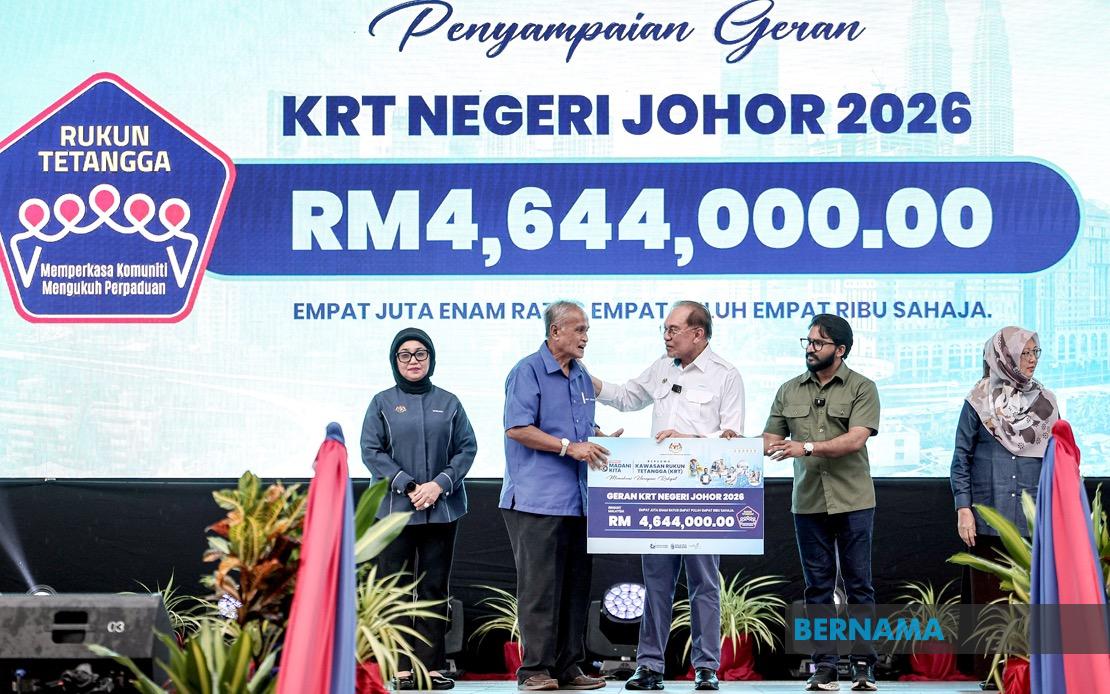
Prime Minister Datuk Seri Anwar Ibrahim has announced a significant boost to community policing resources, approving an increase in the annual grant for Neighbourhood Watch Areas (KRT) to RM10,000 from the previous RM6,000. The enhancement, which will be distributed beginning January 1, 2027, addresses a long-standing concern about inadequate funding for grassroots security institutions that have operated under the same budget constraints for the past decade.
The announcement, made during the MADANI KITA Programme at Dataran Segamat on June 24, signals the government's recognition that KRT organisations play a crucial intermediary role between ordinary citizens and state security apparatus. By channelling resources directly to these neighbourhood-level bodies, the administration hopes to reinvigorate community engagement in addressing local crime and welfare concerns. Deputy Minister of National Unity R. Yuneswaran and Deputy Minister of Domestic Trade and Cost of Living Datuk Dr Fuziah Salleh were present at the event, underscoring the cross-departmental importance of the initiative.
Anwar emphasised that the decade-long freeze on KRT funding had become untenable given the organisation's expanding responsibilities in maintaining social cohesion. The grant increase will apply to all KRT units that maintain proper records of their community development activities and regular reporting to government bodies. This conditionality ensures accountability while incentivising better documentation and transparency across Malaysia's numerous neighbourhood watch schemes, which operate across urban and rural communities nationwide.
The Prime Minister framed the funding increase within a broader narrative about national unity and social harmony. He stressed that Malaysia's foundational strength derives from its successful management of diversity across racial, cultural, and religious lines since independence—a message particularly resonant in a region where communal tensions periodically flare. Rather than viewing these differences as divisive, Anwar argued they should be celebrated as assets that contribute to national cohesion, a philosophy that extends to supporting grassroots institutions like KRT that actively foster inter-community dialogue and consensus-building.
Beyond the KRT announcement, the Prime Minister unveiled complementary investments in institutional infrastructure. An allocation of RM3.205 million has been earmarked for urgent repairs and upgrades at Islamic educational facilities across Johor, encompassing religious schools, madrasahs, study centres, and tahfiz institutions in districts including Batu Pahat, Muar, and Segamat. This funding stream reflects government priorities in strengthening faith-based education infrastructure, ensuring students and educators work within more functional learning environments that support educational quality and institutional sustainability.
The investment in religious educational institutions also carries broader implications for Malaysia's education ecosystem. By prioritising facility improvements at Islamic schools and study centres, the government signals commitment to parity between conventional and religious education streams, addressing longstanding disparities in infrastructure funding. This approach may help reduce perceived gaps between secular and religious education pathways, potentially easing social tensions that sometimes emerge around educational inequity.
In addition to community and educational initiatives, the government allocated RM1.0 million for urgent repairs at Royal Malaysian Police (PDRM) quarters in Johor. Anwar positioned this welfare enhancement as integral to maintaining morale and operational effectiveness among security personnel, arguing that adequate living conditions directly support national security objectives. The investment acknowledges that officer satisfaction and wellbeing translate into better service delivery and reduced turnover among frontline security workers who bear substantial professional risks.
These three spending announcements—KRT grants, religious school infrastructure, and police facilities—reveal a coordinated approach to strengthening the institutional scaffolding that supports Malaysia's security, social cohesion, and educational systems. Rather than pursuing piecemeal upgrades, the government is addressing multiple pressure points simultaneously: community-level crime prevention, faith-based institution capacity, and personnel welfare. For Malaysian readers, particularly those in Johor where the announcements were made, these investments suggest renewed government attention to grassroots institutional capacity after extended periods of budgetary constraint.
The timing of these announcements, occurring in mid-2024 with implementation extending into 2027, indicates deliberate medium-term planning rather than immediate electoral posturing. The January 1, 2027 commencement date for KRT grants allows for budget preparation and administrative processes, suggesting institutional seriousness about follow-through. This approach contrasts with ad-hoc spending announcements and demonstrates longer-term commitment to the funding mechanism.
For Southeast Asian observers, Malaysia's investment in neighbourhood watch infrastructure offers a model for community-police partnership that balances security objectives with grassroots agency. KRT organisations, drawing members from local communities, represent a decentralised approach to crime prevention and social welfare that complements rather than replaces state institutions. The funding increase may inspire similar resource allocation in neighbouring countries similarly invested in community policing models.
The KRT grant increase carries practical significance for thousands of community organisations across Malaysia that manage local security coordination with minimal resources. Neighbourhood watch members, typically unpaid volunteers, have historically operated under severe funding constraints despite their responsibility for crime reporting, community mobilisation, and liaison with police. The RM4,000 annual increase, while modest in absolute terms, potentially enables basic equipment purchases, training programmes, or community engagement activities that enhance operational capacity.
Looking forward, the success of these initiatives will depend on effective implementation and transparent resource tracking. The government's requirement that KRT units maintain detailed activity records and development documentation provides mechanisms for accountability while enabling evidence-based assessment of which programmes generate measurable community security improvements. Malaysian readers invested in crime prevention and community safety will likely monitor whether promised funding materialises on schedule and generates anticipated security dividends across their neighbourhoods.

