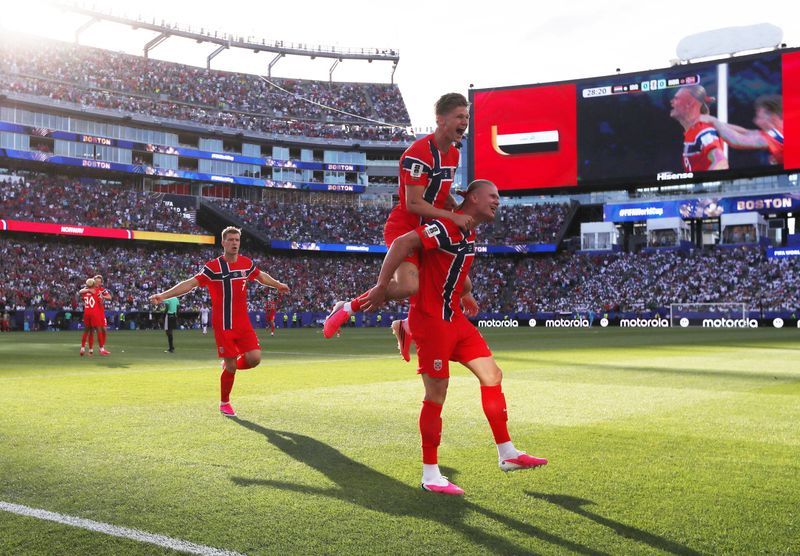
Erling Haaland announced his World Cup arrival in resounding style, netting a first-half double as Norway swept past Iraq 4-1 in their opening group-stage encounter. The strike from the Manchester City forward underscored his extraordinary knack for making an immediate impact on football's grandest stage, adding to an already impressive portfolio that includes debut goals in the German Bundesliga, English Premier League, and UEFA Champions League.
Haaland's clinical finishing overshadowed a somewhat unconvincing overall performance from the Norwegian side, which struggled to maintain possession and was occasionally sloppy in build-up play. The team's reliance on their talismanic attacker became conspicuous throughout the match, with coach Stale Solbakken's tactical approach essentially revolving around creating opportunities for their main weapon. Despite the four-goal winning margin, Norway's display suggested they will need to sharpen their play considerably in subsequent fixtures to compete effectively in the tournament.
The 22-year-old's first goal typified the predatory instincts that have defined his rise to elite status—a poacher's finish following a David Moller Wolfe cross into the penalty area. His second demonstrated both his pressure and opportunism, as his aggressive closing of the Iraqi defence forced a weak backpass that he intercepted and converted when the goalkeeper's clearance attempt deflected off his body into the net. These moments validated the faith invested in him by Norwegian supporters carrying enormous expectations heading into the tournament.
Interestingly, despite the emphatic victory, Haaland himself acknowledged gaps in Norway's execution. The taciturn striker has made a deliberate choice to communicate primarily through his performances rather than extensive media engagement, a stance that contrasts sharply with the more vocal approach of many contemporary athletes. His preference for letting his goals speak reflects both personal temperament and a calculated strategy to remain focused amid the intense scrutiny surrounding young superstars.
Norway's captain and creative hub Martin Odegaard delivered a surprisingly subdued midfield showing, failing to impose himself on the contest with his usual authority. The defensive organisation also faltered temporarily when Aymen Hussein capitalised on some inattention to equalise for Iraq, briefly suggesting the Scandinavian side might face a more testing afternoon than the scoreline ultimately indicated. These defensive lapses will concern Solbakken as his squad prepares for stiffer tests against more accomplished opponents.
Prime Minister Jonas Gahr Stoere's pre-match observation that teams rather than individuals win matches carries particular weight in Norway's case. While Haaland provides the cutting edge and clinical finishing, the surrounding players must elevate their contributions to maximise their chances of advancing from the group stage. The collective appeared to understand this responsibility, even if execution was uneven in this encounter.
Norway's return to World Cup football after a 28-year absence since their last appearance in 1998 prompted considerable celebration among the nation's supporters. The three-point haul from the opening match placed the Scandinavians temporarily atop their group, ahead of France who defeated Senegal 3-1 earlier the same day, on goal difference. However, this early advantage comes with an important caveat: the fixture list ahead will present significantly greater challenges that cannot be overcome solely through individual brilliance.
The performance hinted at both the considerable potential and notable vulnerabilities within this Norwegian squad. Haaland's two-goal contribution provided an enormous cushion against Iraq, allowing the team to manage their display despite technical deficiencies. Against more possession-oriented and defensively cohesive opponents, these shortcomings could prove costly if the midfield continues to lack creative incisiveness and the defence remains vulnerable to straightforward attacking movements.
For Haaland himself, the debut goal maintains a remarkable streak spanning multiple elite competitions. This consistency at the highest level suggests maturity beyond his years and an almost preternatural ability to deliver when stakes are elevated. Malaysian football enthusiasts accustomed to following top-tier European leagues will recognise this performance as characteristic of the Manchester City forward, whose clinical efficiency has become a defining feature in the Premier League and continental competition.
The broader implications for Norway's tournament trajectory remain uncertain despite the emphatic opening victory. While Haaland's individual brilliance offers genuine hope, the team's collective display suggested they remain some distance from the tactical sophistication and consistency required to progress beyond the group stage. The coming matches against stronger opponents will provide a clearer picture of whether this Norwegian side can sustain their initial momentum or whether their progress will ultimately be constrained by the quality gap at this elite level of international football.

