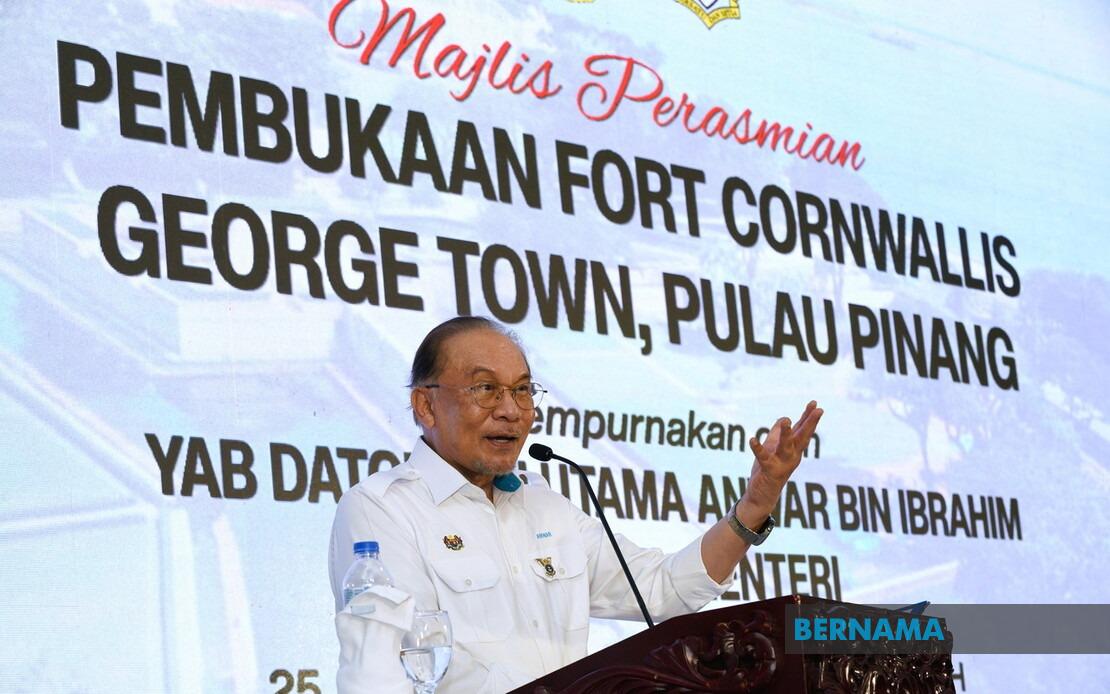
Prime Minister Datuk Seri Anwar Ibrahim has called for a fundamental shift in how Malaysia treats its historical sites, arguing they should serve as classrooms for national consciousness rather than mere tourist attractions. Speaking at the opening ceremony of Fort Cornwallis in George Town on July 25, Anwar outlined a vision where visits to heritage locations become structured learning experiences that transmit crucial lessons about sacrifice, sovereignty and social cohesion to the younger generation.
The Prime Minister's intervention reflects a broader concern across Southeast Asia about how colonial-era sites are interpreted and presented to the public. Rather than allowing these locations to exist in a historical vacuum or be packaged primarily for commercial appeal, Anwar argues they must become active instruments of civic education. This approach recognises that physical preservation alone is insufficient; the narratives surrounding these sites shape how citizens understand their own past and future.
Central to Anwar's argument is the distinction between authentic history and imposed history. He emphasised that Malaysian accounts of the colonial period should emerge from the lived experiences, struggles and resilience of local populations rather than being filtered through the worldview of former colonisers. This reframing is significant for Malaysia's diverse society, where different communities experienced colonialism differently, and where a unified national narrative must accommodate multiple perspectives whilst emphasising shared values of independence and self-determination.
For younger Malaysians, many of whom were born decades after independence, historical sites present an opportunity to grasp viscerally what political independence means and why it matters. Anwar suggested that educational programming at Fort Cornwallis and similar locations could help students understand the concrete costs paid by previous generations—the violence, dispossession and humiliation endured under foreign rule. This knowledge, he implied, should deepen appreciation for the nation's hard-won freedoms and strengthen commitment to national unity.
The Prime Minister specifically highlighted unity as a lesson that historical sites must convey. His emphasis here touches on an ongoing concern in Malaysian politics: the fragility of multi-ethnic coexistence and the dangers of divisions that could be exploited by external powers. By drawing a line from colonial vulnerability to contemporary unity, Anwar positions historical understanding not as antiquarian interest but as essential to national security and stability. The argument carries weight in a region where external powers have long sought to influence domestic politics through ethnic or religious wedges.
Preserving Fort Cornwallis itself becomes, under Anwar's framework, an act not of nostalgia but of defiance. By maintaining the physical structure whilst reclaiming its narrative, Malaysia reasserts ownership over its own story. The conservation effort thus becomes decolonisation—not the destruction of reminders of foreign rule, but the reclamation of interpretive authority. This represents a mature approach to dealing with colonial heritage, one that acknowledges history without being imprisoned by it.
The practical implications of Anwar's proposal deserve attention. Historical sites across Malaysia would require curriculum integration, trained educators, interpretive materials and perhaps digital resources explaining context and significance. Schools would need to coordinate visits as integral parts of history and civics instruction rather than occasional recreational outings. This transformation demands investment, coordination between heritage agencies and education authorities, and agreement on historical narratives—no simple task in a plural democracy.
For Southeast Asian observers, Anwar's intervention speaks to broader regional questions about how postcolonial nations construct identity and transmit values. Thailand, Vietnam, Indonesia and the Philippines all grapple with similar challenges: how to memorialise and learn from periods of foreign domination whilst building forward-looking national projects. Malaysia's approach—treating heritage sites as educational institutions—offers a model that balances acknowledgement of history with purposeful nation-building.
The emphasis on explaining history through the lens of local suffering and resistance also carries implications for how Malaysia addresses contemporary challenges. If younger citizens understand deeply the sacrifices required to achieve independence and the dangers of disunity, they may be better equipped to resist divisive political rhetoric or protect democratic institutions. History lessons become inoculation against the very vulnerabilities that colonialism once exposed.
Yet implementation challenges loom. Agreeing on historical narratives in a multiethnic society where communities experienced colonialism differently requires careful calibration. Different ethnic and religious groups may emphasise different aspects of the nationalist struggle. Educational authorities must ensure that history instruction acknowledges these perspectives whilst maintaining focus on shared values of independence and national unity—a balance that politicians and educators will negotiate in detail.
Anwar's remarks also implicitly challenge the commercialisation logic that often governs heritage management in developing nations. The pressure to maximise tourism revenue can lead sites to emphasise photogenic qualities and entertainment value over historical depth. By arguing for education-first positioning, the Prime Minister suggests that sustained investment in knowledge creation may ultimately serve national interests more effectively than short-term tourism maximisation. This long-term perspective reflects a particular vision of what the state owes its citizens regarding historical consciousness.

