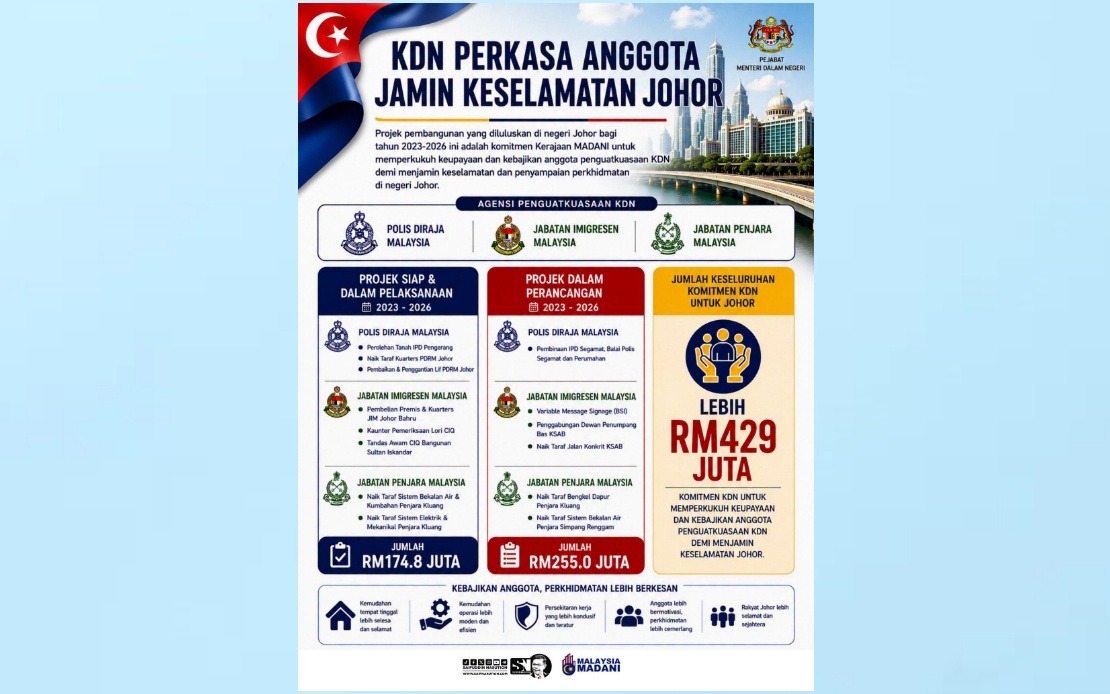
The Home Ministry announced on Thursday a substantial financial commitment exceeding RM429 million directed towards improving conditions for enforcement personnel and upgrading operational infrastructure across Johor since 2023. Minister Datuk Seri Saifuddin Nasution Ismail outlined how this investment spans three critical agencies responsible for maintaining public security: the Royal Malaysia Police, Malaysian Immigration Department, and Malaysian Prisons Department. The decision reflects a broader policy philosophy that recognises personnel welfare as integral to institutional effectiveness rather than merely a supplementary benefit.
The minister articulated a compelling rationale for the investment, positioning workplace improvements as fundamental to operational performance. When enforcement officers work within better-equipped facilities, occupy comfortable residential quarters, and access modern operational tools, their capacity to execute duties with greater efficiency, safety, and effectiveness strengthens considerably. This approach acknowledges that frontline enforcement personnel bear direct responsibility for public safety, making their professional conditions a matter of national interest rather than departmental convenience. The philosophy extends beyond physical infrastructure to encompass systemic support that enables officers to concentrate fully on their security mandate.
Financial allocation breaks down into two distinct tranches reflecting implementation timelines. Approximately RM174.8 million encompasses projects already completed or actively under implementation, while RM255 million is earmarked for initiatives in the planning phase. This bifurcated approach allows for immediate tangible improvements whilst establishing a pipeline of developments that will extend benefits across the medium term, providing sustained momentum for infrastructure enhancement throughout Johor's enforcement sector.
Current implementation initiatives demonstrate concrete progress across all three agencies. The Pengerang District Police Headquarters has progressed with land acquisition, addressing longstanding spatial constraints at local operations levels. The Johor Bahru Immigration Department is advancing office and residential premises procurement, critical for facilitating efficient processing of travel documentation and border administration. Simultaneously, Kluang Prison undergoes basic facility upgrades, recognising that custodial infrastructure directly impacts both inmate management and staff operational conditions. These parallel projects indicate coordinated rather than ad hoc resource deployment.
The pipeline encompasses more substantial infrastructure development with longer implementation horizons. Construction planning for Segamat District Police Headquarters includes integrated design for both operational police stations and residential quarters, addressing the integrated needs of modern policing. The consolidation of bus passenger terminal operations at the Sultan Abu Bakar Complex represents coordination with transport infrastructure, suggesting cross-ministerial planning. Additional improvements target critical facilities including kitchen workshop upgrades at Kluang Prison and water supply system enhancements at Simpang Renggam Prison, addressing operational essentials that impact daily conditions across the correctional system.
The minister connected this Johor-specific allocation to broader national policy frameworks, characterising the investment as consistent with the MADANI Government's development philosophy. Official statements emphasise that each state receives support calibrated to its particular development priorities and population wellbeing requirements. This articulation attempts to address perceptions of regional resource distribution equity, a persistent sensitivity in Malaysian politics where states monitor comparative funding levels carefully.
Prime Minister Datuk Seri Anwar Ibrahim previously clarified parliamentary figures demonstrating significant expansion in Johor's overall development and management allocation, which increased to approximately RM14.6 billion from the previous RM10.2 billion baseline. This context positions the RM429 million enforcement sector investment within a larger spending narrative, suggesting comprehensive state development rather than narrowly focused departmental enhancement. The scale of increase indicates substantial additional federal resources directed toward Johor across multiple portfolios.
For Malaysian readers and regional observers, this allocation carries multiple implications. Domestically, enforcement capacity directly affects public safety perceptions, which influence both economic confidence and quality-of-life assessments across Johor's major urban centres like Johor Bahru and secondary cities including Kluang and Segamat. Enhanced police infrastructure and personnel conditions theoretically translate into improved response capabilities and service quality for residents and businesses. Immigration department improvements facilitate smoother processing of both cross-border movement and legitimate trade, matters of consequence given Johor's geographic position as Malaysia's primary land boundary with Singapore.
Regionally, enforcement sector strengthening contributes to Malaysia's capacity to manage border security, counter human trafficking, and address transnational crime patterns affecting Southeast Asia. Immigration and prisons improvements support Malaysia's obligations under regional cooperation frameworks addressing organized crime and security cooperation. Enhanced facilities at major enforcement institutions signal commitment to institutional professionalism, relevant for bilateral relations and regional confidence in Malaysia's capacity to manage shared security challenges.
The announcement also reflects Malaysian policymaking increasingly recognising that public sector institutional quality depends substantially on personnel conditions and working environments. This represents departure from historical patterns where enforcement agencies operated with minimal infrastructure investment and minimal consideration for officer welfare beyond basic compensation. Modern policing, immigration management, and correctional administration require professional personnel capable of complex decision-making under pressure, a requirement difficult to sustain without corresponding workplace support and modern equipment.
Implementation rigour will determine whether allocated funds translate into anticipated improvements. Malaysian history contains examples of announced allocations that encountered absorption delays, project management challenges, or cost escalations. The minister's commitment to optimal fund utilisation requires sustained attention from oversight mechanisms and performance monitoring systems. Johor residents and enforcement personnel themselves will ultimately assess whether promised infrastructure improvements materialise within projected timeframes.
Longer-term implications depend on whether this RM429 million commitment represents sustained policy direction or annual fluctuation in enforcement sector investment. Sustainable institutional strengthening requires consistent budgetary support across multiple years, enabling capability maintenance and incremental advancement. The framing emphasises government commitment, though budget pressures and competing development priorities continually test such commitments. Observers will monitor whether subsequent budget allocations maintain comparable enforcement sector investment levels.

