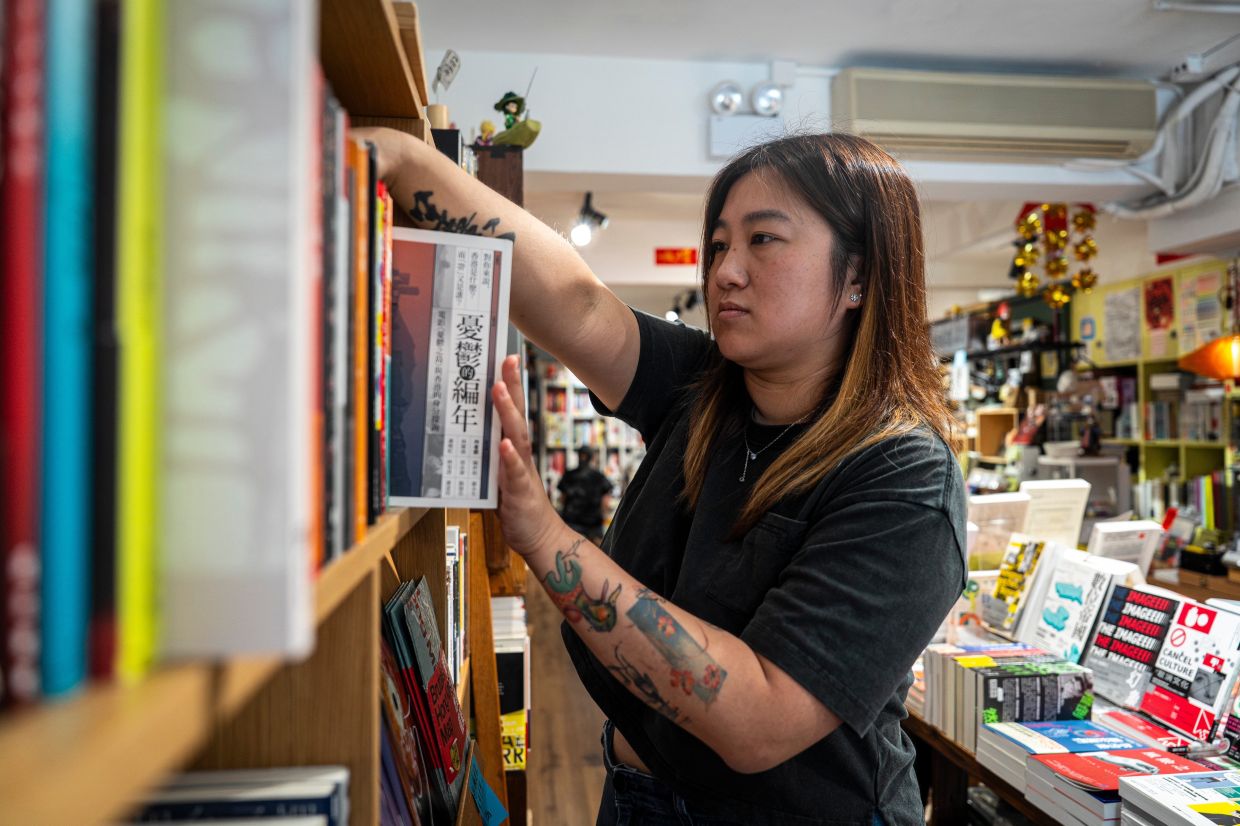
Hong Kong police have detained two individuals on suspicion of selling seditious publications and accepting financial support from overseas political entities, marking the latest enforcement action under the city's stringent national security legislation. The arrests, made on Wednesday, June 24, occurred in the lead-up to Hong Kong's July 1 handover anniversary, a date that has grown increasingly fraught with political significance as the territory grapples with escalating restrictions on civil liberties.
While authorities refrained from publicly naming those arrested, multiple local news outlets, notably the Chinese-language Ming Pao newspaper, cited unidentified sources identifying one of the detainees as Leticia Wong, proprietor of Hunter Bookstore located in the Sham Shui Po district. Wong, a former district councillor with documented pro-democracy sympathies, has maintained a vocal stance on civic matters despite the detention of prominent activists following the 2019 pro-democracy demonstrations. Her potential involvement in this case would represent a significant escalation in efforts to suppress dissenting voices, particularly those operating through cultural and commercial channels.
The arrests underscore the broadening interpretation of what constitutes seditious activity under Hong Kong's regulatory environment. According to an official government statement released Thursday, the two individuals are suspected of displaying items classified as seditious and distributing publications containing seditious content, encompassing materials alleged to incite hostility toward the government, judiciary, and law enforcement. Additionally, they face allegations of receiving remittances traceable to foreign political organisations—a charge that reflects growing concerns among authorities about international support networks for local activists.
Hong Kong's trajectory since the 1997 handover has become a focal point for regional observers monitoring democratic freedoms in East Asia. Beijing's initial assurances that the territory would retain its distinct legal and civil liberties framework have increasingly come under scrutiny as security legislation has expanded. The 2024 national security law, under which Wednesday's arrests were executed, represents a further tightening of constraints on expression, particularly regarding content deemed critical of government institutions or deemed supportive of separatist causes.
For Malaysian and Southeast Asian observers, the Hong Kong situation carries particular resonance. The region has long grappled with tensions between security concerns and civil liberties, with various governments employing similar sedition provisions. Hong Kong's experience demonstrates how such laws, once enacted, can be applied broadly to encompass activities—such as independent bookselling or organising cultural events—that would traditionally fall within protected speech. This has implications for how other Southeast Asian nations approach their own legislative frameworks governing public discourse.
Wong's bookstore has become a focal point of government scrutiny over the past three years. According to Wong's own account provided to international media in the preceding year, government authorities initiated measures against her establishment on 92 separate occasions between July 2022 and June 2025. These interventions ranged from physical inspections and conspicuous police patrols to formal warning letters alleging violations. The cumulative effect of such pressure, whether intentionally designed or not, creates a chilling effect on commercial operations that deal in politically sensitive materials.
The broader context includes scrutiny of a pro-democracy book fair previously held at Wong's location, which drew criticism from pro-Beijing media outlets for embodying what was characterised as "soft resistance." That fair had notably planned to sell a biography of Jimmy Lai, the jailed media tycoon and prominent pro-democracy figure whose detention has become emblematic of Hong Kong's changing political landscape. The public criticism of such commercial activities signals how thoroughly political considerations now permeate even ordinary retail operations.
The pattern of enforcement extends beyond Wong's establishment. In March of this year, authorities arrested the proprietor and staff of a separate bookstore on comparable sedition charges related to selling similar biographical materials. Though those individuals were subsequently released on bail, the incident demonstrated that Wednesday's action reflects a coordinated approach rather than isolated enforcement. The repeated targeting of booksellers and book fairs suggests a systematic effort to control the distribution of politically sensitive historical and biographical narratives.
From a regional perspective, Hong Kong's experience offers a cautionary illustration of how security legislation can incrementally reshape the boundary between protected expression and prohibited speech. Southeast Asian nations with their own sedition laws may observe how Hong Kong's approach influences international perceptions of their own regulatory environments. The distinction between legitimate security concerns and the suppression of legitimate political discourse becomes increasingly blurred in contexts where enforcement patterns suggest systematic targeting of particular viewpoints.
The Hong Kong government maintains that both the existing security legislation framework and the recent 2024 law are essential instruments for preserving stability and that speech protections remain adequately guaranteed under the existing legal architecture. This assertion, however, stands in tension with the documented experiences of individuals like Wong, whose business operations have faced unprecedented levels of scrutiny and intervention. The gap between stated commitments to free expression and the on-the-ground experiences of those engaged in politically sensitive commercial or cultural activities has become increasingly evident to international observers.
The timing of these arrests, occurring just days before the July 1 anniversary marking Hong Kong's return to Chinese sovereignty, carries symbolic weight. This date has traditionally been marked by pro-democracy demonstrations and commemorative events, making the surrounding period a consistent focus for enhanced security operations. The arrests thus contribute to what appears to be a comprehensive effort to constrain the expression of dissenting political sentiment during periods of heightened symbolic importance.
Looking forward, the cases against the detained booksellers will likely receive close attention from international human rights organisations and regional observers monitoring civil liberties trends. For Malaysia and other Southeast Asian nations, the progression of these cases offers insights into how security legislation operates in practice and the mechanisms through which authorities expand the scope of prohibited expression. The detention of individuals engaged in what might be considered ordinary commercial activity—selling books and organising cultural events—demonstrates the potential breadth of application when sedition laws are deployed without clearly defined limitations or judicial oversight mechanisms.

