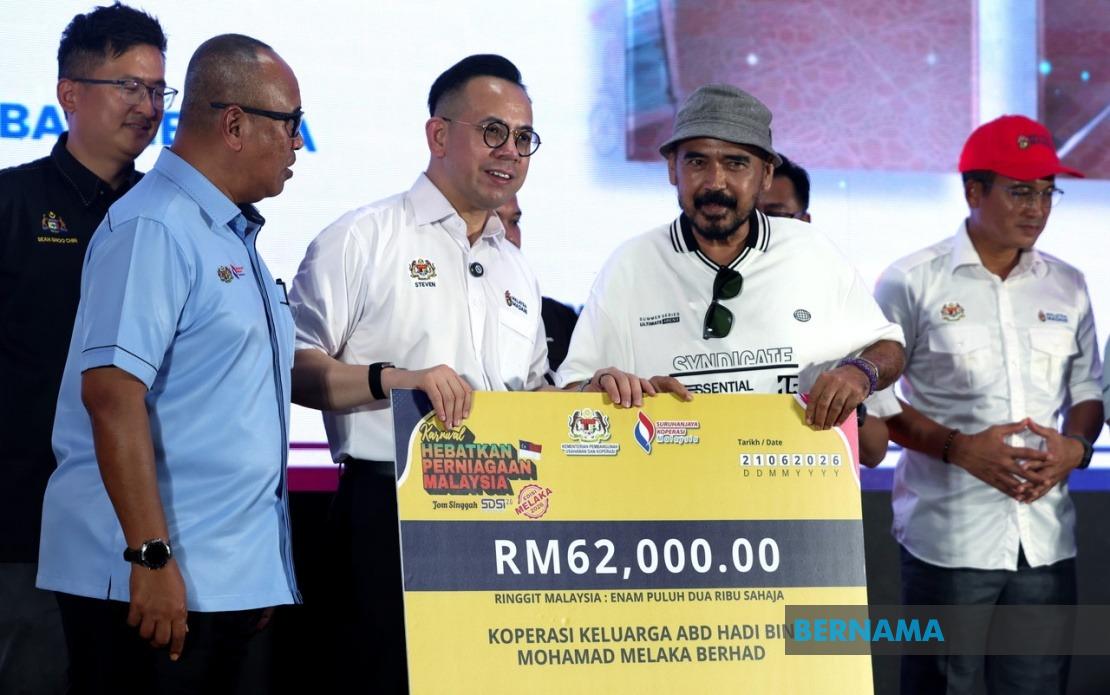
The Empowering Malaysian Businesses Carnival 2026, held in Melaka from June 19 to 21, has emerged as a significant catalyst for entrepreneurial growth in Malaysia, recording RM8.45 million in combined business matching value and financing potential. The three-day event, organised by the Ministry of Entrepreneur Development and Cooperatives (KUSKOP), demonstrated strong market appetite for networking and capital-raising opportunities among local business communities, drawing a substantial footfall of 70,000 visitors to the carnival grounds.
The financial impact of the Melaka carnival extends beyond the headline figures. Direct product sales by entrepreneur vendors totalled RM532,802.77, providing immediate revenue generation for participating merchants and validating consumer interest in locally-produced goods. This direct sales component is particularly noteworthy as it represents tangible, immediate economic activity rather than merely speculative business potential, offering real-time proof of market demand for featured products across various sectors. For emerging entrepreneurs and established small operators alike, such direct-to-consumer engagement opportunities remain challenging to secure, making the carnival platform exceptionally valuable.
Business matching activities formed the centrepiece of the carnival's success. A total of 72 dedicated matching sessions facilitated introductions between 25 potential entrepreneurs and established business partners, generating RM6.4 million in quantified business opportunities. These structured networking sessions represent a deliberate shift from traditional trade fair models, instead focusing on targeted introductions designed to convert casual visitors into genuine commercial partnerships. The quality and depth of these connections suggest sophisticated event curation, with organisers moving beyond mere attendance metrics to ensure substantive business development outcomes.
Financing emerged as the second critical success factor. The carnival's financial interaction sessions benefitted 55 micro, small and medium enterprises (MSMEs), unlocking RM2.05 million in potential financing commitments from various institutional lenders and alternative funding providers. This represents a crucial intervention point in the business development cycle, where many promising entrepreneurs struggle not from lack of viable concepts but from limited access to capital. By bringing financial institutions directly to entrepreneurs rather than requiring businesses to navigate complex application processes independently, the carnival model democratises access to funding mechanisms traditionally concentrated in urban financial centres.
The HPM 2026 Carnival series reflects broader strategic priorities articulated by KUSKOP Minister Steven Sim Chee Keong through the Hebatkan Perniagaan Malaysia (Empowering Malaysian Businesses) agenda. This initiative directly supports the ABCD framework—Accelerating Productivity, Bureaucracy Reduction, Capital Accessibility and Developing Market Access—which recognises that Malaysian SME growth is constrained not by entrepreneurial spirit but by systemic barriers to productivity enhancement, regulatory simplification, financial access, and market development. The carnival operationalises these abstract policy objectives into concrete, experiential interventions.
The integrated platform approach distinguishes the HPM Carnival from conventional business expos. Rather than offering isolated vendor booths with minimal interaction infrastructure, the event explicitly combines capacity-building workshops, strategic networking opportunities, and financing discussions within a single venue ecosystem. This comprehensive architecture acknowledges that modern entrepreneur challenges are multifaceted and interconnected, requiring holistic solutions rather than discrete, siloed interventions. An MSME struggling with production efficiency, seeking suitable financing, and lacking market connections benefits from simultaneous engagement across all three domains rather than pursuing isolated solutions sequentially.
Geographic expansion of the carnival series underscores KUSKOP's commitment to regional inclusivity. Following the Melaka success, the third edition has been scheduled for Penang from July 17 to 19 at the Penang Waterfront Convention Centre (PWCC), extending opportunities beyond the central corridor to Malaysia's northern industrial and trade hub. This sequential regional approach acknowledges distinct business ecosystems within Malaysia, recognising that Penang's manufacturing and export-oriented enterprises require different matchmaking and financing solutions compared to Melaka's tourism and light manufacturing sectors. Subsequent iterations will likely extend to Sabah, Sarawak, and East Coast states, progressively embedding entrepreneurial support infrastructure across Malaysian business geography.
For Malaysian entrepreneurs and the broader regional business community, the HPM Carnival represents a meaningful evolution in state-supported business development. Rather than distributing grants or subsidies—approaches vulnerable to inefficiency and rent-seeking—the carnival model leverages the convening power of government to reduce transaction costs for private-sector business connections. Entrepreneurs avoid expensive consultants or networking events to find financing partners and customers; lenders and customers are brought directly to them. This efficiency-focused approach aligns with contemporary development economics perspectives emphasising market facilitation over direct subsidy.
The financial metrics from Melaka provide a credible foundation for scaling. RM8.45 million in business matching value across 70,000 visitors yields approximately RM120 in potential value per visitor, a ratio that justifies expanded investment in carnival infrastructure. More significantly, the ability to identify and connect 25 entrepreneurs with genuine business opportunities within a single three-day event suggests methodology scalability. If replicated across Malaysia's major population centres, the carnival model could channel hundreds of millions in business opportunity value annually while building entrepreneurial networks that generate sustained economic activity beyond individual events.
The Melaka carnival's success also highlights evolving expectations around government economic programming in Southeast Asia. Malaysian policymakers increasingly recognise that effective entrepreneurial support requires orchestrating complex ecosystems rather than implementing isolated, top-down initiatives. The carnival model demonstrates this ecosystem-orchestration approach, convening entrepreneurs, financiers, suppliers, customers, and regulators within designed interaction frameworks. This approach offers lessons for other Southeast Asian governments seeking to strengthen MSME sectors without resorting to inefficient subsidy regimes or creating new bureaucratic constraints.
Looking beyond the headline achievements, the carnival infrastructure creates secondary benefits often invisible in event reporting. Entrepreneurs gain exposure to peer networks they'll maintain beyond the carnival; financial institutions establish relationships with SME borrowers in their regions; suppliers identify new distribution channels; and policymakers gather real-time intelligence about bottlenecks constraining business growth. These intangible benefits compound over time, creating ecosystem effects that justify continued carnival investment even when individual events fail to reach projected financial targets.
The carnival's emphasis on MSMEs reflects Malaysia's economic reality, where SMEs employ approximately 42 percent of the workforce yet remain constrained by access barriers that prevent many viable enterprises from scaling. By systematically removing these barriers—particularly around financing and market access—the HPM Carnival contributes meaningfully to national productivity enhancement and employment generation. For Malaysian readers, this represents tangible evidence of government economic programming that moves beyond rhetoric toward operationalised support mechanisms that demonstrably create opportunities for local business communities.

