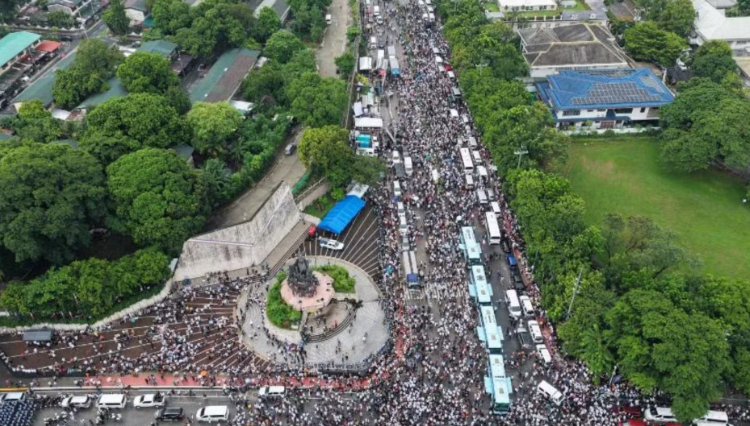
The Philippines witnessed a striking display of religious-political organization on Tuesday when the Iglesia Ni Cristo mobilized tens of thousands of adherents to protest the imminent arrest of Senator Rodante Marcoleta, grinding Manila's EDSA thoroughfare to a standstill during the morning rush hour and creating traffic disruptions stretching kilometres across the capital.
Marcoleta, both a senator and devout member of the influential church, faces graft charges announced just a day earlier. Government ombudsman Jesus Remulla disclosed that prosecutors would charge the legislator with failing to declare 75 million pesos in unspent campaign contributions—funds that authorities contend should have been properly accounted for under electoral law. The senator's legal predicament arrives at an exceptionally delicate political moment, with his vote potentially proving decisive in the Senate trial of Vice President Sara Duterte, which commences the following week.
The Iglesia Ni Cristo's decision to mobilize its faithful on Marcoleta's behalf underscores the sect's enduring influence within Philippine politics and its deep institutional alignment with the Duterte family. The church has historically functioned as a formidable voting bloc, and observers widely regard Marcoleta as nearly certain to vote against conviction in Duterte's impeachment proceedings. The timing of the rally, therefore, carries implications extending far beyond Marcoleta's individual legal situation—it signals the church's willingness to deploy its organizational machinery in defence of Duterte's political position during a critical constitutional moment.
Police estimated the crowd at approximately 8,000 participants in the early morning hours, though spokeswoman Hazel Asilo indicated expectations for substantial growth as the day progressed. The sheer logistical impact proved immediate and severe, with only dedicated bus lanes remaining passable through EDSA while thousands of commuters attempting to reach workplaces and schools found themselves ensnared in gridlock. Such traffic disruptions, affecting hundreds of thousands of ordinary citizens, frequently generate public backlash against protest movements regardless of their underlying political sympathies.
Church spokesperson Edwil Zabala articulated the INC's framing of the charges as selective justice rather than legitimate legal enforcement. In a Facebook video message, Zabala declared the sect's unwillingness to accept Marcoleta's imprisonment and pledged sustained demands for equitable application of the law. The rhetoric employed by church leadership—emphasizing transparency and consistency in prosecutorial decisions—reflects a broader political argument that the Marcos administration has selectively targeted Duterte allies while overlooking alleged misconduct by rival factions.
This protestation occurs within a broader pattern of legal challenges confronting Duterte's political circle. Senator Jose "Jinggoy" Estrada, another administration loyalist, currently faces corruption charges related to a sprawling scandal involving fabricated flood control projects that generated widespread public outrage when exposed. Additionally, Senator Ronald "Bato" Dela Rosa, formerly a trusted Duterte lieutenant, has reportedly gone into hiding to evade arrest on an International Criminal Court warrant connected to alleged atrocities during Rodrigo Duterte's destructive anti-narcotics campaign. These converging legal pressures suggest a sustained effort by Marcos-aligned prosecutors to dismantle the institutional power base that sustained the previous administration.
The Iglesia Ni Cristo's political mobilizations have intensified markedly following Duterte's dramatic estrangement from former ally President Ferdinand Marcos. In November, the church organized a massive demonstration with hundreds of thousands of participants condemning the flood control corruption scandal, with speakers directing blame toward Marcos himself. Subsequently, in January 2025, the INC staged another enormous rally explicitly opposing Duterte's impeachment. Although the country's Supreme Court initially reversed that impeachment, the House of Representatives reinstituted proceedings last month, establishing the preconditions for the trial commencing July 6.
The mathematics of Duterte's conviction remain precarious. Senate conviction requires 16 affirmative votes from the 24-member chamber, meaning she must retain support from at least nine senators. Marcoleta's anticipated loyalty, combined with the INC's demonstrated capacity to mobilize hundreds of thousands of voters, provides meaningful leverage within electoral calculations. Whether President Marcos perceives sufficient political risk to temper prosecutorial pressure on Marcoleta remains unclear, though the administration's actions will communicate volumes about its assessment of the INC's genuine political power.
Marcos himself monitored the Tuesday demonstration closely, cancelling a planned luncheon with foreign press to focus administrative attention on the developing situation. This presidential responsiveness, regardless of his ultimate policy decisions, implicitly acknowledges the Iglesia Ni Cristo's capacity to disrupt normal governance and influence major political outcomes through organized collective action. For Malaysian observers and Southeast Asian analysts, the situation illuminates how religious organizations in the Philippines maintain extraordinary institutional independence and political leverage—a structural reality quite distinct from such relationships in most neighbouring societies.
The unfolding crisis reflects deeper questions about the Philippine judiciary's independence and the trajectory of Duterte-family accountability. Whether prosecutorial actions represent principled enforcement of electoral and anti-corruption law or represent politically motivated persecution of opponents remains contested. The INC's willingness to deploy its organizational apparatus signals genuine concerns within the church hierarchy about legal fairness and institutional survival, not merely defence of one individual senator's interests.

