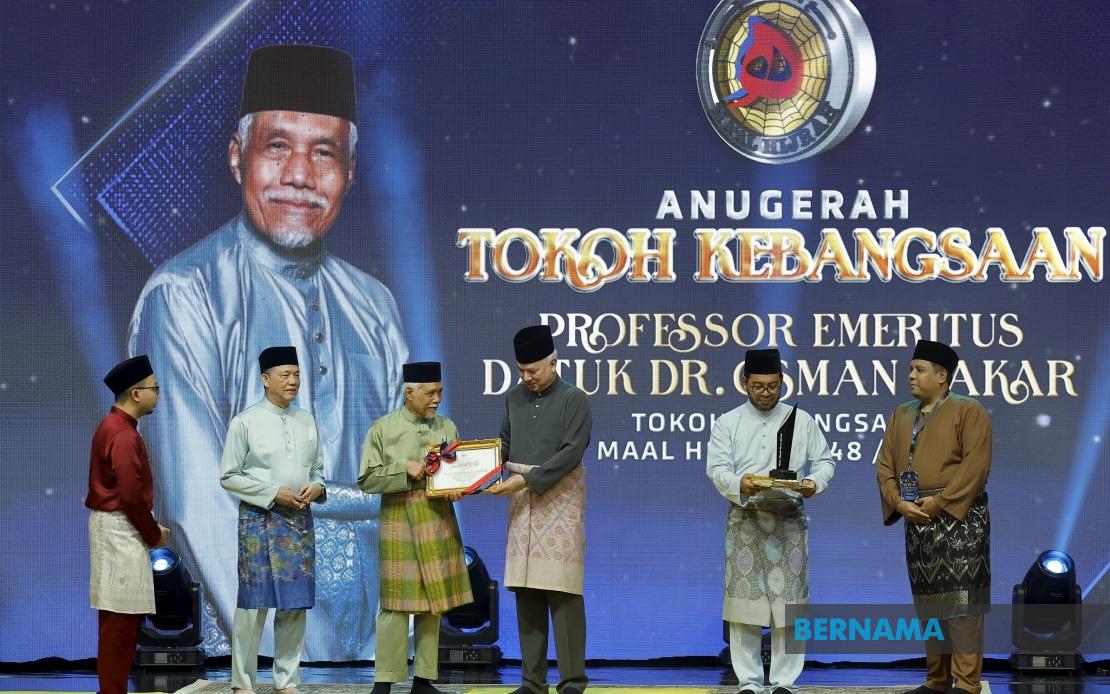
Professor Emeritus Datuk Dr Osman Bakar, rector of the International Islamic University Malaysia, has been bestowed the distinction of National Tokoh Maal Hijrah at the nation's official Maal Hijrah 1448H/2026 celebration held at Putra Mosque in Putrajaya on June 17. The accolade recognises his lifelong dedication to Islamic scholarship and education at one of the region's premier institutions. The award ceremony, held under the patronage of Sultan Nazrin Shah of Perak, presented recipients with cash prizes alongside trophies and certificates of appreciation.
Sharing the honour was Dr Ahmad Al-Raysuni, a prominent Islamic scholar based in Morocco, who was designated the International Tokoh Maal Hijrah. This dual recognition underscores Malaysia's commitment to celebrating both domestic excellence and international Islamic intellectual contributions, positioning the nation as a centre for scholarly discourse within the Muslim world. The selection of recipients reflects deliberate efforts to acknowledge individuals who embody the highest standards of Islamic learning and community leadership.
The 2026 edition of the Maal Hijrah celebration carried the thematic focus of "MADANI Dihayati, Ummah Diberkati", which translates to "MADANI Lived, Ummah Blessed". This theme represents a strategic alignment with Malaysia's broader MADANI governance framework, emphasising the principles of compassion, communal unity, and collective societal advancement. By anchoring the Islamic new year observance to this governmental vision, organisers sought to demonstrate the compatibility between traditional Islamic values and contemporary nation-building efforts.
The ceremony drew high-level government participation, including Deputy Prime Minister Datuk Seri Fadillah Yusof alongside his wife Datin Ruziah Mohd Tahir. The presence of Dr Zulkifli Hasan, Minister in the Prime Minister's Department responsible for Religious Affairs, further underscored the state's institutional commitment to the event. Such attendance reflects the Malaysian government's view of Maal Hijrah celebrations as occasions for reaffirming national values and religious identity at the highest political levels.
For the IIUM, the recognition of its rector represents validation of the institution's role as a standard-bearer for Islamic education in Southeast Asia. Established as a postgraduate institution with later expansion to undergraduate programmes, IIUM has positioned itself as a bridge between Islamic scholarship traditions and modern academic rigour. Osman Bakar's elevation as a national tokoh acknowledges the university's contributions to producing Islamic scholars, policymakers, and thought leaders who operate across the Muslim world.
The Maal Hijrah observance itself carries historical significance as the Islamic calendar's new year, traditionally marking a period of reflection, renewal, and strengthened communal bonds. In the Malaysian context, the national-level celebration has evolved into a platform for reaffirming collective identity and values, particularly as the nation navigates complex questions about religious pluralism, governance, and social cohesion. The ceremony's emphasis on compassion and unity speaks to contemporary challenges facing multicultural societies.
Osman Bakar's scholarly trajectory has positioned him as a bridging figure between Islamic intellectual traditions and contemporary debates surrounding religion's role in modern governance. His work has frequently addressed the intersection of faith and reason, tradition and innovation—themes that resonate particularly in Southeast Asia, where Muslim-majority nations balance religious identity with secular governance structures and diverse populations. His recognition thus carries implications beyond ceremonial acknowledgment, potentially signalling endorsement of particular intellectual approaches to Islamic modernism.
The international dimension of the award, through Al-Raysuni's recognition, reflects Malaysia's aspirations as a leader in Islamic thought and practice within the developing world. By honouring scholars from across the Muslim world, Malaysia projects itself as a cosmopolitan Islamic nation capable of engaging with diverse schools of Islamic interpretation and scholarship. This positioning becomes increasingly important as Middle Eastern religious institutions face questions about relevance and legitimacy, creating space for Southeast Asian Islamic voices to gain prominence.
For Malaysian readers and the broader Southeast Asian context, the recognition carries practical implications for IIUM's continued institutional development and regional influence. Academic institutions often leverage such national honours to strengthen their institutional profiles, attract talent, and secure resources. Osman Bakar's award may well catalyse renewed support for IIUM's research initiatives, particularly in areas addressing Islamic responses to contemporary challenges including artificial intelligence, environmental sustainability, and inter-faith dialogue—themes increasingly central to Muslim-majority governance in the region.
The choice of Maal Hijrah 1448H/2026 as the occasion for these honours also reflects Malaysia's commitment to maintaining visible religious observances as state-sanctioned occasions. Unlike secular new year celebrations, the Islamic calendar marking provides opportunity to reinforce specific values and institutional arrangements that align with the government's development vision. The MADANI framework's invocation alongside traditional Islamic observance demonstrates strategic integration of governance narratives with religious practice.

