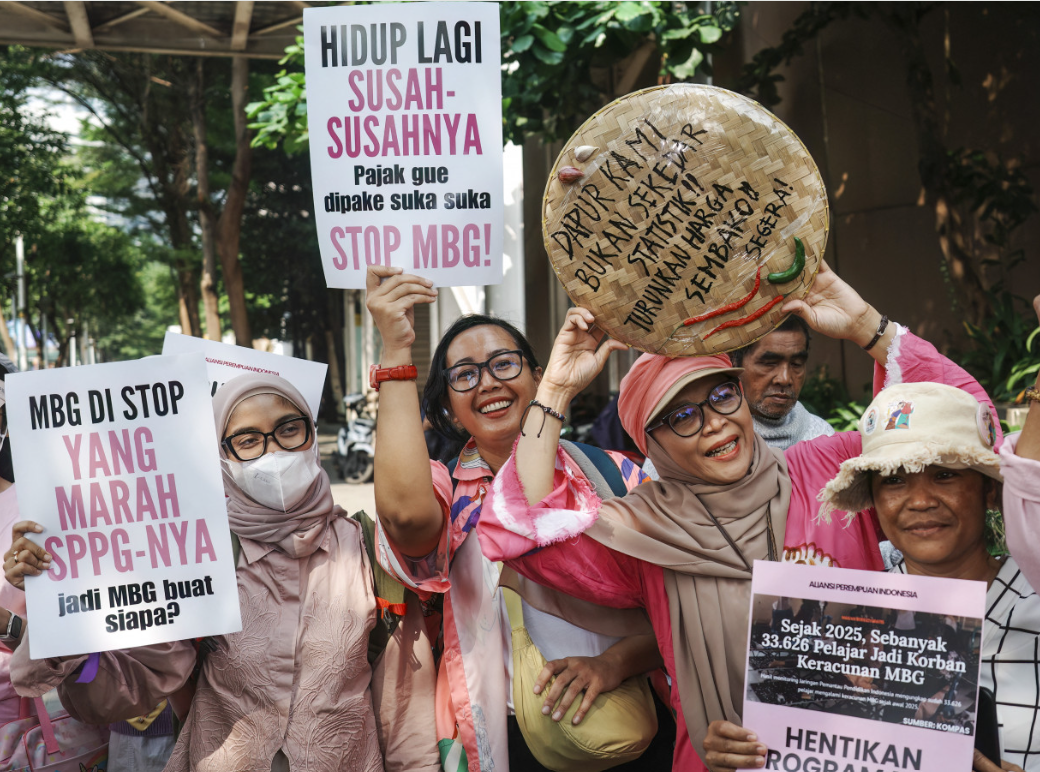
President Prabowo Subianto's ambitious free nutritious meal initiative, designed to tackle childhood stunting across Indonesia, faces mounting credibility challenges as beneficiaries increasingly voice willingness to abandon the assistance rather than accept substandard provisions. The controversy surrounding the programme has intensified following a series of high-profile incidents documenting inadequate meal preparation, prompting calls from both recipients and civil society groups for a comprehensive review before implementation continues further.
The programme's troubles crystallised when Nesti Nagari, a mother from Kediri in East Java, posted images of a meal destined for her eight-month-old infant—an unidentifiable white paste that she ultimately fed to her chickens instead. The social media post resonated widely, accumulating over 11,000 engagements within 24 hours and highlighting the stark disconnect between the programme's nutritional objectives and its ground-level execution. Nagari's experience is far from isolated, with numerous other beneficiaries documenting similar incidents involving unripe fruit, inadequate portions, and meals that fail to meet basic nutritional standards. Her willingness to forgo the government assistance entirely rather than compromise her child's dietary needs reflects a broader sentiment among recipients who possess sufficient resources to feed their families adequately.
Central Java resident Diah Farika, who enrolled in the scheme in May, initially approached the initiative with optimism but quickly encountered systematic problems that eroded her confidence. Over successive weeks, the meals deteriorated in quality and nutritional balance, with kitchen staff dismissing her repeated complaints without substantive responses. Rather than continue accepting substandard provisions, Farika joined other beneficiaries in declining the meals and calling for temporary programme suspension to enable the National Nutrition Agency (BGN) to conduct kitchen inspections and implement quality oversight mechanisms. Her decision underscores a critical insight: beneficiaries themselves recognise that the programme's fundamental concept has merit, but its implementation through inconsistent service providers has fundamentally compromised its credibility and utility.
The quality concerns have resonated beyond individual households, mobilising civil society advocacy. The Indonesian Women's Alliance (API) organised a rally in Central Jakarta last week, bringing together dozens of women's rights advocates to demand government action on programme suspension and comprehensive review. This institutional criticism reflects deepening anxiety that the initiative—however well-intentioned—has become a mechanism serving interests other than those of its intended recipients, particularly the poorest and most nutritionally vulnerable populations across the archipelago.
Problems at the implementation level have created cascading complications affecting multiple stakeholder groups. The nutrition fulfilment service units (SPPG), which function as the operational backbone of the initiative through a network of approximately 27,000 kitchens, have themselves faced operational challenges including delayed funding that forced temporary closures in early June. Private investors who financed kitchen construction now worry about the security of their capital investments, with industry representatives seeking assurances from BGN officials regarding continuity and profitability guarantees. These concerns intensified following a corruption scandal involving former BGN leadership, which prompted the agency's new leadership to halt further expansion of the SPPG network, creating uncertainty about the programme's trajectory.
The financial dimensions of the initiative further complicate the narrative. Originally budgeted at Rp 335 trillion (approximately US$18.74 billion) for 2026, the allocation was subsequently reduced to Rp 268 trillion following public scrutiny over the massive expenditure and its opportunity costs for education and healthcare investments. A study conducted by the Center of Economic and Law Studies (CELIOS) identified a structural efficiency problem: approximately 34 percent of current beneficiaries—roughly 61 million children and pregnant women—do not actually represent the most disadvantaged populations requiring government nutrition intervention. This analysis demonstrates that significant budgetary resources flow to economically secure households with adequate existing nutritional access, diluting the programme's poverty-reduction impact and raising questions about targeting mechanisms.
CELIOS researcher Isnawati Hidayah, instrumental in establishing MBG Watch—an independent monitoring platform created by civil society organisations—articulated the fundamental accountability challenge confronting policymakers. She emphasised that beneficiaries themselves constitute the most credible evaluative voice, as they possess direct knowledge of whether they require assistance and immediately experience consequences when service delivery fails. This perspective shifts the evaluation framework from purely technical or administrative metrics toward lived experience and actual nutritional outcomes, a reorientation that previous programme management apparently neglected.
Responding to mounting pressure, the BGN initiated targeted reforms aimed at recalibrating the beneficiary pool and addressing operational deficiencies. As of Thursday, the agency had removed 76 schools across Java from the programme, immediately affecting more than 39,000 recipients deemed capable of securing nutrition independently. BGN deputy head Agustina Arumsari characterised this contraction as refocusing efforts toward populations with genuine government assistance requirements, acknowledging that universal provision had diluted impact among truly vulnerable demographics. Simultaneously, the agency implemented austerity measures including elimination of daily kitchen incentives during non-operational periods and enhanced performance evaluation protocols targeting underperforming facilities.
The programme's predicament holds particular relevance for Southeast Asian policymakers confronting similar childhood malnutrition challenges. Indonesia's experience demonstrates that massive budget allocations, however well-motivated, cannot substitute for rigorous quality control, transparent supply chain management, and genuine engagement with beneficiary populations regarding service adequacy. The willingness of Indonesian mothers to reject free assistance rather than accept inferior provisions represents a crucial market signal that governments often ignore, potentially explaining why even generously funded nutritional initiatives sometimes fail to achieve their intended public health outcomes.
As the BGN navigates programme recalibration, the underlying tension remains unresolved: whether the initiative represents a genuine commitment to addressing malnutrition among Indonesia's poorest populations or functions primarily as a mechanism for expanding the kitchen infrastructure industry. The beneficiaries' demands for temporary suspension and comprehensive evaluation, supported by civil society oversight mechanisms, suggest that programme legitimacy ultimately depends on demonstrable improvements in meal quality, nutritional content, and equitable distribution to those most in need. Without such reforms, even a fully funded initiative risks further erosion of public trust and the programme's intended developmental impact.

