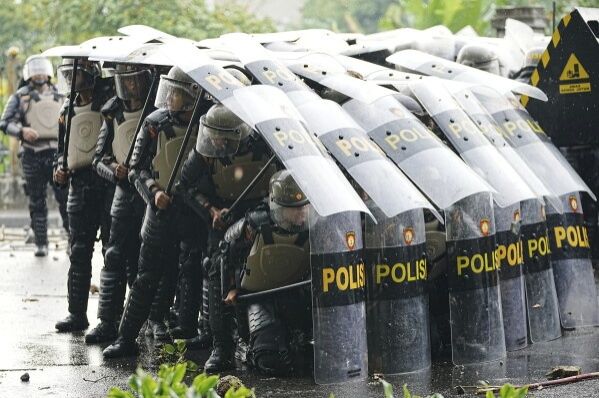
Deepening fissures within Indonesia's security establishment have surfaced after a series of police raids in and around Jakarta resulted in the seizure of assets valued at tens of millions of dollars, while simultaneously drawing the military into a protective deployment that has alarmed governance observers. The episode highlights how institutional rivalries and overlapping jurisdictions within the country's law enforcement ecosystem can spiral into public disputes, undermining public confidence in anti-corruption efforts just as officials attempt to project unity.
Police operations conducted across the capital yielded substantial quantities of gold, cash, and foreign currencies as part of investigations spanning three separate corruption and money-laundering portfolios. In South Jakarta, officers recovered more than USD 3 million in mixed currencies from a concealed two-metre safe located at a restaurant and an adjoining money changer. The seizures represent part of a broader crackdown touching allegations of coal procurement irregularities allegedly linked to power plant supply chains, suspected mismanagement of state insurance fund Asabri and Jiwasraya, and debt settlement matters involving Krakatau Steel subsidiaries.
The controversy intensified when investigators uncovered approximately USD 26.3 million in assets—including 74 kilograms of gold bars alongside cash reserves—at a Jakarta residence belonging to Febrie Adriansyah, the Deputy Attorney General for Special Crimes. The discovery thrust into the spotlight one of Indonesia's most prominent anti-graft prosecutors, whose unit oversees high-profile cases involving state enterprises including Timah and Pertamina, alongside investigations touching President Prabowo Subianto's signature free-meals initiative and former education minister Nadiem Makarim.
What might otherwise have remained a routine investigative operation escalated when armed military personnel subsequently deployed to Febrie's residence, ostensibly for protective purposes. The Attorney General's Office reportedly requested the deployment, citing established protocols safeguarding senior prosecutors. This manoeuvre introduced an element of institutional tension, as the military's visible presence at a location under police investigation created visual imagery suggesting interference or institutional conflict rather than coordination.
Febrie acknowledged ownership of the property on Friday but categorically denied any connection to the seized assets, positioning the discovery as potentially unrelated to his personal conduct. His statement emphasised the Attorney General's Office's commitment to respecting the investigative process while cautioning against premature conclusions drawn from social media speculation or media reportage. The prosecutor's measured response sought to depersonalise the matter, framing it as a straightforward legal process where presumption of innocence must prevail.
President Prabowo's intervention, delivered at a dam inauguration ceremony on Lombok island, carried unmistakable implications for institutional discipline. His remarks called upon officials, military personnel, and prosecutors to reflect upon their accountability to the citizenry, invoking the principle that symbols of authority derive legitimacy from popular sovereignty. The president's inclusion of the Attorney General's Office within his admonition suggested awareness that institutional tensions required high-level messaging to restore cohesion.
Military officials moved swiftly to contain interpretations of their deployment as institutional overreach. A military spokesman stated that security arrangements posed no impediment to law enforcement operations and categorically denied any inter-institutional conflict. The Indonesian military further affirmed its position as supportive of law enforcement authorities while rejecting any suggestion of process interference—a defensive posture indicating sensitivity to narratives portraying military involvement as problematic.
Human rights observers have sounded alarm bells regarding the deployment's implications for civilian control and institutional autonomy. Amnesty International Indonesia warned that visible military presence in civilian law enforcement contexts risks corroding civilian supremacy and undermining public confidence in investigative institutions. The organisation called for explicit guarantees shielding investigators from intimidation or obstruction, reflecting concern that security agency tensions might compromise investigative integrity.
Analysts tracking Indonesia's institutional health have characterised the episode as symptomatic of deeper governance fragmentation. Nicky Fahrizal, researcher at the Jakarta-based Center for Strategic and International Studies, characterised the standoff as evidence of broader institutional breakdown potentially accelerating what he termed "creeping militarization"—a gradual normalization of military involvement in civilian law enforcement domains. His assessment suggests that permitting such escalations to continue without resolution risks fundamental erosion of rule-of-law foundations, potentially triggering investor flight and widespread public disaffection.
The confluence of corruption investigations, asset seizures, and security agency tensions arrives at a particularly sensitive moment for investor confidence. Indonesia's institutional credibility depends substantially upon demonstrating that anti-corruption machinery functions independently and impartially, regardless of personality conflicts or jurisdictional rivalries between agencies. When security institutions appear to operate at cross-purposes, particularly when military deployments accompany corruption investigations, international observers question whether investigations proceed based on evidence or institutional positioning.
For Malaysian observers, the Indonesian scenario offers instructive parallels regarding the risks institutional rivalries pose to governance quality. Cross-border implications merit attention, as investor confidence in one Southeast Asian jurisdiction influences capital allocation across the region. Contagion effects might emerge if international markets perceive Indonesian institutional dysfunction as signalling broader regional governance challenges, potentially affecting Malaysian business environments through capital reallocation and heightened risk premiums.
The unfolding situation demands resolution through explicit institutional protocols clarifying respective agency mandates and constraining overlap that generates friction. Without such frameworks, recurring episodes of apparent inter-agency conflict risk normalizing institutional competition over cooperative law enforcement, ultimately subordinating anti-corruption effectiveness to bureaucratic territoriality. Indonesian leadership faces immediate pressure to demonstrate that security agencies can pursue legitimate investigations while maintaining institutional boundaries respecting both military prerogatives and civilian law enforcement autonomy.

