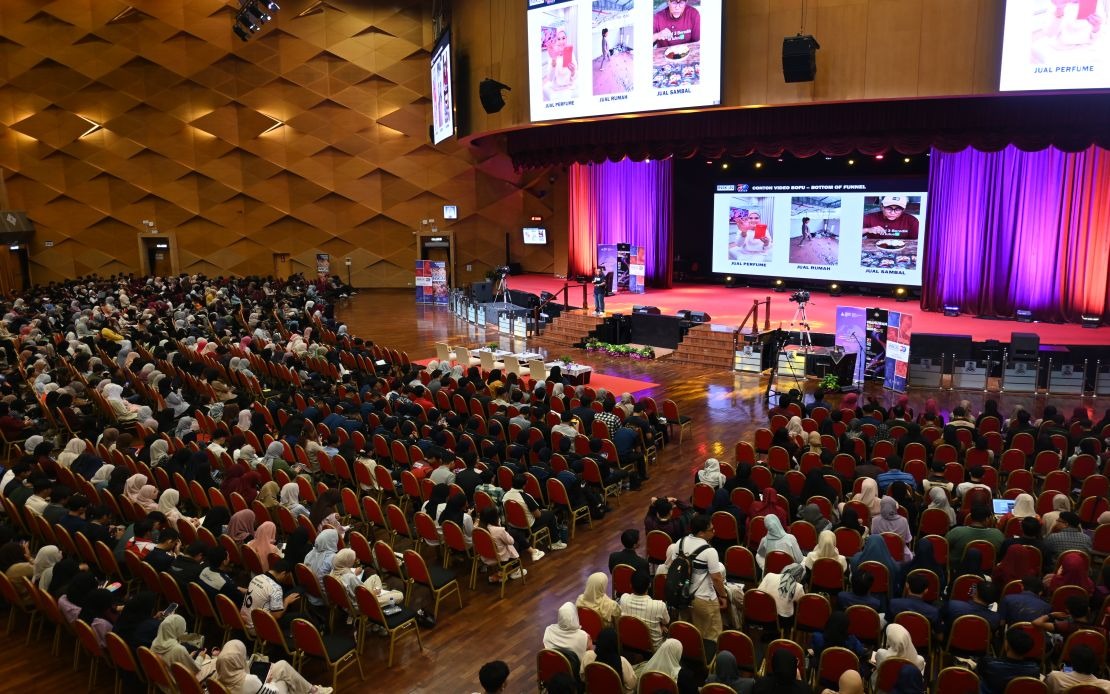
The National Entrepreneurship Institute (INSKEN) and Universiti Teknologi MARA (UiTM) have successfully convened nearly 7,000 aspiring business founders at SUM MEGA 2026, a landmark entrepreneurship seminar that has now entered Malaysia's official records. Held at Dewan Agung Tuanku Canselor at UiTM Shah Alam on June 23, the event drew 6,877 participants through both physical and virtual attendance channels, earning recognition from the Malaysia Book of Records as the nation's largest student-focused entrepreneurship seminar to date. The scale of participation underscores a significant appetite among Malaysian university students for practical business knowledge and networking opportunities in an era when job creation remains a pressing national concern.
The seminar was orchestrated jointly by INSKEN, the Malaysian Academy of SME and Entrepreneurship Development (MASMED), and UiTM, bringing together students from across Malaysia's campuses through structured knowledge-sharing modules, skills development workshops, and strategic peer networking opportunities. The collaborative framework reflects a broader institutional recognition that entrepreneurship education requires coordination among government agencies, academic bodies, and development organisations to be effective. By pooling resources and expertise, the organisers created an environment where students could absorb practical insights while simultaneously building relationships with potential business mentors, peers, and future collaborators—elements that research consistently shows improve startup survival rates and venture quality.
Datuk Mohamad Alamin, deputy minister in the Ministry of Entrepreneur and Cooperatives Development (KUSKOP), characterised the turnout as evidence of shifting attitudes toward entrepreneurship within Malaysia's younger cohorts. Rather than viewing business ownership as an ancillary or risky career trajectory, a growing segment of the student population now regards it as a legitimate and attractive professional pathway. This attitudinal shift carries significant implications for Malaysia's economic resilience and diversification efforts, particularly as the country seeks to reduce dependency on large-scale manufacturing and foreign direct investment. When thousands of university graduates possess both entrepreneurial aspiration and basic business literacy, the economy gains a broader base of potential innovators capable of identifying market gaps and launching ventures in emerging sectors.
Within the Malaysian context, where unemployment among fresh graduates and youth underemployment remain persistent challenges, entrepreneurship programmes serve a dual function. They simultaneously equip individuals with pathways to self-employment while addressing national labour market pressures that might otherwise result in prolonged joblessness or underutilisation of human capital. Mohamad Alamin stressed that entrepreneurship extends beyond individual career advancement; it functions as a macroeconomic engine capable of generating employment across supply chains, fostering domestic innovation, and contributing measurably to gross domestic product growth. In an increasingly competitive regional marketplace where Vietnam, Thailand, and Indonesia are also investing heavily in startup ecosystems, Malaysia's institutional focus on student entrepreneurship represents a strategic response to preserve competitive advantage.
The Ministry's commitment to nurturing entrepreneurial capacity operates across multiple dimensions, encompassing capacity-building programmes, improved access to financing mechanisms, market facilitation, digital transformation support, and comprehensive business development advisory services. This multifaceted approach acknowledges that entrepreneurial success rarely emerges from knowledge alone; it requires concurrent access to capital, customer networks, technological infrastructure, and mentoring from experienced practitioners. By addressing these complementary needs through coordinated policy and programme design, KUSKOP aims to raise the overall quality and sustainability of new ventures launched by Malaysian entrepreneurs, thereby improving their contribution to economic growth and employment creation.
Datuk Mustaffa Kamil Ayub, INSKEN Board of Trustees chairman and UiTM board member, emphasised that the overwhelming attendance at SUM MEGA 2026 signals a maturation of entrepreneurial culture within Malaysian society, particularly among younger demographics. He reframed entrepreneurship beyond a mere vocational choice, positioning it instead as a foundational mindset and cultural orientation capable of catalysing systemic economic transformation. This conceptualisation reflects international best practices observed in successful entrepreneurial ecosystems across Singapore, South Korea, and the Nordic region, where entrepreneurial thinking becomes embedded in educational curricula and societal values from an early age. The cultivation of such a mindset throughout Malaysia's higher education system could yield compounding benefits over decades, as successive cohorts of graduates internalise problem-solving orientations, risk tolerance, and innovation-seeking behaviours.
A central pedagogical framework deployed throughout SUM MEGA 2026 emphasises the MOFA approach, an acronym encompassing marketing, operations, finance, and business administration. This structured methodology ensures that participating students receive balanced, comprehensive exposure to the functional domains essential for operational sustainability and competitive resilience. Rather than focusing narrowly on product development or sales tactics, the MOFA framework acknowledges that entrepreneurial success depends on simultaneous competence across multiple management disciplines. For student participants from non-business academic backgrounds, exposure to financial management principles, operational efficiency practices, and administrative systems provides foundational knowledge that might otherwise require years of trial-and-error learning post-launch.
SUM MEGA 2026 functions as a strategic instrument within INSKEN's broader portfolio of entrepreneurial development initiatives, which also encompasses the INSKEN Masterclass, the BANGKIT programme, and the PROTÉGÉ mentorship scheme. Collectively, these programmes create a developmental pipeline that accommodates entrepreneurial learners at different stages of progression, from initial awareness and capability-building through to advanced peer learning and individualised mentoring relationships. The availability of multiple programmatic entry and progression points increases the likelihood that students with varying starting knowledge levels, learning preferences, and entrepreneurial readiness will find suitable developmental pathways. Such ecosystem comprehensiveness distinguishes Malaysia's institutional approach from ad-hoc seminars that might excite enthusiasm temporarily but fail to provide sustained support structures necessary for venture establishment and growth.
The alignment of SUM MEGA 2026 with Malaysia's National Entrepreneurship Policy 2030 demonstrates institutional coherence between grassroots capability-building and national strategic objectives. The policy framework recognises that entrepreneurship is not a peripheral economic activity but a central pillar of Malaysia's developmental agenda, particularly as the nation transitions toward high-value industries and innovation-driven competition. By convening large cohorts of university students and exposing them to entrepreneurial fundamentals and networking opportunities, INSKEN and partner organisations advance the tangible implementation of policy aspirations. When educational institutions, government ministries, financial sector participants, and industry associations coordinate their efforts around shared entrepreneurial objectives, the probability increases substantially that policy-level ambitions translate into ground-level behavioural change and venture creation.
For Malaysian readers and regional observers, the success of SUM MEGA 2026 carries implications extending beyond the immediate participants. The event demonstrates that demand exists within Malaysia's youth population for structured entrepreneurship education and that institutional mechanisms capable of delivering such education at scale are increasingly operational. As regional economies compete for talented entrepreneurs and innovative startups, Malaysia's ability to cultivate entrepreneurial capability among its university population influences its relative attractiveness as an entrepreneurial hub. Countries and regions that systematically develop entrepreneurial human capital tend to experience advantages in attracting capital, technology partnerships, and innovative ventures that generate employment and economic dynamism. The investments that INSKEN, UiTM, MASMED, and KUSKOP are making in large-scale entrepreneurship education therefore constitute strategic investments in Malaysia's long-term competitive positioning within the Southeast Asian economic landscape.

