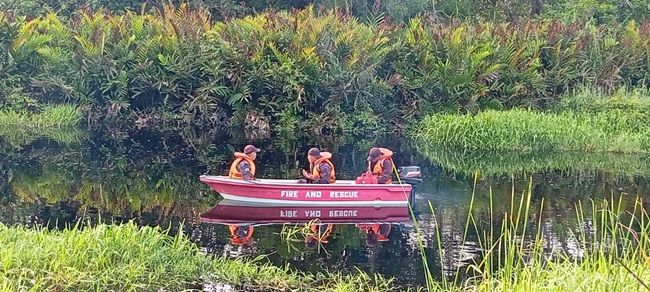
Brunei's fire and rescue authorities intensified their hunt for a missing man believed to have been attacked by a crocodile in Kampong Baru Sungai Bera, with the search operation extending into its third consecutive day without any sign of the victim. The disappearance has mobilized one of the sultanate's most comprehensive river rescue efforts, reflecting the gravity of the situation and the unpredictability of crocodile encounters in the region.
The Fire and Rescue Department coordinated a multifaceted search strategy employing an array of modern equipment and personnel resources. Rescue boats patrolled the river systematically throughout extended operational hours, while specialized teams combed both banks of Sungai Bera on foot, scrutinizing every accessible section for potential evidence or remains. Aerial reconnaissance using the department's unmanned drone technology provided an elevated perspective of the waterway and surrounding terrain, allowing rescuers to scan areas difficult or impossible to reach from ground level.
The operation drew support from several arms of Brunei's security apparatus. Royal Brunei Police Force officers arrived from Seria Police Station, while specialized maritime personnel from POLMAR—the force's dedicated marine police unit—brought expertise in water-based emergency response. The Wildlife Division also participated, bringing knowledge essential to understanding crocodile behavior and likely movement patterns following such an incident. This interagency coordination reflected the seriousness with which authorities were treating both the rescue effort and the broader public safety implications.
Senior Superintendent Amirul Hadi Junaidi, the Commanding Officer of the Operations Branch, assumed leadership of the coordinated response, centralizing decision-making and resource allocation across the various participating departments. The establishment of a Tactical Command Post provided a dedicated coordination hub from which rescue operations could be directed efficiently and real-time information shared among all responding agencies.
The incident began when the FRD received a distress call on Wednesday, June 24, alerting them to a male victim who had apparently encountered a crocodile while engaged in fishing activities along the river. The report triggered an immediate deployment of firefighting resources: two fire engines arrived with nine personnel under the command of Acting Station Officer Mohd Zulkifli Md Tahir. This rapid response enabled responders to gather crucial initial information directly from the victim's family members at the scene, establishing that the man had been fishing when the crocodile attack occurred.
The transformation of an initial emergency response into a sustained multi-day search operation highlighted the challenges posed by crocodile incidents in Southeast Asian waterways. Unlike many other emergencies where quick initial intervention can prevent tragedy, crocodile attacks often unfold rapidly in remote or semi-remote locations, and subsequent search efforts become protracted operations dependent on environmental conditions and the unpredictability of wildlife behavior.
Sungai Bera's geography and the surrounding Kampong Baru area present particular challenges for rescue operations. The river environment offers numerous refuge points and deeper sections where a large crocodile might withdraw after an attack. Weather conditions, water flow rates, and visibility all factor into the effectiveness of both boat-based and aerial searches, necessitating coordinated efforts across multiple hours and days to comprehensively cover the affected area.
Crocodile attacks, while statistically rare in Brunei compared to some other Southeast Asian nations, carry significant implications for riverside communities and fishing populations who depend on waterways for livelihood and sustenance. Such incidents typically prompt renewed discussions about wildlife safety protocols, the balance between human activities and wildlife conservation, and the effectiveness of existing warning systems and safety measures in crocodile-inhabited areas.
The search operation underscores the risks inherent in traditional fishing practices in regions where large predators remain present. Many fishing communities across Southeast Asia operate with historical knowledge of crocodile behavior and traditional safety practices, yet modern equipment and increased human activity along waterways have altered the traditional risk calculus. The incident may prompt authorities and community organizations to reassess safety messaging and educational outreach regarding crocodile awareness and river safety protocols.
For Malaysia and the broader Southeast Asian region, the Brunei incident serves as a reminder of the ongoing human-wildlife conflict challenges that persist across the region's river systems and wetland areas. Similar crocodile incidents have occurred in Malaysian waters and other neighboring nations, where saltwater crocodiles continue to inhabit mangrove forests, estuaries, and river systems. The coordinated response demonstrated by Brunei's agencies reflects best practices in interagency emergency management that other regional nations have also adopted.
The continuation of the search operation without immediate results reflects both the commitment of rescue personnel and the inherent difficulties of locating individuals in natural water environments where visibility is limited and the landscape constantly changes. As the operation progressed through successive days, authorities maintained hope while simultaneously grappling with the realistic assessment that recovery outcomes in crocodile attack situations often depend significantly on the speed of initial intervention and circumstances beyond responders' control.

