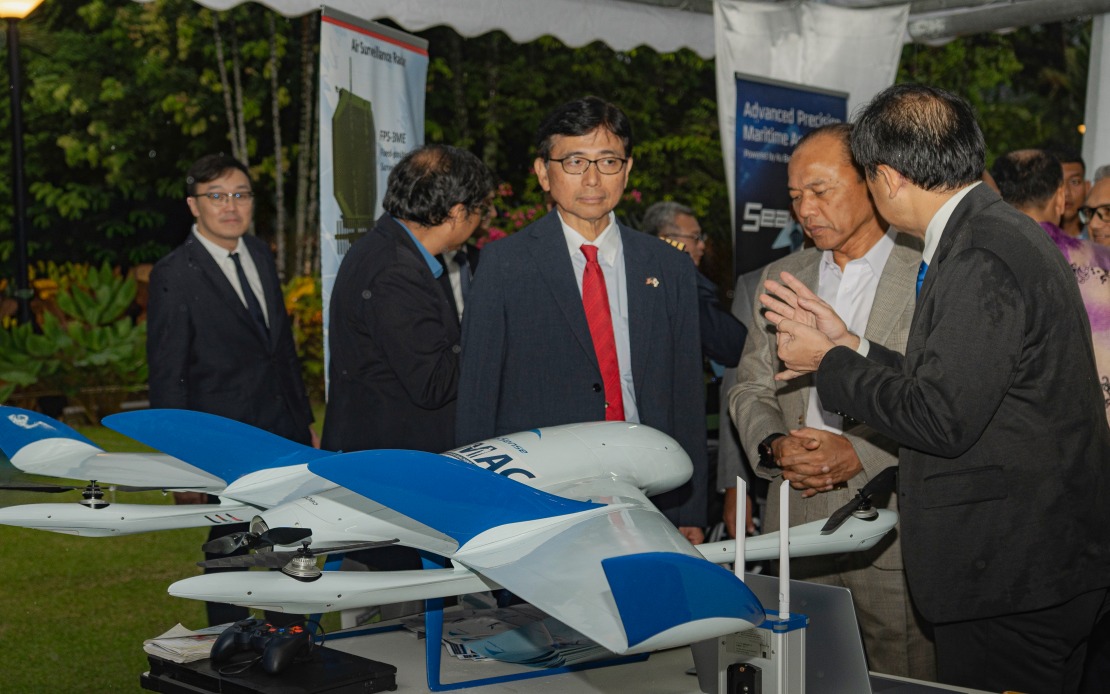
Japan is positioning itself for significantly expanded security cooperation with Malaysia, according to remarks by Japanese Ambassador Noriyuki Shikata at a military commemoration event in Kuala Lumpur this week. The declaration follows recent discussions between Prime Minister Sanae Takaichi and Malaysian Prime Minister Datuk Seri Anwar Ibrahim, where both leaders reaffirmed their commitment to fortifying defence and security ties amid what Tokyo characterizes as an increasingly volatile global environment. For Malaysia and other Southeast Asian nations navigating complex geopolitical pressures, Japan's willingness to deepen engagement represents an important signal of Tokyo's continued focus on the region as a strategic priority.
The timing of these overtures carries particular weight given the broader competition for influence unfolding across the Indo-Pacific. Both capitals have endorsed a convergence between Japan's Free and Open Indo-Pacific framework and ASEAN's own Indo-Pacific outlook, a diplomatic alignment that demonstrates how regional powers are attempting to establish common ground on security matters. This convergence is not merely symbolic—it reflects substantive efforts to coordinate responses to shared challenges while promoting economic development and stability across one of the world's most strategically important waterways. For Malaysia, which sits at the crossroads of vital shipping lanes and faces its own maritime security concerns, this alignment offers opportunities to enhance capabilities while maintaining its non-aligned approach to great power competition.
The elevation of Japan-Malaysia ties to a Comprehensive Strategic Partnership in 2023 provides institutional scaffolding for this expanded cooperation. Shikata emphasized that as the nations approach their 70th diplomatic anniversary next year, Tokyo intends to leverage this framework to push bilateral engagement into new domains. This language suggests Japan's planners view Malaysia not as a peripheral partner but as a country whose geographic position, economic weight, and political influence merit sustained high-level attention. The ambassador's commitment to advancing cooperation across defence and security alongside other sectors indicates Tokyo's holistic approach to strengthening regional partnerships.
Maritime security forms the practical core of this deepening relationship. The MALPAN bilateral exercise, conducted regularly by the Japan Maritime Self-Defence Force and Royal Malaysian Navy, has become a recurring fixture in the South China Sea and the Strait of Malacca. This year's iteration marked a notable escalation when the Royal Malaysian Air Force joined the drills, expanding the exercise's scope into the air domain. Such joint training builds mutual familiarity between armed forces, develops interoperability, and implicitly signals to other regional actors that Japan and Malaysia maintain coordinated approaches to safeguarding critical maritime routes. For Malaysia, a country dependent on seaborne trade and navigating complex territorial claims in its waters, such practical cooperation directly serves national interests without requiring formal alliance commitments.
Tokyo has also deployed official security assistance as a tool for deepening ties with Southeast Asian partners. Japan's Official Security Assistance programme, inaugurated in 2023, represents a shift in how Tokyo provides military aid, moving beyond traditional development assistance into more direct security support. Malaysia ranked among the earliest recipients of this assistance. Last year, Japan supplied unmanned aerial vehicles and rescue boats—equipment with clear maritime applications suited to Malaysia's geographic and operational requirements. The announcement that Japan will provide diving support vessels to the Royal Malaysian Navy under the 2025 iteration of the programme underscores how these contributions are tailored to address specific capability gaps while simultaneously demonstrating Japan's practical commitment to regional partners.
The provision of equipment for ceasefire monitoring to the ASEAN Observer Team reveals another dimension of Japanese support, one that extends beyond bilateral defence cooperation into broader regional peace and stability efforts. Malaysia's diplomatic leadership within ASEAN has positioned it as a potential venue for conflict resolution and multilateral security coordination. By channeling support through ASEAN mechanisms rather than bilateral channels alone, Japan reinforces ASEAN's centrality in regional architecture while simultaneously spreading the benefits of Japanese assistance across the bloc. This approach allows Japan to strengthen ties with individual nations while maintaining the consensual approach that ASEAN members collectively prefer.
Defence industry collaboration represents an emerging frontier in the partnership. The participation of ten Japanese companies in Defence Services Asia 2026, Malaysia's premier defence exhibition, demonstrates Tokyo's interest in commercial dimensions of security cooperation. More significantly, Japan and Malaysia have established a Terms of Reference framework to launch a bilateral defence industry dialogue. Such mechanisms typically precede defence procurement arrangements, technology transfer agreements, or joint research initiatives. For Malaysian defence planners, access to Japanese military technology and manufacturing expertise could upgrade national capabilities, particularly in maritime and air domains where Japan maintains technological advantages. For Japanese defence firms, Malaysia offers potential export markets and opportunities for technology partnerships that enhance their global competitiveness.
The involvement of General Tan Sri Malek Razak Sulaiman, Malaysia's Armed Forces chief, at the Japan Self-Defence Forces Day reception underscores that these discussions occur at the highest levels of Malaysia's military establishment. The presence of top defence officials at diplomatic events signals institutional buy-in and suggests these partnerships extend beyond foreign ministry rhetoric into genuine operational planning. Malaysia's military leadership evidently views enhanced cooperation with Japan as strategically beneficial, a perspective that likely reflects shared assessments of regional security challenges and opportunities.
Contextualizing this cooperation within broader regional dynamics reveals important strategic implications. China's growing military capabilities and assertiveness in the South China Sea have prompted many Southeast Asian nations to diversify security partnerships rather than concentrate influence with any single great power. Japan, as a like-minded democracy with technological sophistication and maritime capabilities, offers an alternative partner for capacity building and strategic coordination. Malaysia's balanced approach—maintaining economic ties with China while diversifying security partnerships—reflects how Southeast Asian nations are attempting to manage great power competition without sliding into exclusive blocs that could destabilize the region.
The emphasis on upholding international law and supporting de-escalation, as articulated by Ambassador Shikata, contrasts implicitly with more coercive approaches to regional security. Japan and Malaysia's shared commitment to keeping sea lanes open and secure aligns with the interests of trading nations dependent on freedom of navigation. This framing appeals to Malaysia's interests as a commercial hub reliant on open shipping routes and suggests that the expanding partnership rests on shared interests in maintaining the institutional and legal frameworks that enable prosperity across the Indo-Pacific.
Looking forward, the announced commitment to deepen cooperation represents both opportunity and challenge for Malaysia. The opportunity lies in accessing Japanese technical expertise, defence equipment, and intelligence capabilities that could enhance Malaysia's ability to manage maritime security, counter non-traditional threats, and participate effectively in regional stability efforts. The challenge involves calibrating these partnerships to avoid appearing to align too closely with any particular great power strategy while maintaining the flexibility that has characterized Malaysia's foreign policy approach. The bilateral defence industry dialogue, in particular, will require Malaysian officials to make judgments about technology absorption, industrial capacity, and the long-term strategic implications of deepened defence integration.
The next year, culminating in the 70th anniversary of diplomatic relations, will likely see concrete manifestations of these pledges. Whether through expanded joint exercises, new defence procurement arrangements, enhanced intelligence sharing, or technological collaboration, Malaysia should expect increasingly visible and substantive expressions of this partnership. For Japan, such outcomes would validate its Indo-Pacific strategy and demonstrate that its approach to regional engagement—emphasizing democratic values, rule of law, and practical capacity building—resonates with Southeast Asian partners. For Malaysia, deepened security cooperation with Japan offers tools to address genuine capability gaps while maintaining the strategic autonomy that remains central to its national interests.

