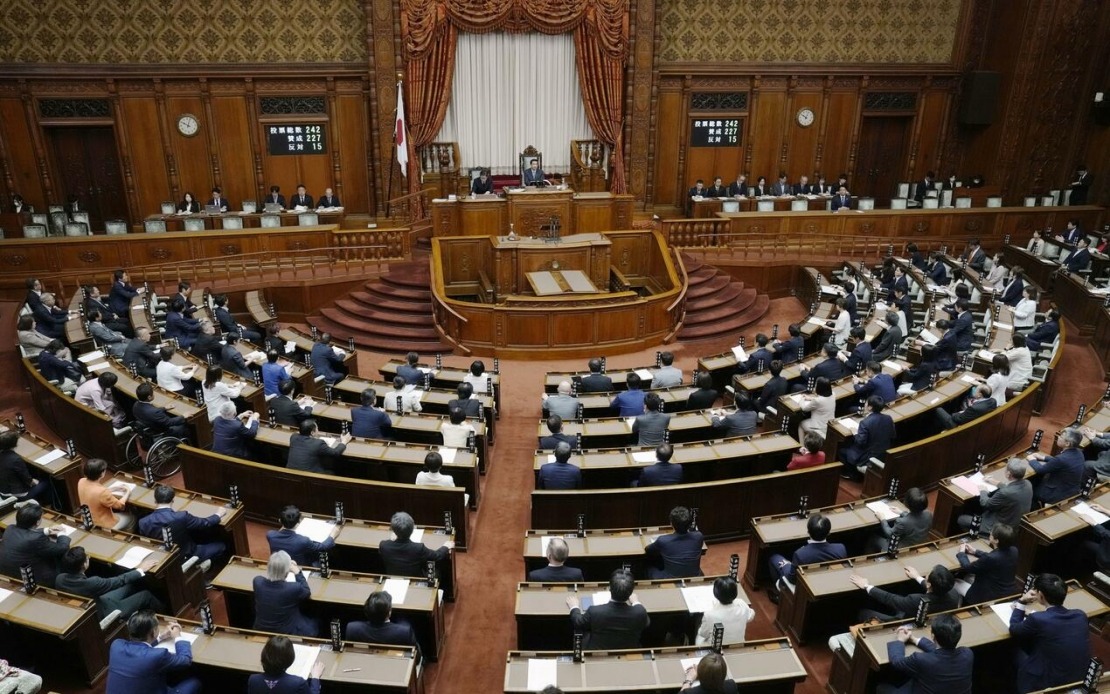
Japan's parliament has taken a significant step in modernising its defence architecture by enacting legislation Friday to overhaul the Air Self-Defence Force, making explicit recognition of space as a critical operational domain. The restructuring represents a fundamental shift in how Tokyo conceptualises national security in an era where satellite systems underpin both military capabilities and civilian infrastructure. The renamed force, due for launch during the fiscal year ending March 2027, signals Japan's determination to establish credible deterrence against emerging threats beyond traditional airspace.
Central to the reorganisation is the creation of a dedicated space operations group to be commanded by a lieutenant general, marking the elevation of space operations to a command-level responsibility. This structural change enables Japan to develop more sophisticated space domain awareness and expand its satellite surveillance architecture, capabilities increasingly vital as geopolitical rivalry intensifies across the Indo-Pacific. The establishment of this unit reflects recognition that contemporary conflict scenarios involve contested space environments, where adversaries may attempt to degrade or destroy critical orbital infrastructure. Japan's move parallels similar efforts by allies including Australia and South Korea, which have likewise upgraded their space warfare preparedness in response to Chinese military modernisation.
Defence Minister Shinjiro Koizumi articulated the civilian dimensions of space technology during a news conference, emphasising that dependency on orbital systems extends far beyond military applications. Satellite navigation systems, smartphone mapping services, and weather forecasting all rely on space-based infrastructure that societies now take for granted. This observation carries particular weight for Southeast Asian nations similarly vulnerable to disruption of space systems, whether through deliberate military action or accidental collision. Japan's restructuring underscores how space security has become inseparable from societal resilience and economic continuity.
The legislation simultaneously addresses personnel challenges that have increasingly strained the Self-Defence Forces by raising post-retirement benefits for members. Recruitment and retention have become persistent headaches as Japan's demographic decline shrinks the pool of military-age citizens whilst competing sectors offer comparable compensation. By enhancing retirement provisions, lawmakers hope to stabilise force composition and preserve institutional knowledge. The measure reflects pragmatic recognition that technical space operations require highly trained personnel who might otherwise pursue lucrative opportunities in the private aerospace sector.
Parliament also authorised appointment of a second senior vice defence minister, a structural innovation designed to distribute workload during emergencies and major disasters. This redundancy improves continuity of command whilst enabling expanded high-level defence engagement with the United States and other security partners. The arrangement acknowledges that contemporary crises—whether military confrontation, natural disaster, or hybrid threat—demand sustained senior-level attention that a single vice minister cannot reliably provide. The position is expected to be filled as early as summer, underscoring the government's urgency in operationalising these reforms.
Particularly significant for regional security dynamics is the upgrade of the Ground Self-Defence Force's 15th Brigade, stationed in Naha, Okinawa Prefecture, to full divisional status. This enhancement directly responds to Beijing's assertive maritime conduct throughout the southwestern approaches to Japan, including waters near the Senkaku Islands. By elevating the 15th Brigade, Tokyo augments its capacity to respond to contingencies in this strategically crucial zone where Chinese People's Liberation Army vessels increasingly operate. The upgrade also carries symbolic weight, signalling to regional partners and adversaries alike Japan's commitment to maintaining deterrent presence in its southwestern frontier.
For Southeast Asian observers, Japan's defence restructuring offers instructive lessons regarding institutional adaptation to shifting security environments. The integration of space operations into conventional military command structures represents a model that regional countries confronting similar pressures—particularly those dependent on critical satellite infrastructure for maritime domain awareness or communications—might emulate. Japan's approach demonstrates how strategic modernisation need not wait for perfect conditions but can proceed incrementally through legislative action that enjoys broad political consensus.
The timing of this legislation reflects Japan's broader strategic posture under Prime Minister Fumio Kishida's administration, which has moved decisively to strengthen defence capabilities following years of relatively cautious security policies. The three per cent defence spending increase enacted last year and subsequent force modernisation initiatives signal Tokyo's intention to graduate from a defensive security posture to one capable of projecting stabilising influence across the region. Space-based capabilities constitute an essential element of this transition, enabling Japan to contribute meaningfully to regional security without provocative surface deployments.
China's expanding military capabilities and assertive behaviour in the East China Sea and South China Sea have catalysed this transformation. Beijing's development of anti-satellite weapons and space warfare doctrines has forced Japan and other regional democracies to abandon comfortable assumptions about the inviolability of orbital space. The decision to formally organise space operations within the Self-Defence Forces hierarchy acknowledges that future conflicts may involve simultaneous campaigns across multiple domains including space, cyber, maritime, and air.
Implementation of these reforms will unfold gradually through fiscal 2027, allowing Japan time to recruit and train space operations personnel, develop doctrine, and coordinate with allied nations on interoperability standards. The United States, which maintains sophisticated space warfare capabilities and has itself recently elevated Space Force operations, will likely provide technical assistance and operational planning support. Such coordination reinforces the alliance's capacity to maintain freedom of operation in contested domains whilst deterring Beijing from miscalculation.
For Malaysia and other Southeast Asian nations, Japan's space defence initiative carries indirect but important implications. A Japan confident in its ability to maintain space superiority becomes a more effective security anchor in the region, capable of sustained operations even in contested environments. Enhanced Japanese space capabilities also contribute to the broader constellation of allied surveillance and communication systems upon which smaller regional navies depend for maritime awareness. The ripple effects of Tokyo's institutional reforms thus extend well beyond Japanese territory into the broader security architecture that underpins stability throughout Southeast Asia.

