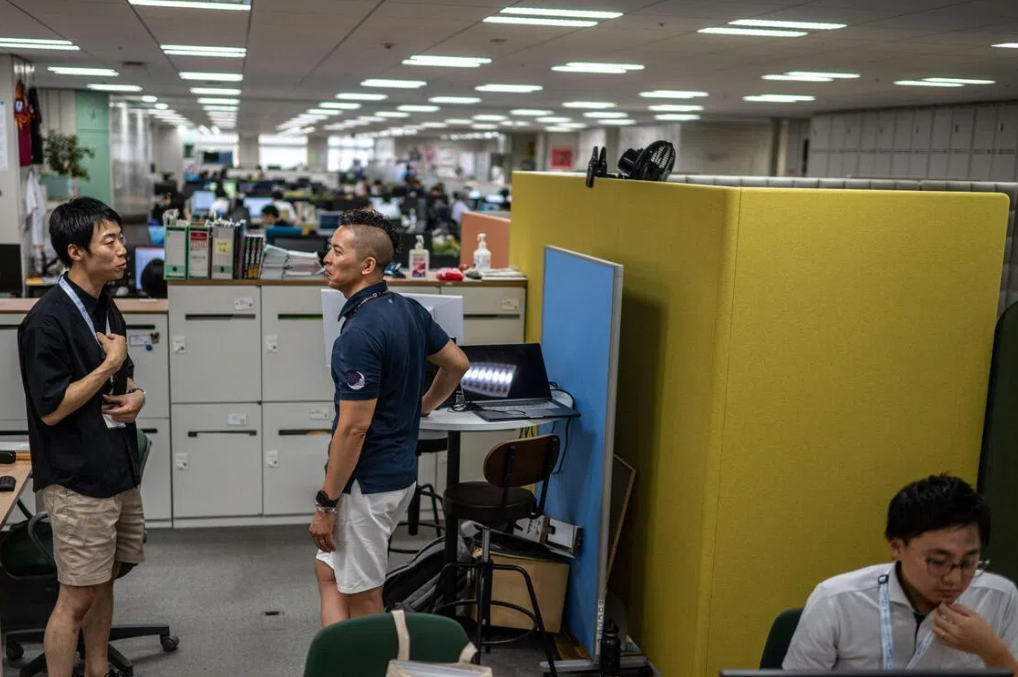
Japan's capital is grappling with an unexpected workplace etiquette crisis as its government-backed initiative to help office workers endure extreme summer temperatures collides with social anxieties about body hair visibility. The Tokyo metropolitan government expanded its "Cool Biz" campaign in April, explicitly encouraging workers to abandon traditional business suits in favour of casual wear including T-shirts, trainers, and crucially, shorts. The effort represents a logical response to the country's sweltering climate, yet it has exposed deeply ingrained cultural sensitivities about workplace appearance that officials did not fully anticipate.
The backlash has crystallised around the term "sunehara", or "leg hair harassment", a newly minted expression reflecting women's reported discomfort at encountering male colleagues with visible shin hair in office settings. This phenomenon reveals how clothing choices carry far more cultural weight in Japan than purely functional considerations of temperature management. The controversy demonstrates that relaxing dress codes involves navigating complex social norms that vary significantly by gender, with expectations around body presentation deeply embedded in Japanese workplace culture.
Evidence of public ambivalence emerged from a June survey conducted by Gorilla Clinic, a men's cosmetic treatment chain with a vested commercial interest in the findings. The poll revealed nearly even division on the acceptability of workplace shorts, with 53.5 per cent of respondents opposing the practice while 46.5 per cent supported it. Notably, women substantially outnumbered men among those expressing reservations, suggesting a pronounced gender divide in attitudes toward casual leg exposure in professional environments. This statistical split highlights the gendered nature of workplace appearance standards in Japan, where women have historically faced stricter scrutiny regarding their physical presentation.
The concern extends beyond abstract notions of propriety into tangible anxiety about bodily exposure. Survey respondents cited worries about body shape and body hair as primary objections to shorts-wearing, indicating that the debate is fundamentally about controlling the visibility of natural human physiology in shared office spaces. This reflects broader tensions in Japanese society between modernisation pressures and traditional aesthetic and behavioural standards, particularly regarding what bodies should look like when viewed by colleagues.
The discomfort has rippled into unexpected territory, affecting male workers' own self-perception and purchasing decisions. Akifumi Funatsu, a director at Gorilla Clinic, reported that male clients are increasingly seeking laser hair removal treatments, motivated not primarily by vanity but by a sense of social responsibility. These men appear to have internalised a belief that exposed leg hair represents a potential source of workplace discomfort for their female colleagues, transforming a physiological characteristic into what some perceive as a correctable faux pas. This psychological shift demonstrates how dress code discussions can become deeply personal, influencing decisions about one's own body.
The historical context reveals that Japan's journey toward workplace casualness has been gradual and incremental. The original Cool Biz campaign launched in 2005 when Yuriko Koike, then serving as environment minister, introduced guidelines encouraging workers to abandon jackets and ties in favour of short-sleeved shirts. At that time, former Prime Minister Junichiro Koizumi's public appearance without conventional formal wear provided high-profile validation for the concept. Following the 2011 earthquake and tsunami that devastated Japan's energy infrastructure, the government introduced "Super Cool Biz", which further liberalised workplace dress standards. Over the past two decades, casual clothing has gradually become normalised, particularly within progressive sectors such as technology start-ups.
The current expansion to include shorts represents a threshold moment in this gradual liberalisation, one where the government is clearly pushing boundaries beyond what many workers, particularly women, are comfortable accepting. Tokyo environmental official Noboru Watanabe articulated the government's position to international media, emphasising that the initiative aims to provide workers with flexibility rather than mandate specific clothing. His statement that "there should be no issue as long as the work attire is not offensive to anyone" acknowledged the subjective nature of workplace appropriateness while essentially passing the definitional burden to individual workers and organisations.
The timing of this push is not incidental but directly linked to Japan's intensifying climate challenges. The country faces increasingly brutal summer heat accompanied by high humidity that severely compromises the body's natural cooling mechanisms through perspiration. Official data from the Fire and Disaster Management Agency documented seven heat-related deaths and 4,580 hospitalisations during a single week in July, underscoring the genuine public health dimensions of the problem. The government's promotion of casual, cooler clothing thus reflects legitimate concerns about worker safety and comfort during extreme weather events that are becoming more frequent and severe.
Beyond workplace dress codes, Japanese consumers have embraced a rapidly expanding market of heat-mitigation technologies and products. Clothing incorporating integrated cooling fans, specialised cooling wipes, heat-blocking umbrellas, and portable ventilation devices have become increasingly prevalent as individuals attempt to manage exposure to dangerous temperatures. This market expansion reveals how adaptation to climate stress occurs simultaneously through policy intervention and consumer innovation, with individuals seeking personal solutions while governments attempt systemic approaches.
The unresolved tension at the heart of this debate touches on fundamental questions about workplace culture and gender dynamics that extend well beyond Japan's borders. As organisations worldwide reconsider dress codes in light of climate change, they will inevitably confront similar questions about whose comfort takes precedence, whose bodies are subject to scrutiny, and how much flexibility can be introduced without triggering social friction. The Cool Biz expansion has inadvertently highlighted how ostensibly neutral practical decisions about workplace attire actually involve deeply contested assumptions about appropriate bodily presentation, particularly along gender lines.
Looking forward, the resolution of this dispute may reveal much about Japan's broader capacity to balance practical adaptation with social convention. The government's position that workers should have choice appears reasonable in principle, yet the "leg hair harassment" controversy suggests that genuine choice requires both expanding options and creating genuine social acceptance for those options. Without addressing underlying attitudes about body visibility and workplace decorum, simply authorising shorts may simply transfer discomfort from those overheating in formal wear to those feeling self-conscious about their exposed skin, hardly a satisfactory outcome for anyone.

