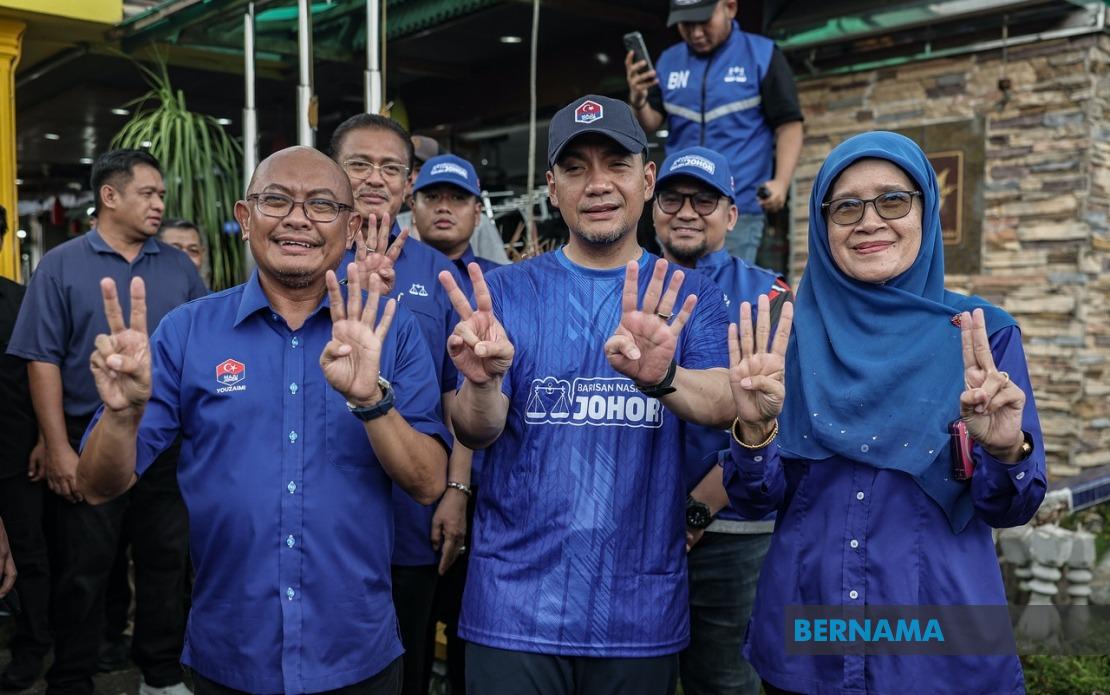
The Barisan Nasional's framework for distributing electoral seats hinges fundamentally on a commitment to sacrifice and unwavering loyalty from each constituent party, according to Johor Menteri Besar Datuk Onn Hafiz Ghazi. Speaking at a machinery meeting in Mersing on June 29, he articulated how this delicate balance has enabled the long-standing coalition to navigate Malaysia's multi-ethnic political landscape while preserving unity across UMNO, MCA, and MIC.
At the heart of Onn Hafiz's message was a particular example that underscores the disciplined approach BN demands of its members. For four decades, UMNO had pursued the Tenggaroh state seat without success, yet the party's grassroots remained steadfast in their commitment to the broader coalition agenda rather than fracturing over perceived slights. This decades-long restraint, he argued, exemplifies the maturity and institutional discipline that distinguishes BN from rival political groupings. The contrast is deliberately pointed: a lesser coalition structure might have splintered under such sustained electoral frustration, but BN's component parties have absorbed such disappointments as the necessary price of maintaining a unified front.
The mathematics of Tenggaroh's electoral composition reveal why such power-sharing arrangements remain contentious yet strategically important. The constituency contains approximately 39,000 registered voters, of whom only about 500 identify as Indian. Yet BN continues to field a candidate from MIC, the Malaysian Indian Congress, in this seat despite the community's small numerical presence. This decision signals more than mere symbolism; it represents an explicit commitment to maintaining multiracial representation within BN's structure, even when demographic realities might suggest alternative calculations. For Onn Hafiz, preserving this principle matters as much as the electoral outcome itself.
The upcoming Johor state election scheduled for July 11 will test whether these power-sharing arrangements translate into enhanced electoral performance. Onn Hafiz set an ambitious benchmark for the Tenggaroh contest, targeting a winning majority of 3,000 votes compared to BN's previous margin of 1,356 votes. This escalation in expectations reflects broader strategic aims beyond a single seat: demonstrating to sceptical party members across the coalition that disciplined adherence to power-sharing principles yields tangible electoral rewards. If UMNO members see their decades of loyalty rewarded through larger victories, the incentive structure for maintaining coalition discipline strengthens considerably.
Tenggaroh presents a three-way battle that complicates BN's task. Beyond BN's UMNO candidate Mohd Youzaimi Yusof, the seat will feature Muhamad Amerul Muhamad from Perikatan Nasional's Bersatu faction and Md Yusof Dawam representing Pakatan Harapan through PKR. This multi-cornered configuration reflects the fragmentation that has characterised Malaysian state politics since 2018, where no single bloc commands overwhelming dominance. For BN, it presents both opportunity and risk: opposition votes split between rival coalitions could advantage the BN candidate, yet any slippage in its own voter mobilisation becomes immediately costly.
The broader context informing Johor's electoral dynamics centres on how Malaysia's ruling coalitions maintain cohesion in an increasingly complex political environment. Power-sharing arrangements create inherent tensions between component parties seeking to satisfy their respective voter bases and the coalition's collective interest in presenting a united front. Onn Hafiz's emphasis on sacrifice and loyalty represents an attempt to reframe these inevitable compromises as virtuous necessities rather than unsatisfactory concessions. When UMNO relinquishes a seat to MIC, the narrative becomes one of demonstrating confidence in coalition partners rather than accepting defeat.
For Malaysian observers, particularly those in states with diverse ethnic compositions, the Tenggaroh example illustrates enduring questions about how competitive democracies accommodate multiple communities within coalition frameworks. The 500 Indian voters in a 39,000-person constituency represent a minority whose specific interests might be addressed through dedicated representation rather than generic appeals from a major-party candidate. Yet BN's approach assumes that coalition stability and shared governance principles outweigh the potential disadvantages of smaller communities fielding less numerically competitive candidates. This calculation has sustained the coalition for decades, though newer political formations have challenged its underlying assumptions.
Onn Hafiz's insistence that previous electoral failures did not trigger defections from coalition discipline speaks to institutional culture within UMNO that contrasts sharply with recent exits from the party by high-profile figures. The machinery meeting at Taman Lautan Biru served partly to reinforce this culture of collective commitment ahead of early voting on July 7 and election day proper on July 11. BN candidates Mohd Youzaimi Yusof and Alwiyah Talib, representing Tenggaroh and Endau respectively, require mobilised party structures functioning without internal recrimination or resentment.
The emphasis on increasing winning majorities rather than merely securing victories reflects sophisticated understanding of how electoral mandates translate into political capital. A narrow majority in a single seat contributes one representative to the state assembly; a commanding majority provides moral authority for policy implementation and symbolic proof that the coalition's approach resonates with voters. For a leadership seeking to validate power-sharing principles against growing competition from Perikatan Nasional, which has pursued different coalition models, demonstrating voter preference for the BN approach becomes strategically essential.
Looking forward, the Johor state election will indicate whether the disciplined loyalty Onn Hafiz praised within UMNO's machinery extends to ordinary voters who face their own strategic calculations. The test is whether BN's argument—that sacrificing individual party interests to preserve coalition strength produces better long-term governance outcomes—persuades an electorate increasingly accustomed to evaluating coalitions on performance grounds. Should BN substantially improve its majorities in seats like Tenggaroh, Onn Hafiz's framework gains credibility; should results disappoint, questions about the sustainability of power-sharing arrangements will inevitably resurface.

