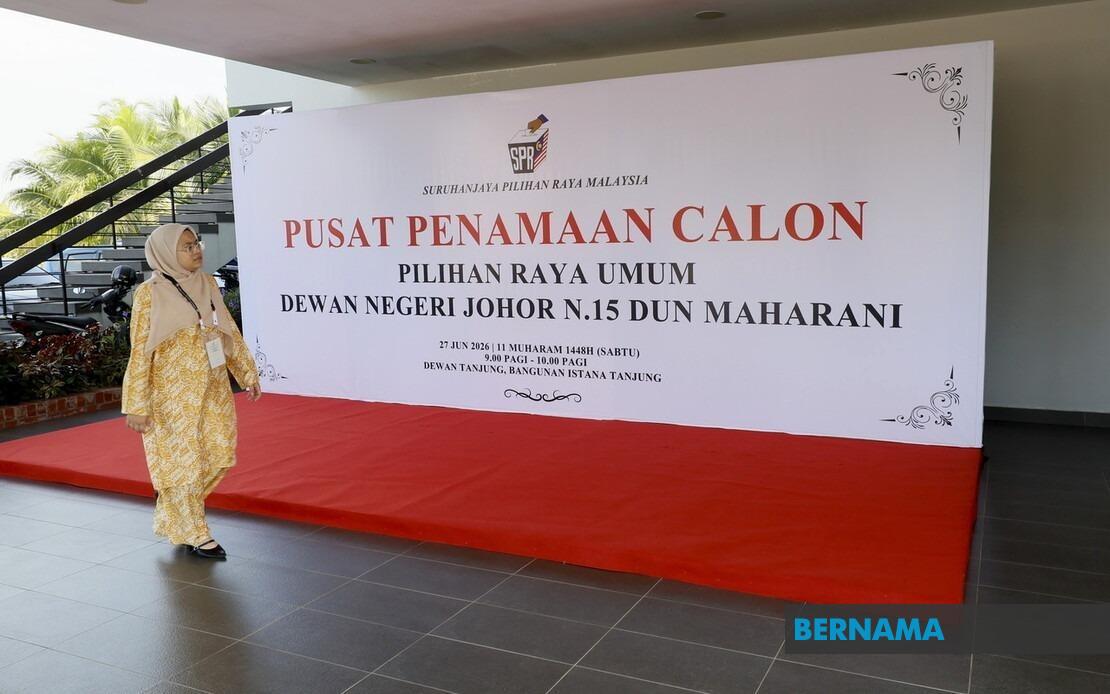
The 16th Johor State Election moved into its opening phase today as nomination centres across the state began accepting candidacy papers from prospective politicians seeking election to the State Legislative Assembly. The Election Commission (EC) activated 56 nomination centres simultaneously at 9 am, providing a one-hour window for candidates to lodge their nomination documents with Returning Officers before the 10 am deadline. This formal kick-off marks a critical juncture in Johor's political calendar, setting in motion a competitive electoral process that will reshape the composition of the state assembly in the coming weeks.
The election framework established by the EC creates a compressed yet intensive campaign schedule designed to balance the candidates' need for visibility against voter fatigue. The 14-day campaigning period runs from today until 11:59 pm on July 10, followed by early voting on July 7 and the main polling day on July 11. This timeline represents the standard election cycle following the dissolution of the State Legislative Assembly on June 1, which was formally announced by the state authority. The compressed schedule reflects both the EC's operational preferences and the political momentum that ruling coalitions typically seek to maintain during electoral contests.
As of yesterday, the EC reported that 593 nomination forms had been distributed to interested parties, with 133 prospective candidates having already confirmed their candidacy by submitting the mandatory election deposits. These figures suggest a moderately contested election, though the final tally of candidates will only emerge after the 10 am nomination deadline closes and the EC makes its official announcement of eligible contestants. The deposit requirement serves as a preliminary filter, ensuring that only genuinely committed candidates proceed to the campaign phase, thereby reducing frivolous candidacies that might clutter the ballot.
The electorate participating in this election comprises 2,727,926 registered voters, a substantial constituency reflecting Johor's population and economic significance within Malaysia. This total breaks down into 2,703,175 ordinary voters, 12,041 military personnel and their spouses, and 12,710 police personnel and their spouses. The inclusion of security force voters demonstrates Malaysia's practice of allowing uniformed personnel democratic participation, though subject to specific regulations governing their political activities. For Malaysian observers, this voter pool underscores Johor's importance as a political battleground, given that Johor's electoral dynamics have historically influenced federal political outcomes.
The ruling Barisan Nasional (BN) enters this election as the incumbent force, having controlled 40 of the 56 state seats prior to dissolution. BN fields candidates across all constituencies through three component parties: the United Malays National Organization (UMNO) contesting 36 seats, the Malaysian Chinese Association (MCA) with 16 candidates, and the Malaysian Indian Congress (MIC) fielding four candidates. This distribution reflects BN's traditional ethnic-based party structure, where component parties contest constituencies where their respective communities constitute significant voter populations. UMNO's dominance within BN's Johor contingent reflects both Malay majority demographics and the party's organizational strength in the state.
Pakatan Harapan (PH), the primary opposition coalition, contests all 56 seats through three constituent parties. The PKR fields 20 candidates, Amanah contributes 19, and the Democratic Action Party (DAP) presents 17 candidates. This near-uniform geographic spread demonstrates PH's strategic intent to challenge BN across all demographics and constituencies, signalling ambitions to recapture the state. The coalition's expansion beyond its traditional urban and non-Malay strongholds represents a deliberate attempt to compete in constituencies where BN has historically enjoyed advantages. This broadened approach reflects PH's experience in federal politics and its attempt to replicate those successes at state level.
Perikatan Nasional (PN), the third major coalition, adopts a more selective strategy by contesting 37 of the 56 seats. The Pan-Malaysian Islamic Party (PAS) fields 11 candidates, primarily in constituencies with strong Islamic voter populations, while the Malaysian United Indigenous Party (Bersatu) contests 16 seats. Additionally, PN fields the Malaysian Indian People's Party (MIPP) in five seats and Parti Pejuang Tanah Air (Pejuang) in one seat. PN's approach reflects the coalition's emerging position as a significant but geographically concentrated force within Johor's political landscape, particularly strong in constituencies with substantial Malay-Muslim electorates where PAS and Bersatu maintain organizational capabilities.
Several smaller parties seek parliamentary representation in this election, diversifying the competitive landscape. The newly-registered Parti Bersama Malaysia (Bersama) makes its electoral debut by contesting 15 seats, representing an attempt by a new political force to establish itself in Johor politics. The Malay-Muslim oriented MUDA fields candidates in four seats, primarily targeting younger voters dissatisfied with established parties. The Parti Sosialis Malaysia (PSM) contests a single seat, maintaining its minimal but persistent presence in Malaysian electoral contests. This proliferation of smaller parties reflects broader trends within Malaysian politics where voter fragmentation and rising discontent with traditional coalitions create space for new political entrants.
Nomination day traditionally generates significant public interest and political theatre as party supporters gather at nomination centres to demonstrate backing for their candidates. The scenes today around the 56 centres across Johor are expected to include party rallies, banner displays, and enthusiastic supporter turnouts that characterize Malaysian electoral rituals. These gatherings serve multiple functions: they energize the party base, generate media attention, test organizational capacity, and send signals to party leadership about grassroots enthusiasm for particular candidates. For voters observing these gatherings, they provide informal assessments of candidate popularity and party organizational strength.
The Election Commission has issued explicit reminders to all candidates and supporters regarding compliance with the Election Offences Act 1954 and relevant local authority by-laws. Particular emphasis has been placed on restrictions governing the use of musical instruments and vehicle-mounted loudspeakers during campaign activities. These regulations aim to maintain public order and prevent noise pollution while campaigns intensify. Violations of these provisions can result in penalties for candidates and their campaign teams, creating incentives for compliance. Malaysian voters have witnessed in past elections how campaign rule violations occasionally generate controversy and legal consequences for candidates and party officials.
Weather conditions present a practical consideration for today's nomination activities. The Malaysian Meteorological Department forecasts rain across several Johor locations during the morning hours, with thunderstorms anticipated in afternoon periods. While rainfall typically does not deter determined candidates and supporters from attending nomination centres, it may affect the scale of gathering and campaign demonstrations. Afternoon thunderstorms could disrupt transportation and limit outdoor activities, potentially affecting the energy surrounding nomination day proceedings. Nonetheless, such weather variations remain manageable challenges within the broader electoral timeline.
Police deployment of 4,832 personnel throughout Johor underscores the security and traffic management requirements accompanying the nomination process. The force has established road closures and diversions involving 19 major roads near nomination centres statewide, ensuring that vehicular congestion does not impede candidate and supporter movement. This substantial police presence demonstrates the security resources that Malaysian election operations demand, particularly in a state as large and populous as Johor. The traffic management reflects experience from previous elections and coordination between police, local authorities, and the EC to facilitate smooth nomination proceedings.
The composition of the outgoing assembly provides historical context for assessing today's election significance. Before dissolution, BN's 40-seat majority provided stable governance, while PH held 12 seats, PN controlled three seats, and MUDA held one seat. The shift from this distribution will indicate whether voters desire continuity of BN-led governance or preference for opposition coalition leadership. Johor's electoral verdict carries implications beyond the state itself, as the state assembly's composition influences federal political dynamics and intra-party factional struggles within BN and PH. For Malaysian political observers, today's nomination commencement marks the beginning of a contest that will reshape not only Johor's political landscape but potentially influence broader national political trajectories.

