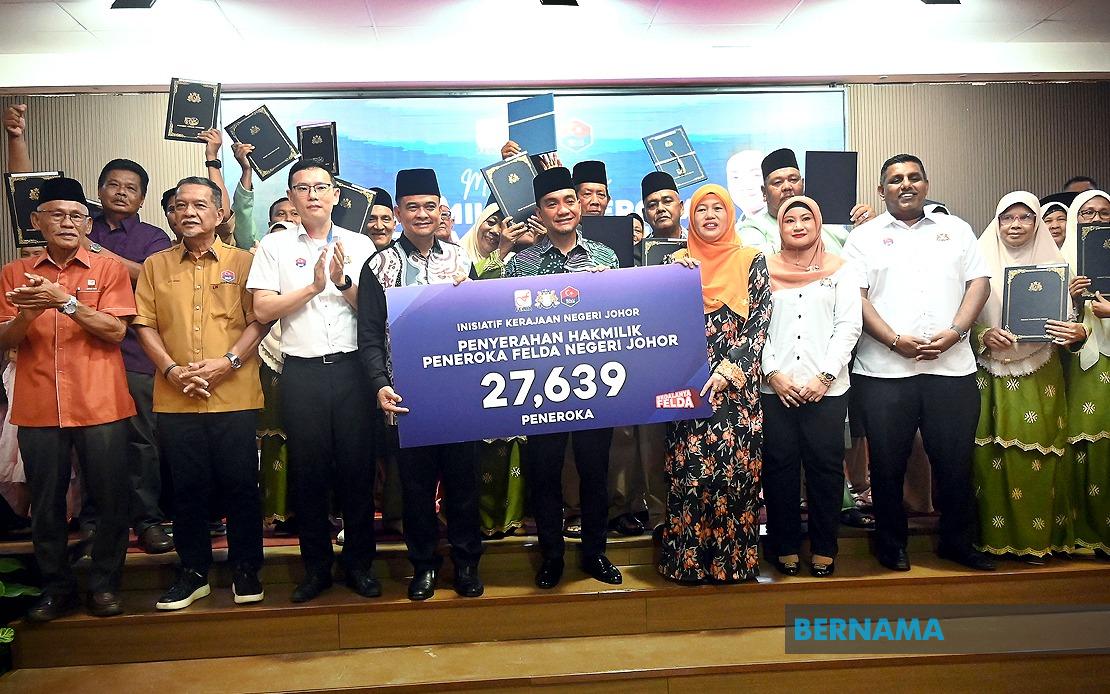
Johor has virtually eliminated a decades-long backlog of unresolved land ownership disputes that have plagued Federal Land Development Authority (FELDA) settlers across the state. At a land title presentation ceremony in Kluang on June 23, Menteri Besar Datuk Onn Hafiz Ghazi announced that 27,639 out of 27,642 applications have been processed and settled, bringing the resolution rate to 99.99 per cent. The achievement represents the culmination of sustained administrative effort to clear title barriers that have constrained property rights and economic mobility within FELDA communities for decades.
The three-application shortfall underscores the granular nature of the remaining work, suggesting that outstanding cases likely involve complex or disputed circumstances rather than systematic delays. The presentation of titles to 210 settlers from Kluang, Kota Tinggi and Mersing on the same day demonstrated the government's commitment to translating policy achievement into tangible outcomes for affected residents. These recipients now hold formal documentation for both plantation holdings and residential plots, addressing a critical gap in tenure security that has historically limited settlers' capacity to use land as collateral for credit or make informed investment decisions.
The FELDA land title problem emerged from the authority's founding in 1956 as a vehicle for agricultural development and poverty alleviation. While the scheme succeeded in settling hundreds of thousands of Malaysians on cultivable land, administrative processes for formalizing ownership often lagged behind settlement. Over subsequent decades, incomplete documentation created a parallel economy of uncertain tenure, where settlers occupied and worked land without formal legal recognition. This situation generated cascading problems: inability to sell or lease land freely, difficulty accessing government credit programs, family disputes over succession, and vulnerability to administrative reclaim. The backlog became emblematic of institutional inefficiency, particularly as earlier settlers aged and sought to transfer property to heirs.
Johor's approach to resolving this issue reflects a broader policy recognition across Malaysian state governments that FELDA settlers represent a politically significant and economically important constituency requiring sustained attention. The Johor government framed its initiative explicitly as part of the state's rural development agenda, signalling that land title security is not merely a technical administrative matter but a cornerstone of rural prosperity. By positioning FELDA welfare as a government priority, Onn Hafiz acknowledged both the historical neglect of these communities and the competitive political value of delivering tangible improvements in their lived circumstances.
The involvement of Johor Agriculture, Agro-based Industry and Rural Development Committee chairman Datuk Zahari Sarip at the ceremony underscores institutional coordination required to manage the resolution process. FELDA settlements involve multiple government touchpoints—the authority itself, state land offices, agricultural departments, and local councils—and clearing title backlogs demands synchronized action across these bodies. The fact that resolution reached 99.99 per cent suggests that Johor successfully navigated these coordination challenges, though the three remaining cases hint at persistent pockets of complexity where inter-agency alignment may still be incomplete.
For Malaysian readers, particularly those familiar with rural land issues, this resolution matters beyond Johor's boundaries. FELDA operates in multiple states, and land title uncertainty persists in other jurisdictions as well. Johor's demonstrated capacity to systematically clear a massive backlog provides a model and creates pressure on other state governments to pursue similar initiatives. The achievement also carries implications for the broader federal FELDA administration, suggesting that state-level intervention can effectively address problems that the authority itself may have struggled to resolve independently. This dynamic reflects the reality that in Malaysia's federal structure, state governments often possess practical authority over land matters that supersedes federal agency mandates.
The economic significance of this resolution extends beyond individual settler welfare. Formalized land titles increase the asset base available for rural credit markets, potentially enabling farmers to access financing for mechanization, diversification, or consolidation. Titled land can be securitized, attracting institutional investment into FELDA schemes. More fundamentally, property rights certainty underpins productive investment decisions—settlers who fear title insecurity may defer improvements or upgrades, whereas secure tenure encourages longer-term agricultural planning and asset enhancement. The 27,639 resolved cases therefore represent not merely administrative closure but potential activation of dormant economic capacity within rural communities.
The timing of this announcement also carries political resonance. Land rights and rural development have become increasingly salient across Southeast Asia as agricultural sectors face pressures from climate change, commodity market volatility, and demographic shifts toward urbanization. Johor's move to address historical injustices in settler communities demonstrates political responsiveness to constituencies that can feel neglected as national attention focuses on urban centers and high-growth sectors. This framing resonates particularly in Malaysia, where FELDA settlers have long constituted a politically organized group capable of swing voting in electoral contests.
The remaining 0.01 per cent of unresolved applications—the three outstanding cases—warrant closer scrutiny. Such outliers often involve scenarios where title cannot be issued without resolving underlying disputes: dual claims to the same land, settler abandonment and encroachment by third parties, or documentation so deficient that reconstruction proves impossible. The Johor government's decision to pursue resolution to this level rather than closing the initiative with slightly lower figures suggests administrative rigour, though it also indicates that truly complete closure may remain elusive. The government's commitment to continued attention suggests mechanisms exist for addressing these holdouts through judicial or administrative channels.
Looking forward, the challenge shifts from clearing historical backlogs to preventing new accumulation of unresolved title applications. This requires strengthening processes for contemporaneous title registration when new settlers join FELDA schemes or when land transfers occur within settlements. Johor's announcement implicitly signals that the state government will maintain the institutional apparatus and budgetary commitment required to sustain this improved performance. The mention of continued government attention to whatever issues arise in FELDA settlements indicates recognition that land tenure remains a live political issue requiring sustained engagement rather than one-off resolution campaigns.
The broader implication for Malaysia's rural development trajectory is that property rights formalization remains foundational to rural prosperity and political stability. The FELDA case demonstrates both the cost of historical administrative neglect—decades of unresolved applications affecting hundreds of thousands of people—and the feasibility of systematic remediation when political will aligns with administrative capacity. As Malaysia confronts the challenge of sustaining agricultural competitiveness and rural incomes amid economic transformation, ensuring secure and accessible land tenure must remain central to rural policy architecture.

