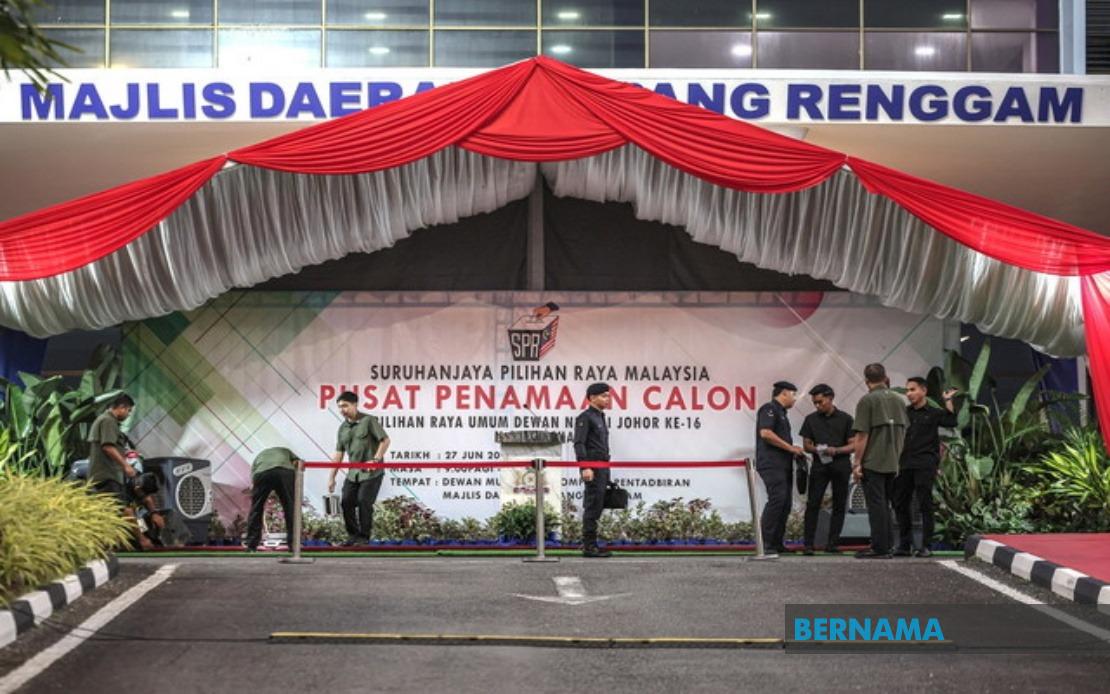
The 16th Johor State Election kicked off today with all 56 nomination centres across the state opening their doors at 9am, marking the formal commencement of what promises to be a closely watched electoral contest. Candidates vying for the 56 state assembly seats had exactly one hour—until 10am—to file their nomination papers with the returning officer at their designated centres, a compressed timeline designed to maintain momentum in the election schedule set by the Election Commission.
The nomination process itself followed established protocols, allowing flexibility in submission procedures. Candidates could hand over their nomination papers personally, accompanied by their proposer and seconder, or alternatively send representatives to complete the filing. This streamlined approach accommodated varying circumstances while maintaining the formal requirements necessary to validate candidatures. Once the verification process concludes, officials will release the final list of eligible contenders, confirming who has met all regulatory requirements to contest the election.
The visible energy surrounding nomination day reflected the significance of this electoral moment for Malaysia's southern state. Party supporters and campaign operatives began converging on nomination centres as early as 6.30am, well before the official opening, creating scenes of political mobilization across Johor Bahru and district towns. The early arrivals underscored the competitive nature of the contest and the determination of various political factions to demonstrate grassroots support as their chosen candidates embarked on the formal campaign trail.
Weather conditions posed a variable challenge to the day's proceedings. The Malaysian Meteorological Department had forecast scattered rainfall across several districts including Johor Bahru, Muar, Batu Pahat, Kota Tinggi, Pontian, Tangkak, and Kulai during the morning hours, while Segamat, Kluang, and Mersing were expected to experience clearer skies. Afternoon thunderstorms were anticipated across most of the state, particularly affecting Johor Bahru, Segamat, Kluang, and Kota Tinggi, potentially complicating campaign activities in the days ahead. Despite meteorological headwinds, the nomination process proceeded as scheduled without reported disruptions.
Security arrangements underscored the Election Commission's determination to maintain order throughout the election cycle. Police personnel, working alongside volunteers from the People's Volunteer Corps (RELA), deployed focused resources around nomination centres to ensure smooth operations and prevent any incidents that might compromise the electoral process. Traffic control measures were implemented to manage the flow of vehicles and supporters, reflecting the concentrated activity that nomination day generates in constituency areas across the state.
The electoral landscape itself is substantial in scope. The Election Commission's voter statistics reveal that 2,727,926 individuals are eligible to participate in this election. This figure encompasses 2,703,175 ordinary civilian voters, supplemented by 12,041 military personnel and their spouses, and 12,710 police personnel and their spouses. This composition of the electorate reflects Malaysia's inclusion of uniformed service members in the electoral process, a practice that distinguishes the nation's democratic framework from some comparable regional democracies.
The campaign period itself will extend for 14 days following the completion of nomination verification, running until 11.59pm on July 10. This fortnight will determine the visible intensity of electoral competition, with candidates and parties deploying resources, organizing rallies, and engaging voters across their respective constituencies. For campaign strategists, the two-week window represents both an opportunity and a constraint—sufficient time to build momentum and reach voters, yet compressed enough to maintain focus and resource efficiency.
The Election Commission has scheduled early voting for July 7, accommodating voters unable to participate on the main polling day. This provision acknowledges the practical realities of working individuals and those with legitimate reasons for being absent from their constituencies. The primary polling day itself is set for July 11, when the 2.7 million eligible voters will formally cast their ballots to determine which political parties and individual candidates will represent them in the state assembly for the next electoral cycle.
For Malaysian observers and regional analysts, the Johor election carries implications extending beyond the state's boundaries. As the nation's second-largest state by population and a consistent political bellwether, outcomes here often signal broader trends in federal politics. The result will provide insight into voter sentiment regarding governance performance, economic conditions, and the strategic positioning of major political coalitions. Party strategists from across the peninsula will scrutinize Johor's electoral dynamics closely, extracting lessons applicable to their own constituencies and national political calculations in the run-up to eventual federal elections.

