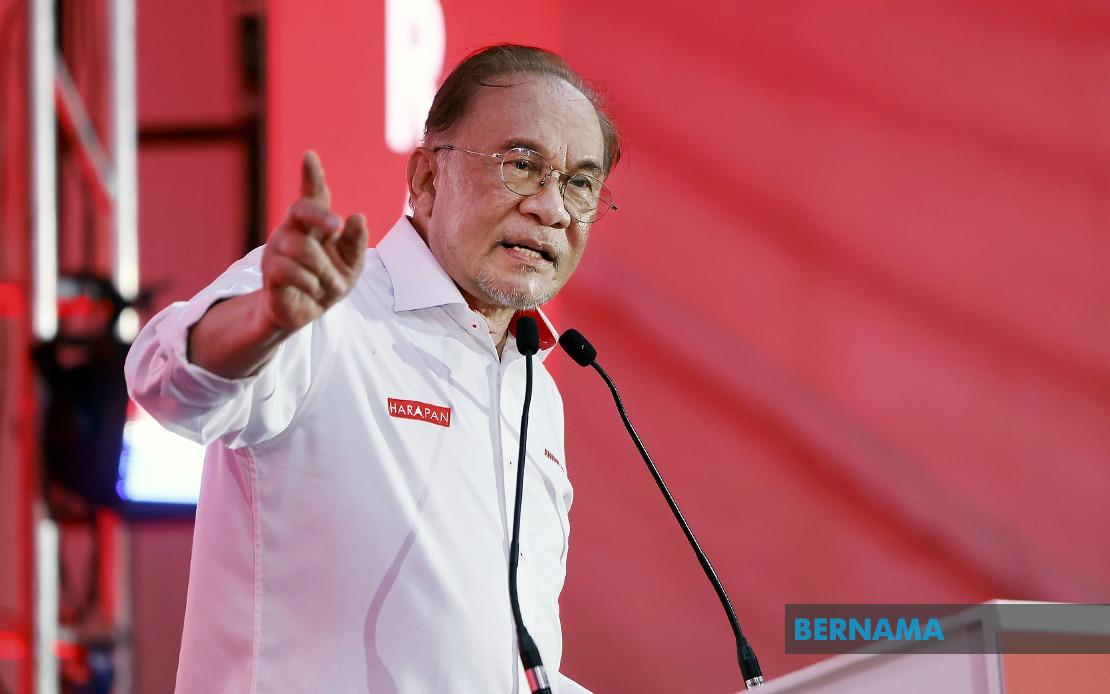
Prime Minister Datuk Seri Anwar Ibrahim unveiled fresh fiscal figures demonstrating that Johor has received substantially more in federal transfers than it has contributed in tax revenue over the past three years, a claim he presented while announcing Pakatan Harapan candidates for the upcoming Johor State Election in Tangkak on June 22. According to records held by the Finance Ministry, the resource-rich state generated approximately RM14 billion in federal revenue during the 2023-2025 period, yet the national government channelled RM16 billion back into Johor through a combination of development initiatives, recurrent operating allocations, and targeted social programmes. Anwar, who simultaneously holds the Finance Ministry portfolio, emphasised the importance of publicly clarifying this fiscal relationship to demonstrate the current administration's commitment to Johor's continued prosperity and development trajectory.
The Prime Minister's disclosure forms part of a broader narrative the MADANI Government seeks to establish ahead of state-level electoral contests: that it has fundamentally reoriented federal fiscal policy toward more equitable resource distribution. This messaging carries particular weight in Johor, where the Federal government's financial commitment directly influences public perceptions of developmental priorities and political responsiveness. By quantifying the RM2 billion net transfer to the state over three years, Anwar positioned the administration as a steward of taxpayer money that invests substantially beyond what any single state contributes, underpinning a federalist philosophy that wealthier and more economically productive states should subsidise broader development.
Examining historical trends reveals a significant reorientation in operating expenditure allocations to Johor. Under the previous government, the state received between RM6 billion and RM7 billion annually for administrative and operational purposes. The current administration has lifted this to RM8.7 billion annually, representing a real increase of approximately 24 to 45 percent depending on the baseline year. This expansion occurred within a period of significant fiscal constraints and competing demands from other states and federal programmes, making the elevation particularly noteworthy for demonstrating prioritisation of Johor within broader budgetary constraints.
Development expenditure allocations, which fund capital projects and infrastructure initiatives, have expanded even more dramatically. From RM2.3 billion in 2022, the allocation surged to RM4.8 billion by 2026, roughly doubling within a four-year window. This trajectory suggests accelerated investment in Johor's physical infrastructure, ranging from transportation networks and utilities to social amenities and economic zones. For Malaysian readers tracking regional development patterns, such allocations typically translate into tangible projects including road upgrading, port facilities, industrial areas, and public service infrastructure that shape economic competitiveness and livelihood opportunities.
According to projections Anwar presented for 2026, Johor ranks as the third-largest overall recipient of combined operating and development expenditure allocations, trailing only Sabah and Sarawak. This positioning reflects constitutional arrangements that assign substantially higher allocations to East Malaysian states, alongside demographic factors and geographic development needs. Within Peninsular Malaysia's context, however, Johor's rank as a major beneficiary demonstrates its significance within federal fiscal planning. The state's economic output and population size—approximately 4.2 million people according to recent census data—justify considerable federal investment even as East Malaysian states receive proportionally heavier support.
Beyond conventional development allocations, Johor has featured prominently in the MADANI Government's social assistance programmes. The state ranked second nationally in recipients of both Sumbangan Tunai Rahmah (STR), which provides direct cash transfers to lower-income households, and Sumbangan Asas Rahmah (SARA), which offers basic necessities assistance. Only Selangor surpassed Johor in these metrics, reflecting both states' substantial urban and semi-urban populations where such targeted welfare reaches larger beneficiary pools. For Johor residents, this positioning meant preferential access to cash transfer schemes designed to cushion economic pressures from inflation and cost-of-living escalation.
The fiscal narrative Anwar articulated carries implications for inter-state equity and federal-state relations in Malaysia's complex fiscal federalism architecture. Malaysia's constitutional structure grants states certain revenue sources—primarily land-based taxes and licensing fees—while the Federal government controls lucrative income taxes and customs duties. This structural asymmetry necessitates federal transfers to equitable service delivery across states. Anwar's emphasis on Johor receiving more than it contributes implicitly justifies this redistribution mechanism as essential for equitable development, though it simultaneously raises questions about whether wealthier states like Selangor, Kuala Lumpur, and Penang contribute disproportionately to support less developed regions.
The timing of these revelations, announced during opposition-held Johor's election campaign, suggests strategic political calculation. The ruling coalition likely anticipated Johor voters responding positively to evidence of substantial federal investment, particularly if opposition parties had questioned the government's commitment to the state's development. By quantifying federal generosity with precise figures and year-on-year comparisons, Anwar positioned the MADANI Government as a competent steward of public finances that prioritises Johor despite broader fiscal constraints. The presentation format—concrete numbers rather than rhetorical claims—appeals to rational economic discourse and invites public verification through official Finance Ministry data.
For Southeast Asian observers monitoring Malaysian political dynamics, Anwar's fiscal disclosure exemplifies how federal governments increasingly deploy budgetary transparency as an electoral tool. Rather than allowing opposition parties to claim disproportionate state neglect, the current administration preemptively marshalled financial data demonstrating tangible commitment. This approach reflects international governance trends toward evidence-based political messaging, though sceptics might note that selective presentation of favourable fiscal relationships requires context about overall budget allocation frameworks, real per-capita differences, and comparative investment in opposition-held versus government-friendly states.
Looking forward, these fiscal commitments create expectations among Johor constituencies for continued substantial federal investment. Should the state's allocation receive reduced priority following elections, either due to changed political circumstances or broader fiscal constraints, public perception of federal commitment could deteriorate significantly. Conversely, sustained or expanded allocations would vindicate the government's current messaging and potentially strengthen ruling coalition performance in future contests. The RM8.7 billion annual operating allocation and projected RM4.8 billion development expenditure essentially establish baseline expectations that future governments would struggle to reduce without triggering public backlash.
The regional dimension also merits consideration for readers assessing Malaysia's broader development strategy. Johor's position as a major federal investment recipient reflects both its economic importance as a manufacturing and trade hub and its strategic location proximate to Singapore. Federal infrastructure investments in Johor—particularly those enhancing cross-border connectivity and economic integration—generate benefits extending beyond state boundaries to influence national economic performance and regional competitiveness within Southeast Asia. Enhanced Johor infrastructure supports Malaysia's broader ambitions in regional trade, foreign direct investment attraction, and high-value manufacturing clusters competing against Thailand, Vietnam, and Indonesia.

