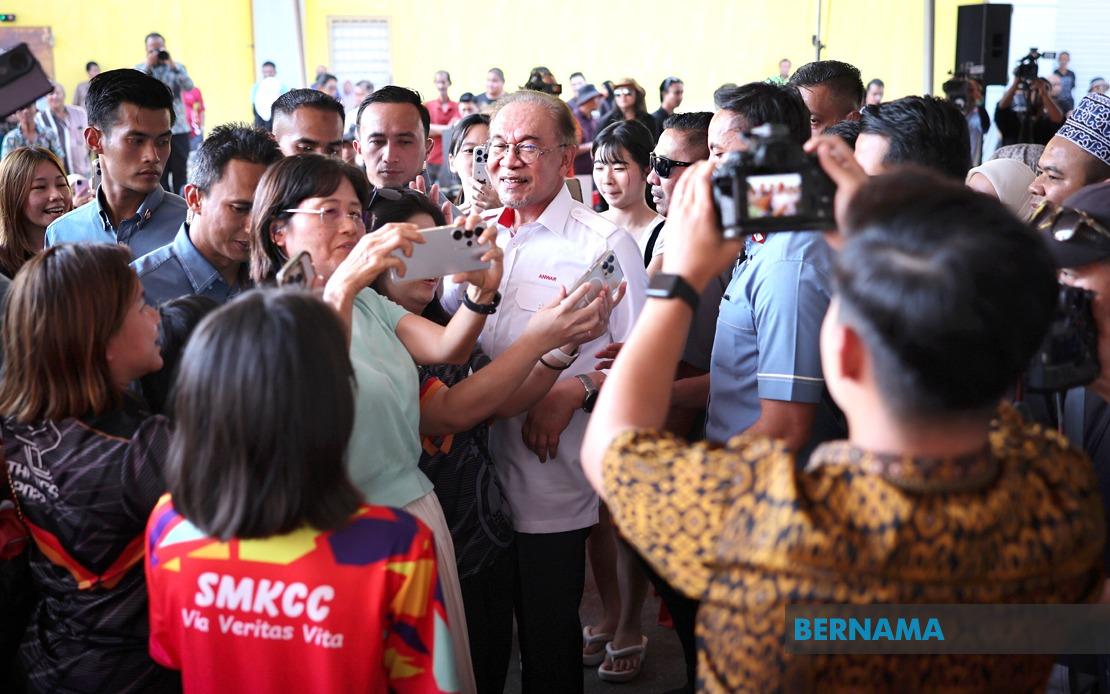
The Johor state election campaign has shifted into overdrive as political parties across the spectrum launched aggressive final-day appeals to voters, with all major coalitions and independent movements orchestrating simultaneous shows of strength in their respective constituencies. With polling day arriving on July 11, the official campaigning period ended at 11:59 pm on July 10, leaving candidates and party machinery scrambling to convert undecided voters in what promises to be a closely contested race for control of Malaysia's southern stronghold.
Pakatan Harapan, the ruling coalition led by Prime Minister Datuk Seri Anwar Ibrahim, deployed its heaviest firepower across five strategic locations to energize its base before the final bell. Anwar's multi-location campaign blitz commenced in the Bukit Gambir state legislative constituency, proceeded through Bukit Batu and Layang-Layang, and culminated in a major rally branded the 'Johor Ke Depan, Undi Harapan Grand Finale Programme' in Pasir Gudang. The staging of such high-profile closing events underscores the coalition's determination to retain influence in a state where political dynamics have shifted dramatically over recent years, with the Prime Minister's personal involvement signalling the national significance party strategists attach to the Johor outcome.
Within the PH machinery, individual candidates pursued complementary ground-level strategies tailored to their constituencies. Suhaizan Kaiat, contesting the Larkin seat, adopted a grassroots engagement approach by conducting walkabouts at shopping malls in Johor Bahru, accompanied by Parti Amanah Negara Vice President Datuk Seri Dr Dzulkefly Ahmad. This contrasting style—intimate voter interaction rather than stadium-style rallies—reflects the coalition's attempt to build support across different demographic segments. Suhaizan emphasized that the feedback and voter concerns accumulated during the two-week campaign period represented both a mandate and a responsibility he would discharge if elected, framing his candidacy around responsiveness to constituent grievances.
Barisan Nasional, the traditional governing force in Johor, adopted a notably different closing strategy centered on spiritual and moral appeals. Coalition Chairman Datuk Seri Dr Ahmad Zahid Hamidi, who serves as Deputy Prime Minister, opted to conclude BN's campaign through participation in the 'BN Grand Supplication & Doa Selamat' event in Kulai district, signalling a shift toward faith-based messaging during the final stretch. This approach contrasts sharply with traditional BN campaign tactics and suggests recognition that in closely contested elections, appeals to shared spiritual values may prove more persuasive than purely policy-based arguments among segments of the electorate.
Incumbent Johor Menteri Besar Datuk Onn Hafiz Ghazi, the BN candidate for Machap, adopted an unusually contrite closing message. Through a Facebook video, the state leader publicly apologized to Johor voters for perceived shortcomings in his administration, a posture suggesting acknowledgment that public satisfaction with BN's governance record requires explicit address rather than implicit assumption of voter loyalty. Such contrition from an incumbent—rare in Malaysian politics—reflects the competitive pressure the coalition faces and the need to assuage voter concerns about administrative performance and accountability.
Perhaps Bersatu, the influential Malay-Muslim party playing the kingmaker role in Malaysian politics, leveraged its campaign conclusion to appeal directly to voter discernment. Party President Tan Sri Muhyiddin Yassin encouraged Johoreans to synthesize information accumulated during the campaign and make reasoned electoral choices, framing voting as a deliberative process rather than an emotional or communal act. His messaging acknowledged that the two-week campaign period provided voters with substantive data about competing parties' platforms and track records, shifting rhetorical emphasis toward rational evaluation rather than personality-driven politics.
The Bersama party, led by prominent figures Datuk Seri Rafizi Ramli and Nik Nazmi Nik Ahmad, orchestrated their closing through a 'Ceramah Finale BERSAMA' event designed to synthesize and counter opposing campaign narratives. Rafizi's promised final address was framed as a comprehensive summation of issues raised throughout the campaign period, suggesting an intent to provide voters with a synthesizing framework for understanding the election's central stakes and ideological divisions.
MUDA, the younger party seeking to establish itself as a genuine political force, marked its campaign conclusion through the 'Puteri Wangsa Grand Finale Lecture,' with party President Amira Aisya Abd Aziz delivering messaging centered on voter empowerment. By emphasizing the absolute power voters possess to determine electoral outcomes, MUDA attempted to mobilize participation among younger and politically engaged citizens who may respond to framings emphasizing agency and democratic power rather than traditional party loyalty.
The organizational scale of the election itself—172 candidates contesting across 56 state seats—ensures multi-faceted competition across urban and rural constituencies with distinct demographic and socioeconomic profiles. This breadth of competition means that final campaign strategies necessarily vary across geographic and constituency-specific contexts, with national coalitions attempting to coordinate messaging while permitting candidates flexibility to address local concerns and preoccupations.
Weather forecasts from the Malaysian Meteorological Department predict clear morning conditions transitioning to afternoon rain or thunderstorms, potentially influencing voter turnout patterns and requiring parties to anticipate how climatic conditions might affect participation rates across different regions and times of day. Such logistical considerations often prove decisive in closely contested elections where mobilization efficiency directly correlates with electoral success.
The intensity of final campaign activities across all major political groupings—from ruling coalition to opposition, from established parties to newer entrants—demonstrates the genuine competitiveness of the Johor contest and the stakes involved for national political configurations. The result will signal not merely which party governs Malaysia's second-largest state but also broader patterns of voter satisfaction with the incumbent national government, effectiveness of opposition political organization, and the trajectory of newer political movements in the Malaysian electoral landscape.

