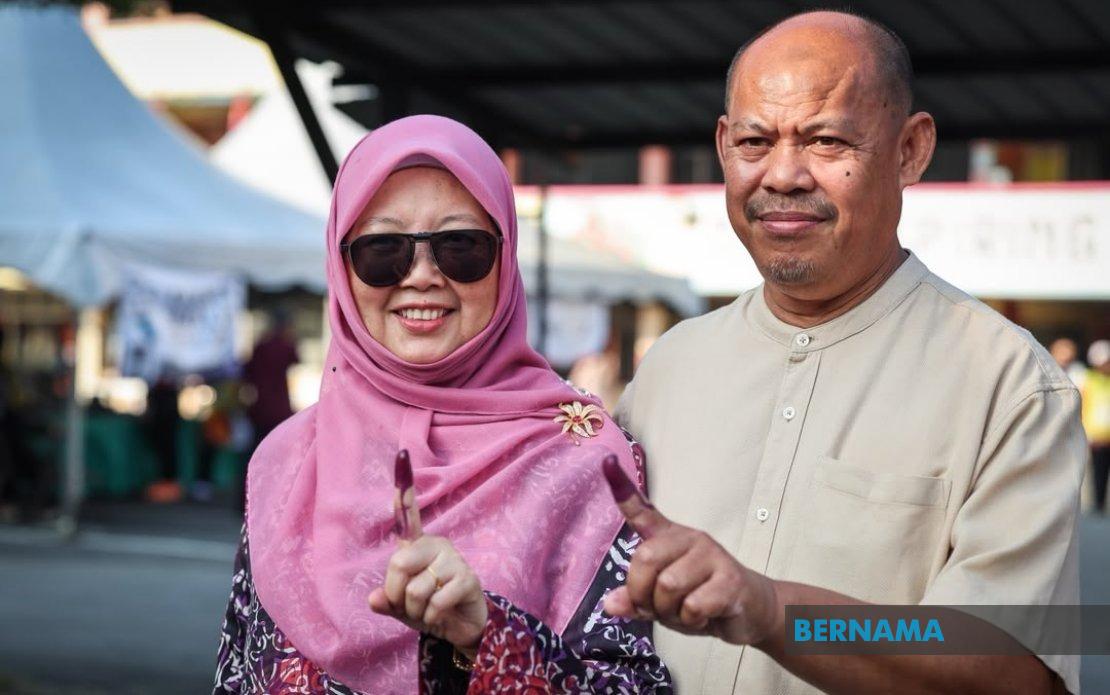
The 16th Johor state election saw prominent party figures demonstrating their commitment to the democratic process by heading to polling stations at dawn on July 11, setting a visible example for the electorate across the southern state. Leading the charge was Johor PKR chairman Datuk Seri Dr Zaliha Mustafa, who voted at Sekolah Menengah Kebangsaan Bandar Baru Uda in Johor Bahru just after 9 am, accompanied by her husband Dr Ahmad Adzlan Musa. The pair exercised their franchise in the Larkin constituency, where both were registered voters, underscoring the principle that civic duty applies equally regardless of political position or public profile.
Dr Zaliha, whose résumé includes a previous appointment as Minister in the Prime Minister's Department overseeing Federal Territories, used her presence at the polling station to address waiting media representatives and make a direct appeal to the broader Johor population. She emphasized the importance of early participation in the electoral process, framing voter turnout not merely as a right but as a collective responsibility that shapes the state's political trajectory. Her public message carried particular weight given her seniority within the PKR machinery in Johor, where the party holds significant grassroots organization.
The former federal minister drew attention to adverse weather conditions forecast to affect the state during the afternoon hours, specifically highlighting rainfall expected from midday onwards. This meteorological consideration proved tactically relevant, as heavy rain during peak voting hours could suppress turnout, particularly among elderly voters, those with mobility challenges, or workers unable to take extended breaks from employment. By encouraging citizens to arrive at polling stations early, Dr Zaliha implicitly acknowledged that logistical factors—weather, congestion, operational delays—can meaningfully influence who manages to cast ballots and who faces barriers to participation.
Similarly proactive was Johor DAP chairman Teo Nie Ching, who cast her ballot approximately half an hour later at Sekolah Jenis Kebangsaan Cina Kulai Besar in the Kulai constituency. The timing of her vote, around 9:30 am, reflected the broader pattern among opposition-aligned party leadership to establish visible presence in the electoral narrative from the election's opening moments. This choreographed early voting by senior figures serves multiple strategic purposes simultaneously: it demonstrates confidence in the democratic process, projects party unity and organizational discipline, and generates photographic and narrative content for media consumption and social media amplification among supporters.
The dual participation of PKR and DAP leaders illustrates how the 16th Johor election represented a significant moment for the political opposition in Malaysia's second-largest state by population. Both parties maintained substantial parliamentary representation and grassroots followings in Johor, making their performance in this state election consequential for their national political trajectories. Early voting by party hierarchies, particularly women in prominent leadership roles like Dr Zaliha and Teo, also carried symbolic significance regarding women's participation in Malaysian political structures and decision-making authority.
Johor holds particular electoral importance within Malaysia's broader political landscape. As a major state with substantial economic output, considerable urban and rural populations, and a history of competitive multi-party contests, the state election outcomes frequently signal shifting voter preferences that ripple through national political calculations. The 2023 Johor election represented the first comprehensive statewide poll following the 2022 general election, offering an early barometer of public sentiment regarding the then-current federal government's performance and policy direction.
The spectacle of senior party leaders voting early, whilst relatively routine in most democracies, carries particular resonance in Malaysia's political context. Public demonstrations of faith in electoral institutions by major political figures help reinforce civic confidence in the democratic process, particularly important given periodic discourse surrounding electoral transparency and fairness. When opposition leaders participate visibly and without apparent apprehension, it implicitly endorses the election's credibility and procedural integrity.
Weather considerations mentioned by Dr Zaliha reflected practical realities of tropical electoral administration. Johor's monsoon patterns mean that July elections frequently contend with afternoon rainfall, particularly during the southwest monsoon season. Such meteorological patterns have historically influenced voter behaviour in Malaysia, with some research suggesting weather-related suppression of turnout in rural and semi-rural constituencies where voters face longer travel distances to polling stations. Early voting campaigns thus represent rational efforts to maximize participation despite climatic obstacles.
The participation of women leaders in prominent electoral roles also reflects evolving gender dynamics within Malaysian political parties. Both Dr Zaliha's position as chairman of PKR Johor and Teo's equivalent role within DAP demonstrate substantial female representation in party organizational hierarchies, though such leadership positions remain underrepresented relative to party membership demographics. Their high-profile early voting served implicitly to normalize women's substantive political engagement and decision-making authority beyond symbolic or ceremonial roles.
From a Southeast Asian perspective, Malaysia's 16th Johor state election represented a crucial democratic exercise in a region where electoral integrity and transparency remain subjects of considerable international attention. The visible participation of opposition leaders in polling processes contributes to regional democratic health and demonstrates the capacity of Malaysian political institutions to manage competitive elections involving multiple significant political parties with substantively different policy platforms and ideological orientations.
The early voter rush by party leadership, whilst strategically motivated, also reflected practical campaign calculations. By appearing early and encouraging widespread public participation, parties sought to maximize their organizational advantage through higher overall turnout, based on assumptions that engaged voters aligned with their respective bases would participate more reliably when explicitly encouraged. Such tactical voting mobilization efforts have become standard features of modern Malaysian electoral campaigns across all major parties.

