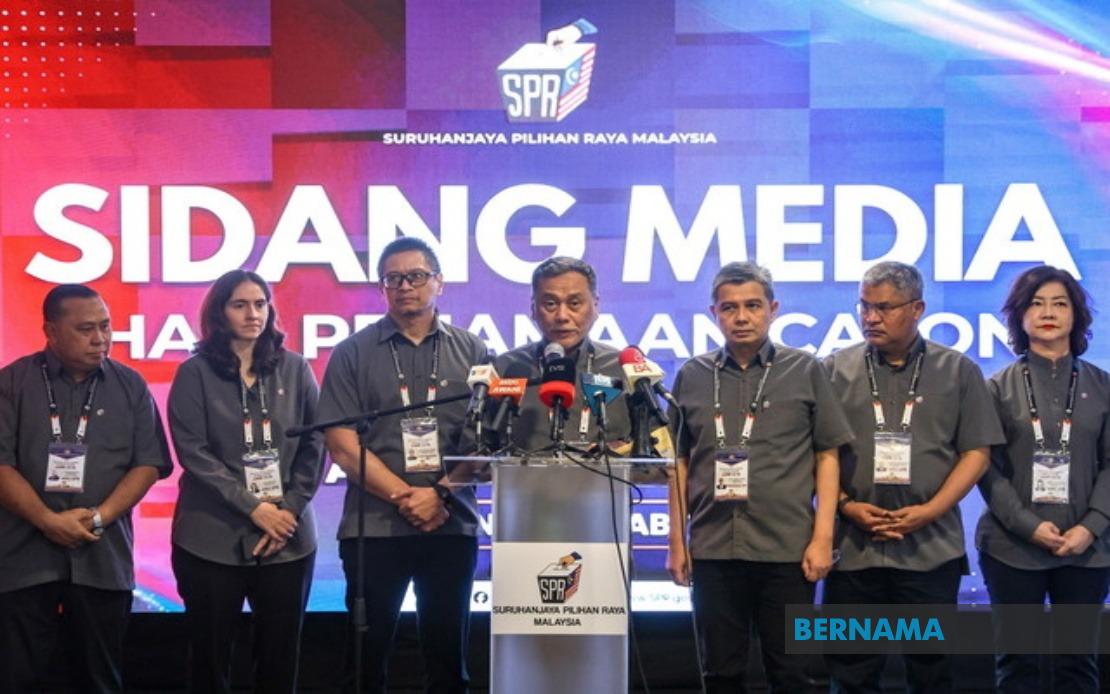
The Election Commission has officially confirmed that the 16th Johor state election will proceed with 172 candidates representing a diverse range of political interests, following the successful completion of the nomination process across all 56 nomination centres on June 27. EC chairman Datuk Seri Ramlan Harun announced that every nomination paper submitted was accepted without any disqualifications, signalling a smoothly administered registration phase ahead of what is expected to be a closely contested election in one of Malaysia's most politically significant states.
The candidate pool reflects Malaysia's evolving political landscape, with female representation reaching 34 candidates—approximately 20 per cent of the total field—while 138 male candidates rounded out the slate. This gender composition underscores ongoing discussions within Malaysian political circles regarding women's participation in elected office, though the proportion remains substantially below gender parity benchmarks increasingly advocated by civil society organisations and international observers.
The two major coalition blocs have demonstrated near-identical confidence in the contest by each nominating exactly 56 candidates to cover every seat. Barisan Nasional, the traditional governing coalition, fields the same number as Pakatan Harapan, the primary opposition alliance, suggesting both sides view the election as genuinely competitive. This parity in candidate numbers reflects the intense political competition that has characterised Johor politics since the state's political realignment in recent electoral cycles, when control shifted between competing coalitions.
Perikatan Nasional, the third-largest grouping, has nominated 33 candidates, representing a strategic decision to contest approximately 59 per cent of available seats. This approach by PN suggests selective fielding in constituencies where the coalition perceives realistic winning prospects, a common practice among smaller political formations seeking to maximise resource efficiency and avoid splitting opposition votes where doing so would disadvantage aligned parties.
Several smaller and emerging political entities have also secured representation on the ballot. Parti Bersama Malaysia enters the contest with 15 candidates, while MUDA, the youth-oriented reform party that gained prominence in recent federal elections, has fielded four candidates. Parti Orang Asli Malaysia and Parti Sosialis Malaysia each present single candidates, reflecting their limited organisational reach but indicating commitment to participation in Johor's democratic process. Additionally, six independent candidates are contesting, seeking to represent local interests outside formal party structures.
The distribution of contest types across Johor's 56 constituencies reveals a fragmented political environment. Fourteen seats are expected to feature straight fights between two candidates, the simplest electoral scenario, while 27 constituencies will see three-cornered contests involving three candidates each. The complexity intensifies in twelve seats where four candidates will compete, and three constituencies where voters will choose among five candidates. This fragmentation, particularly the prevalence of multi-candidate contests, could prove decisive in determining final outcomes, as victory margins in crowded races often prove slimmer than in direct two-way battles.
The nomination process completion represents a critical juncture in Johor's electoral cycle. The state, home to approximately 4 million people, occupies considerable strategic importance within Malaysia's political structure due to its size, economic significance, and historical role as a BN stronghold. Recent political shifts, however, have demonstrated that Johor is no longer predictable electoral territory, with both major coalitions viewing the state as winnable and therefore deserving substantial campaign resources and candidate quality.
For Malaysian observers and political analysts, the candidate lists offer insights into party strategies. The major coalitions' identical candidate numbers suggest neither side has conceded ground, while the presence of numerous smaller parties indicates continued fragmentation of Malaysia's political space. This pluralistic competition, while democratic in character, potentially complicates post-election coalition-building if no single grouping achieves a clear majority.
The Election Commission's smooth administration of the nomination process, with no disqualifications or procedural irregularities reported, contrasts with past elections elsewhere that have generated controversy over candidate validation. This efficient handling reflects institutional improvements in electoral management, though the actual conduct of campaigning and voting will ultimately determine whether the election meets international standards for transparency and fairness.
For Malaysian voters in Johor, the diverse candidate field presents substantive choice across ideological and policy positions. The presence of multiple coalitions and independent candidates means voters can select representatives aligned with varying visions for the state's economic development, local governance priorities, and federal-state relations. This competitive environment theoretically encourages candidates to articulate detailed policy positions and engage substantively with constituent concerns.
The election's timing within Malaysia's broader political calendar carries additional significance. Johor results will provide indicators of shifting voter sentiment ahead of potential future federal elections, making the contest consequential beyond the state's boundaries. Both BN and PH will scrutinise voting patterns to calibrate their national strategies, particularly regarding which policy messages resonate most effectively with Malaysian electorates in different regions.
As campaigning now commences, political parties will attempt to mobilise their 172 candidates to connect with Johor's voters. The breadth of choice available—from established coalitional blocs to smaller reform-oriented parties to independent candidates—reflects a Malaysian political system in transition, where traditional certainties have eroded and electoral outcomes have become genuinely competitive across multiple constituencies. The Johor election will test whether this competitive dynamism translates into higher voter turnout and more engaged democratic participation.

