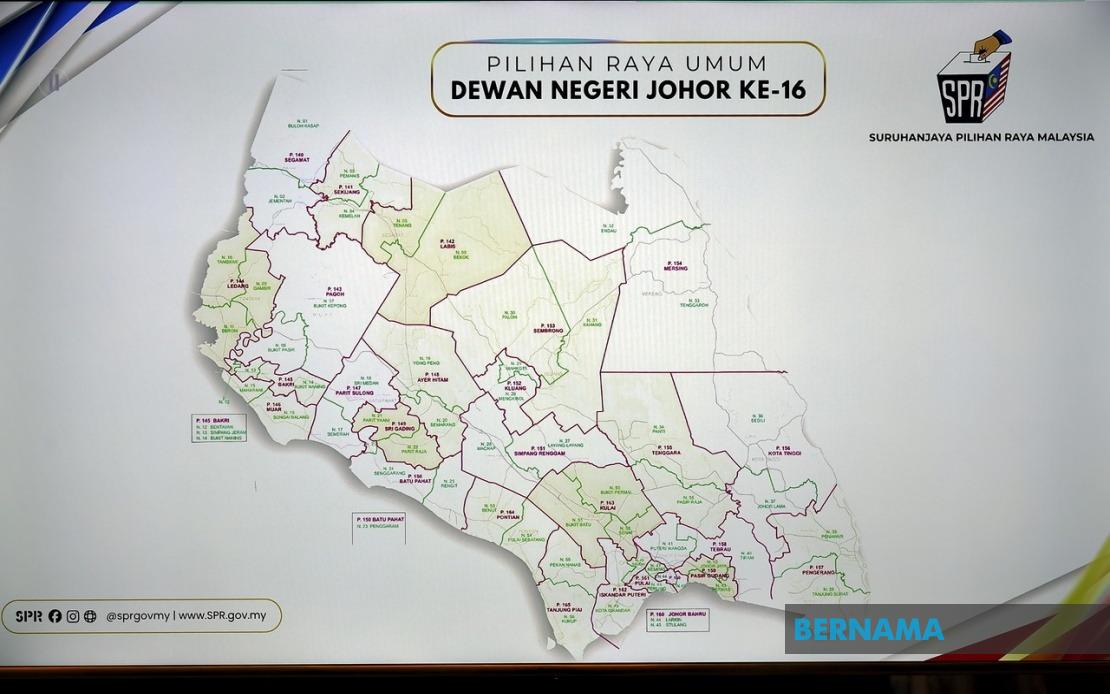
The political battleground in Johor shifts into high gear tomorrow as nomination day formally launches the state's 16th election, setting the stage for an intensely competitive race that will reshape the region's political landscape. With candidates set to register between 9 am and 10 am at designated centres statewide, the Election Commission's screening process will determine the final roster of contenders vying for position in Malaysia's second-largest state. Polling day has been scheduled for July 11, with early voting opportunities available on July 7 for eligible voters unable to cast ballots on the main election day.
Nearly 2.73 million eligible voters across Johor will have the opportunity to determine their state representatives, according to official figures from the Election Commission. This substantial electorate comprises over 2.7 million ordinary citizens, supplemented by 12,041 military personnel and their spouses, alongside 12,710 police officers and family members who maintain voting rights. The breadth of the voting population underscores the significance of this election in determining not only Johor's governance direction but also its potential influence on broader Malaysian political dynamics, given the state's economic importance and strategic location within the federation.
Pakatan Harapan has committed to contesting every single seat available, demonstrating an aggressive approach to reclaiming influence in a state where the coalition faces substantial headwinds from incumbent forces. The tripartite coalition fields 20 candidates from Parti Keadilan Rakyat, 19 from Amanah, and 17 from the Democratic Action Party, reflecting an equitable distribution of electoral opportunities among its constituent parties. This full-slate strategy signals PH's determination to present voters with comprehensive alternatives across all constituencies, though the coalition's performance in previous contests suggests recovery in the state will prove challenging given historical voting patterns favouring establishment parties.
Barisan Nasional, currently holding the lion's share of legislative seats from the 2022 election, enters this contest with equal ambition by fielding candidates in all 56 seats. The coalition's composition reveals UMNO's continued dominance with 36 nominees, complemented by 16 from the Malaysian Chinese Association and four from the Malaysian Indian Congress. This distribution reflects BN's traditional coalition architecture and suggests confidence among component parties in their ability to retain control of Johor's legislative assembly, particularly given their commanding 40-seat majority from the previous election cycle.
Perikatan Nasional, despite its weaker electoral position, maintains ambitions through its three component parties, with PAS contesting 11 seats, Bersatu fielding 16 candidates, and the Malaysian Indian People's Party standing five aspirants. The coalition's strategy appears focused on consolidating support in specific constituencies rather than pursuing universal representation, reflecting pragmatic assessments of its competitive prospects. This targeted approach differs markedly from the universalist strategies of larger coalitions and suggests PN recognises electoral mathematics that favour concentrated engagement over dispersed efforts.
The broader electoral field has expanded beyond traditional heavyweight contenders, with newer political entrants seeking to make meaningful impressions. The Malaysian United Democratic Alliance is contesting four seats, capitalising on its appeal to younger urban voters dissatisfied with conventional politics, while the Socialist Party of Malaysia fields a single candidate. Most notably, Parti Bersama Malaysia is preparing to contest 15 seats in what represents the party's electoral debut at the state level, potentially introducing a wild-card element into campaign dynamics and vote distribution.
The Election Commission has prioritised administrative preparation ahead of nomination day, urging prospective candidates to verify nomination forms in advance through the Returning Officer's Office or State Election Office to prevent procedural delays or rejections. Candidates have simultaneously been advised to settle deposit payments promptly and retain receipts as proof when submitting nomination documents, a reminder reflecting the technical complexities governing electoral participation and the consequences of administrative missteps.
Anti-corruption enforcement has emerged as a priority concern for the Malaysian Anti-Corruption Commission, which has issued formal directives to all candidates and political parties regarding lawful conduct under the MACC Act 2009 and the Election Offences Act 1954. The commission has established five 24-hour operations rooms positioned across Tampoi, Batu Pahat, Kluang, Segamat, and Mersing, creating accessible channels through which the public can report suspected corrupt practices or abuses of state power. This infrastructure suggests authorities anticipate heightened electoral competition may create temptations for misconduct and represent proactive efforts to maintain electoral integrity throughout the campaign period.
The dissolution of the Johor State Legislative Assembly on June 1 initiated the formal legal countdown toward electoral renewal, triggering constitutional timelines that culminate in the July 11 polling date. This 40-day interval between legislative dissolution and voter engagement represents the window within which political parties must mobilise campaigns, articulate policy platforms, and persuade the electorate to grant them governing mandates at the state level.
The 2022 Johor election established the baseline against which tomorrow's results will be measured and interpreted. Barisan Nasional's overwhelming 40-seat victory positioned the coalition as the dominant political force in the state, while Pakatan Harapan secured 12 seats reflecting weakened support in this traditionally BN-friendly electorate. Perikatan Nasional won three seats in that contest, demonstrating its ability to penetrate certain constituencies, while Malaysian United Democratic Alliance captured a single seat, signalling emerging voter openness to political alternatives despite the dominance of established parties. Tomorrow's nomination day will reveal whether these patterns persist, shift dramatically, or transform into unpredictable results that reshape Johor's political configuration and test the resilience of Malaysia's competitive electoral framework.

