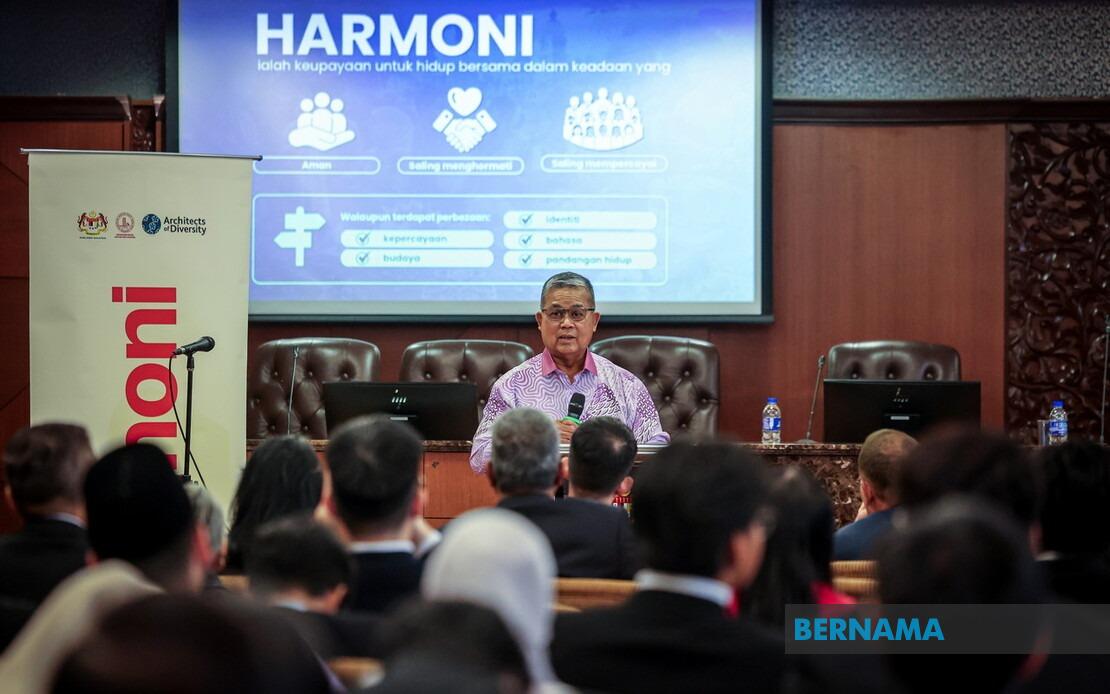
The Department of National Unity and National Integration (JPNIN) is embarking on a comprehensive research initiative to create a Community Tension Index, a measurement tool designed to gauge the state of social cohesion across Malaysia and track developments in areas involving racial, religious and royalty sensitivities. According to Minister of National Unity Datuk Aaron Ago Dagang, this index will generate empirical data that the government can rely upon when designing preventative measures and responding to divisive issues that threaten the country's social fabric. The timing of this move reflects growing recognition among policymakers that Malaysia's plural society requires sophisticated monitoring mechanisms to identify potential flashpoints before they escalate into broader conflict.
Datuk Aaron unveiled the initiative during his address at the 2026 Harmony Symposium, an event organised by the Secretariat of the Malaysian Parliamentary Cross-Party Group on Racial and Religious Harmony at the Parliament Building in Kuala Lumpur on June 26. The symposium brought together cross-party lawmakers and stakeholders to discuss strategies for maintaining interethnic and interreligious harmony in an increasingly complex information environment. By presenting the Community Tension Index as a central component of Malaysia's unity-strengthening agenda, the minister signalled that government responses to social tensions would increasingly be informed by systematic research rather than reactive policymaking.
The development of this index arrives at a particularly significant moment for Malaysia's national security landscape. Between January 1, 2025 and January 31, 2026, the Malaysian Communications and Multimedia Commission (MCMC) removed 1,493 pieces of online content related to the 3R issues—religion, royalty and race—through enforcement actions. This substantial volume of removed content underscores the scale of potentially divisive material circulating in Malaysia's digital spaces and illustrates why government agencies believe a more systematic approach to understanding and addressing social tensions has become necessary. The statistic serves as a concrete indicator of the kinds of issues the Community Tension Index would help identify, track and contextualise across different regions and demographics.
Minister Aaron's remarks highlighted a particular concern animating the index development: the structural nature of digital polarisation in contemporary society. He emphasised how social media algorithms create what researchers term "filter bubbles" and "echo chambers"—digital environments where individuals encounter primarily content that aligns with their existing viewpoints, progressively reinforcing those beliefs while insulating users from alternative perspectives. This algorithmic sorting mechanism, Aaron explained, contributes substantially to polarisation in Malaysian society by narrowing spaces where healthy, cross-community discourse can occur. As algorithms increasingly mediate how Malaysians access information and interact with one another across digital platforms, understanding these dynamics becomes essential for crafting effective unity-building interventions.
The widening gaps in understanding between communities that algorithmic sorting produces represent a qualitative shift in Malaysia's unity challenges. Unlike historical instances of communal tension that erupted through physical gatherings or conventional media, today's polarisation often occurs silently within digital networks, with individuals increasingly exposed to narratives that portray other communities in unflattering or dehumanising terms. The Community Tension Index would theoretically capture emerging patterns in these digital divides before they manifest as offline conflict, allowing government bodies and civil society organisations to target interventions at critical moments when perspectives remain malleable.
Beyond the index itself, JPNIN is simultaneously pursuing a parallel institutional initiative that would complement the research framework. The department has been conducting engagement sessions with diverse stakeholders—including religious leaders, community organisations, political parties, and civil society groups—to gather feedback on a proposal to establish a National Harmony Commission (SKN). This prospective commission would function as a dedicated institutional mechanism explicitly focused on early prevention, mediation and conflict resolution. Rather than simply investigating incidents of disharmony after they occur, the SKN would emphasise front-loading interventions at earlier stages of tension development, attempting to resolve conflicts through constructive dialogue and mediation before they harden into entrenched positions.
The proposed National Harmony Commission would also possess investigative powers regarding issues with potential implications for national harmony, suggesting a more robust institutional role than advisory or facilitative bodies. This combination of preventative capacity and investigative authority indicates that policymakers envisage the SKN as a proactive rather than merely reactive institution. By investigating emerging tensions while simultaneously working to resolve them harmoniously, the commission would occupy a distinctive institutional space within Malaysia's governance architecture, neither purely advisory nor overtly enforcement-oriented.
The combination of the Community Tension Index and the proposed National Harmony Commission reflects a broader strategic orientation within JPNIN toward what might be termed "early warning architecture" for social conflict. Rather than relying primarily on security responses to communal violence after it erupts, this framework prioritises identifying concerning patterns and trends before escalation, then deploying diplomatic, meditative and dialogue-based interventions to defuse tensions. For a multi-ethnic, multi-religious democracy like Malaysia, where historical episodes of intercommunal violence have imposed substantial human and economic costs, this preventative orientation potentially offers significant advantages over purely reactive approaches.
The emphasis on systematic measurement through the Community Tension Index also addresses a persistent challenge in unity efforts: the lack of reliable, comparable data on the state of social cohesion across Malaysia's regions and demographic groups. Previous interventions have often relied on anecdotal reports or responses to specific incidents, making it difficult to discern broader patterns or allocate resources strategically. A robust index would provide longitudinal data tracking how cohesion levels change over time, how different regions compare, and which specific factors most strongly correlate with tensions. This data-driven approach, while not eliminating the need for qualitative judgment and local expertise, would give policymakers a more grounded foundation for their decisions.
For Malaysian civil society and international observers monitoring the country's progress toward deepening interethnic and interreligious understanding, these institutional developments merit careful attention. The effectiveness of the Community Tension Index will depend significantly on the methodological rigor of its construction and the quality of data collection mechanisms. Similarly, the National Harmony Commission's impact will hinge on whether it receives adequate resourcing, institutional independence and stakeholder buy-in. Success requires not only sophisticated institutional design but also genuine commitment from government agencies, political leaders across the spectrum and community organisations to utilise research findings and work collaboratively through formal mediation processes.
The regional implications of Malaysia's approach deserve consideration as well. As Southeast Asian democracies grapple with rising polarisation fuelled by social media algorithms and digital misinformation, Malaysia's institutional experimentation with early warning systems and proactive mediation mechanisms could offer lessons for neighbouring countries facing similar challenges. The region's diversity—spanning multiple nations with different ethnic, religious and political compositions—makes the problem of managing plurality while maintaining social cohesion a shared challenge. Malaysian successes or setbacks with the Community Tension Index and National Harmony Commission will likely attract attention from policymakers across Southeast Asia searching for effective institutional responses to digital-age polarisation.
The timing of these initiatives also reflects Malaysia's evolving approach to security. For decades, the country's strategies for maintaining communal peace relied heavily on specific legislation, law enforcement responses and restrictions on expression deemed sensitive. The Community Tension Index and National Harmony Commission represent a complementary track that does not abandon these tools but supplements them with preventative, research-based and dialogue-oriented mechanisms. This layered approach acknowledges that legal prohibitions and enforcement actions, while necessary, operate downstream of the processes through which tensions develop and beliefs harden. By adding upstream interventions focused on early detection and mediation, Malaysia positions itself to address the roots of polarisation rather than solely managing its symptoms.

