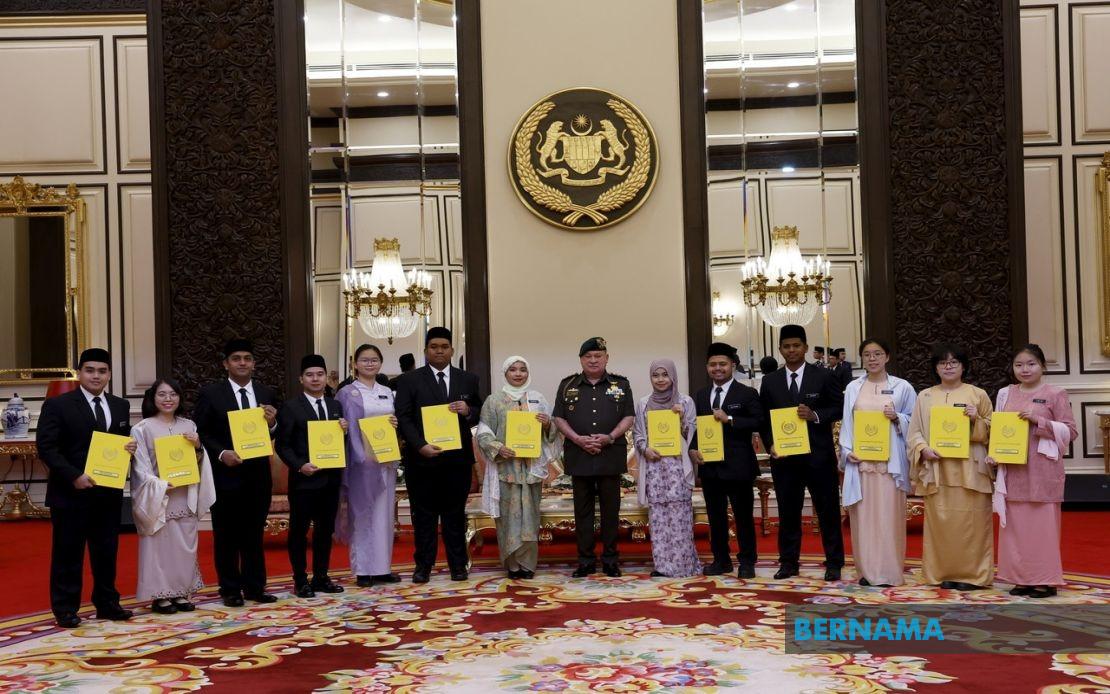
His Majesty Sultan Ibrahim, King of Malaysia, distributed the 2026 Yang di-Pertuan Agong Scholarships (BYDPA) to 14 high-achieving scholars during a formal presentation ceremony at Istana Negara in Kuala Lumpur on June 24. The occasion recognised exceptional Malaysian talent pursuing advanced research qualifications, reflecting the monarchy's enduring commitment to nurturing the nation's intellectual capital and supporting transformative academic pathways.
The scholarship cohort comprised two equal divisions based on their chosen fields of postgraduate study. Seven recipients will undertake doctoral programmes, whilst their seven counterparts will engage in Master's-level research initiatives. This balanced distribution underscores the government's strategic emphasis on developing expertise across both the foundational research and emerging specialisation phases of academic advancement.
Geographic diversity characterised the placement of the successful candidates. Four scholars secured opportunities at internationally recognised universities beyond Malaysia's borders, positioning them to engage with cutting-edge research communities and bring global knowledge networks back to the domestic context. The remaining ten recipients will pursue their studies within Malaysia's research-focused university ecosystem, strengthening local institutional capacity and ensuring that advanced scholarship remains accessible through established domestic channels.
The ceremony drew attendance from high-ranking government officials overseeing public sector coordination. Tan Sri Wan Ahmad Dahlan Abdul Aziz, who holds the position of Director-General of the Public Service, and Tan Sri Dr Azmi Rohani, Comptroller of the Royal Household at Istana Negara, both witnessed the proceedings. Their presence underscored the significance accorded to the BYDPA scheme within Malaysia's broader framework for developing high-calibre civil servants and research professionals.
Following the formal presentation, Wan Ahmad Dahlan spoke with attending journalists about the scholarship's institutional importance and financial dimensions. He characterised the BYDPA as Malaysia's most prestigious scholarship programme, emphasising its distinctiveness within the constellation of government-sponsored educational schemes. The financial generosity embedded in the BYDPA structure represents a significant commitment of public resources, as it provides substantially more comprehensive funding than competing government scholarship initiatives.
The financial superiority of the BYDPA reflects deliberate policy choices about prioritisation and resource allocation. By offering the highest funding envelope among government scholarship programmes, Malaysian authorities signal their determination to attract and retain the nation's most talented potential researchers and academics. This investment logic recognises that advanced research capacity depends not merely on identifying capable individuals but on providing the material conditions and financial security necessary for rigorous intellectual work.
For Malaysian readers and policymakers, the BYDPA scheme represents an important institutional mechanism for maintaining the country's intellectual competitiveness within the Southeast Asian region and globally. The dual pathway—supporting both local and international placements—reflects a pragmatic recognition that knowledge flows bidirectionally. Scholars who complete advanced research abroad bring exposure to international best practices, methodologies, and networks back to Malaysian institutions, whilst those who remain domestically strengthen local research infrastructure and create pathways for mentoring the next generation of scholars.
The distribution of scholarships across doctoral and master's levels addresses different stages of research career development. Doctoral recipients gain access to the most comprehensive training in independent research design, execution, and knowledge creation. Master's-level researchers develop specialised expertise and research competencies that feed into professional practice, industry innovation, and teaching roles within universities and research organisations. Together, these cohorts constitute a pipeline addressing distinct institutional needs.
The international placement of four scholars positions them within global academic hierarchies whilst maintaining their obligation to Malaysian national development. Many recipients of prestigious international scholarships subsequently channel their expertise back into Malaysian research institutions, government agencies, and private sector innovation initiatives. This brain circulation, as opposed to brain drain, depends partly on maintaining institutional pathways and professional opportunities domestically—a factor that successive Malaysian governments have emphasised in articulating the rationale for comprehensive scholarship programmes.
The BYDPA's positioning as Malaysia's premier government scholarship programme also reflects broader trends in how developing and middle-income countries approach human capital development. Rather than spreading limited resources thinly across numerous programmes, concentrating excellence funding into flagship schemes creates visible institutional prestige, attracts higher-quality applications, and generates demonstration effects that encourage private sector and non-governmental scholarship initiatives to expand complementary opportunities.
For the 14 recipients themselves, the scholarship represents not only financial enablement but also official recognition of their research potential and an expectation that they will contribute meaningfully to Malaysian knowledge production and societal development. The ceremony's formal setting at the royal palace emphasises that advanced scholarship carries not merely individual benefit but national importance—recipients are framed implicitly as stewards of Malaysia's intellectual future and contributors to national advancement through knowledge creation and knowledge application.