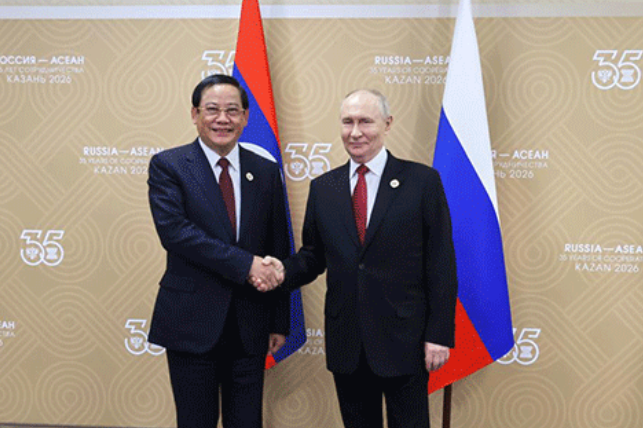
Laos and Russia have moved to solidify their longstanding partnership with an array of new agreements and commitments, including a groundbreaking deal on nuclear energy cooperation. Prime Minister Sonexay Siphandone and Russian President Vladimir Putin held substantive talks at the Russia-ASEAN Summit in Kazan last month, during which both leaders reaffirmed their nations' shared strategic interests and pledged to deepen ties across energy, trade, education, and security matters. The encounter marked the conclusion of Sonexay's inaugural official visit to Moscow since his appointment, an occasion that underscores Laos's continued alignment with Russia despite the latter's international isolation.
The centrepiece of the bilateral engagement was the signing of an intergovernmental agreement on peaceful nuclear energy cooperation. Putin characterised this accord as a watershed moment, emphasizing that it establishes the contractual framework necessary for constructing a small nuclear power plant utilising Russian technology within Laotian territory. For a landlocked Southeast Asian nation heavily dependent on hydropower and vulnerable to climate variability, nuclear energy represents a strategic diversification of its power generation portfolio. The initiative reflects broader patterns of Russian technological engagement in the region and positions Moscow as a consequential player in Southeast Asia's energy transition, an arena traditionally dominated by Western firms and Chinese investment.
At the diplomatic level, Putin expressed Russia's high regard for Laos, framing the relationship as rooted in mutual respect, friendship, and balanced reciprocity. He specifically acknowledged Laotian support for enhancing Russia's institutional ties with the Association of Southeast Asian Nations, particularly as 2026 approaches with the 35th anniversary of formal Russia-ASEAN diplomatic relations. The Russian president also commended President Thongloun Sisoulith for attending Moscow's Victory Day commemorations in May and for dispatching a Lao military contingent to participate in the 80th anniversary parade honouring Soviet triumph in the Second World War—gestures that underscore Vientiane's consistent deference to Russian commemoration efforts and historical narratives.
The bilateral agenda extended well beyond nuclear matters into a comprehensive suite of collaborative sectors. Both governments identified energy, industrial development, mining, agriculture, digital transformation, banking infrastructure, transportation networks, tourism promotion, and educational exchange as priority areas for expanded cooperation. This breadth reflects a mature partnership spanning decades, rooted in Cold War-era ties when Laos fell within Moscow's sphere of influence. Contemporary cooperation preserves that historical linkage while adapting to present-day economic realities and strategic considerations in an increasingly multipolar Asia-Pacific region.
Educational collaboration emerged as a particularly significant dimension of the partnership. Prime Minister Sonexay expressed gratitude for Russia's sustained commitment to human resource development, highlighting the annual scholarship schemes and professional training programmes extended to Laotian nationals, including government officials and civil servants. Such initiatives represent soft power assets that reinforce institutional connections between Moscow and Vientiane, cultivating generations of Lao elites with Russian language proficiency and familiarity with Russian institutional practices. The forthcoming completion of the Laos-Russia Friendship School in Vientiane, constructed through intergovernmental cooperation, will further institutionalise these educational linkages and serve as a physical symbol of bilateral affinity within the Laotian capital.
Meanwhile, Sonexay took the opportunity to leverage the summit platform for economic engagement. He presided over a Laos-Russia business forum explicitly designed to stimulate trade flows and attract direct investment from Russian enterprises into Laotian ventures. Such economic forums represent attempts to translate political goodwill into tangible commercial outcomes, though historically the volume of Russia-Laos bilateral trade has remained modest compared to Laos's engagement with China, Thailand, and Vietnam. Nevertheless, the initiative signals governmental commitment to expanding the economic dimension of the partnership beyond traditional aid and technical cooperation arrangements.
On international affairs, both leaders identified convergence on global and regional issues as a cornerstone of their relationship. Putin noted that Laos and Russia maintain collaborative positions at the United Nations and in other multilateral forums, sharing perspectives on most consequential policy matters. This alignment reflects Laos's non-aligned foreign policy tradition and its historical reluctance to openly rupture relations with any major power, even as strategic realities have forced shifting calibrations. For Russia, Laotian support in multilateral institutions provides incremental diplomatic backing within ASEAN frameworks and global governance structures where Moscow faces considerable Western opposition.
The diplomatic calendar also registered cultural and ceremonial significance. Prime Minister Sonexay presided over the formal handover of two elephants to the Kazan Zoo, a gift from President Thongloun and the Laotian people acknowledging both the 65th anniversary of bilateral diplomatic relations and Russia Day on June 12. Such symbolic gestures, though seemingly peripheral, reinforce affective dimensions of statecraft and cultivate favourable public narratives around international partnerships. The choice of elephant gifting carries particular resonance given the animal's cultural significance throughout Southeast Asia and its prominence in Laotian national symbolism.
The Kazan summit itself provided the diplomatic architecture enabling these substantive discussions. By hosting the Russia-ASEAN gathering, Russia demonstrated continued capacity for regional diplomatic engagement despite geopolitical constraints, while simultaneously creating bilateral opportunities for bilateral leaders like Sonexay to conduct strategic business outside traditional multilateral frameworks. For Laos, participation in such high-profile summits enhances international visibility and provides forums for advancing national interests and showcasing partnerships that reinforce Vientiane's strategic autonomy.
From a Southeast Asian perspective, the Russia-Laos rapprochement reflects persistent great power competition for regional influence. While China dominates Laotian economic ties through Belt and Road infrastructure investments and Vietnam maintains historical cultural and security linkages, Russia maintains diplomatic and strategic relevance through selective technological cooperation, military training, and historical ties. The nuclear energy agreement particularly signals Russia's technological ambitions in the region and hints at Moscow's willingness to compete in the civil nuclear sector despite broader sanctions regimes.
For Malaysian and broader ASEAN observers, the Russia-Laos dynamic illustrates how smaller Southeast Asian states navigate relationships with major powers while ostensibly maintaining non-aligned positioning. Laos's engagement with Russia demonstrates that despite Western pressure on sanctions and geopolitical realignment, countries retain agency in managing diverse partnerships. This approach—maintaining cooperative ties with Russia while simultaneously deepening Chinese economic integration and Vietnamese security partnerships—represents a diplomatic balancing act increasingly common across the region, albeit with varying degrees of sustainability and internal coherence.
The nuclear cooperation agreement deserves particular scrutiny from a regional security perspective. While framed as purely civilian energy cooperation, nuclear technology transfer and expertise development carry dual-use implications worth monitoring by regional observers and international monitors. The agreement establishes precedent for Russian nuclear involvement in Southeast Asia and may influence future technology transfer arrangements within the region, particularly as nations seek to diversify energy sources and reduce carbon emissions in line with climate commitments.

