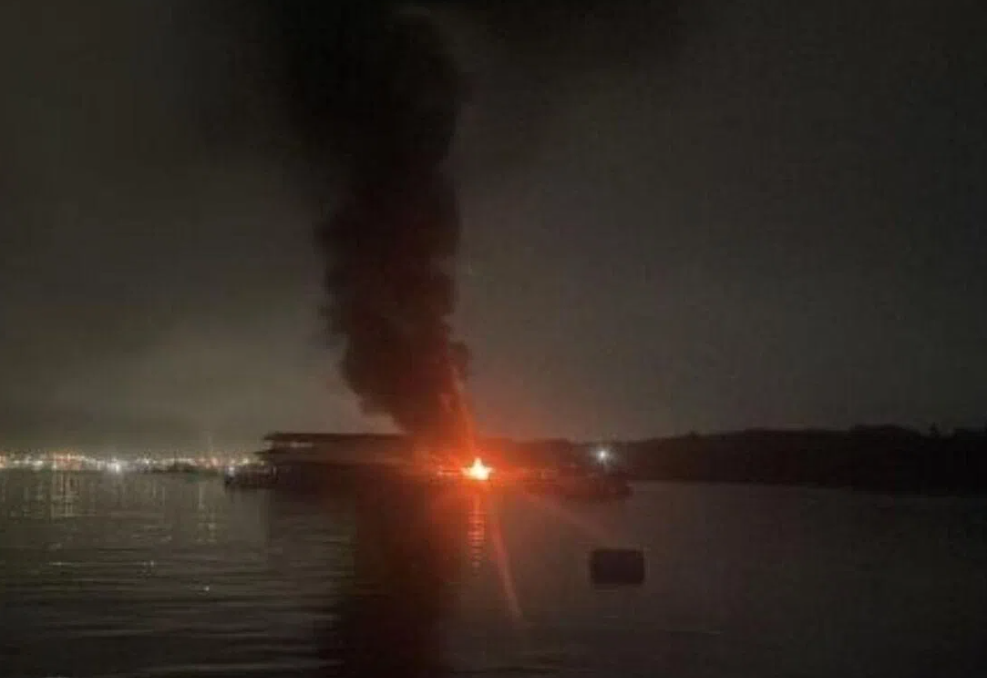
A dramatic waterside fire near Singapore's Pulau Ubin on June 24 forced emergency responders into a lengthy battle against flames that consumed at least two floating fish farms anchored off the Lorong Halus jetty. The Singapore Civil Defence Force received the alert at approximately 8.10pm and deployed marine vessels in collaboration with the Maritime and Port Authority of Singapore and Airport Emergency Service to battle the blaze, which ultimately required several hours to fully extinguish. The incident, which claimed no injuries, has drawn attention to vulnerability within Singapore's aquaculture sector and the particular risks posed by tropical weather patterns to floating farming infrastructure.
Investigators have identified a suspected lightning strike as the source of ignition, with strong indication that the solar panel array on one of the farms absorbed a direct hit during what would have been a typical afternoon thunderstorm. The fire subsequently spread to neighbouring facilities before being contained, highlighting how quickly flames can propagate across tightly clustered farming operations on open water. The reliance on solar power systems at these farms, while environmentally sensible, introduces an additional hazard factor that operators have not fully mitigated through protective grounding or shielding mechanisms.
One farm owner has publicly disclosed losses estimated at S$120,000, encompassing not merely structural damage but also the destruction of operational assets critical to daily farming activities. Beyond the solar panels and generators rendered inoperable by the fire, the incident claimed fish feed supplies, a fishing boat, and at least three fish traps. Critically, damaged fishing nets permitted approximately half of that farm's entire stock to escape into surrounding waters, compounding the financial toll and creating an unquantifiable ecological consequence.
The owner's account reveals a troubling pattern of prior incidents with lightning damage to the solar installations, suggesting that existing protective measures prove inadequate for the electrical hazards inherent to the marine environment. In previous occurrences, workers stationed at the farms had been able to respond immediately, preventing minor electrical incidents from cascading into larger conflagrations. The absence of on-site personnel during this particular event, however, allowed the fire to develop unchecked until emergency services could mobilise, underscoring a critical gap in operational safety protocols for 24-hour monitoring.
Floating aquaculture operations in Singapore's waters operate under considerable constraints, with these particular farms positioned in the narrow waterway between Pulau Ubin and Pulau Ketam near Pasir Ris. The proximity of multiple farming operations in this zone creates mutual vulnerability; a fire at one installation immediately threatens neighbours, necessitating rapid response and cooperation among operators. The incident saw farmers from adjoining installations voluntarily assist in containment efforts, demonstrating the informal support networks that currently substitute for institutional safeguards.
A particularly vexing aspect of this incident involves the farm owner's assertion that he cannot pursue an insurance claim for the damage. This reveals a significant gap in risk management and financial protection for Singapore's aquaculture operators, many of whom operate on comparatively thin profit margins. Without insurance recourse for weather-related incidents, individual farms bear catastrophic financial exposure to naturally occurring hazards, fundamentally altering the economic viability of these operations and potentially incentivising under-investment in safety infrastructure.
The fire at Pulau Ubin assumes broader significance within Singapore's food security strategy. As a densely populated city-state with limited agricultural land, Singapore has increasingly positioned aquaculture as a cornerstone of its ambition to produce thirty percent of its nutritional needs domestically by 2030. Floating fish farms represent a scalable solution to land constraints, yet incidents such as this illuminate the operational vulnerabilities that accompany technological intensification of food production. The sector cannot expand reliably without addressing infrastructure resilience and financial protection mechanisms.
For Malaysia and the wider Southeast Asian region, Singapore's experience offers instructive lessons regarding aquaculture vulnerability to tropical climatic conditions. As countries throughout Southeast Asia expand mariculture operations to meet rising protein demand, the risks demonstrated at Pulau Ubin—lightning strikes, rapid fire propagation, inadequate insurance frameworks, and the limitations of dispersed emergency response—warrant serious consideration in regulatory and operational planning. Many regional farming operations operate with comparable or lesser safeguards than those evident in Singapore's more regulated environment.
The ongoing investigation by authorities will likely focus on whether the solar panel system lacked appropriate surge protection, grounding, or isolation mechanisms that might have prevented electrical energy from igniting adjacent materials. Recommendations emerging from official findings could reshape industry standards across Singapore and potentially influence practices throughout Southeast Asia. The incident also raises questions about whether regulatory bodies have adequately assessed the cumulative fire risk posed by clustering numerous facilities in confined waterway zones where emergency vehicle access remains inherently compromised.
Looking forward, operators and regulators must collaborate to establish mandatory protective measures for solar installations, enhanced monitoring protocols during high-risk weather periods, and improved insurance products tailored to aquaculture-specific hazards. The gap between the farm owner's experience with prior lightning incidents and the absence of systematic mitigation suggests that institutional learning has not yet translated into sector-wide practice. Without such evolution, Singapore's aquaculture sector remains vulnerable to repetition of similar incidents that could jeopardise both individual operators and the nation's broader food resilience objectives.

