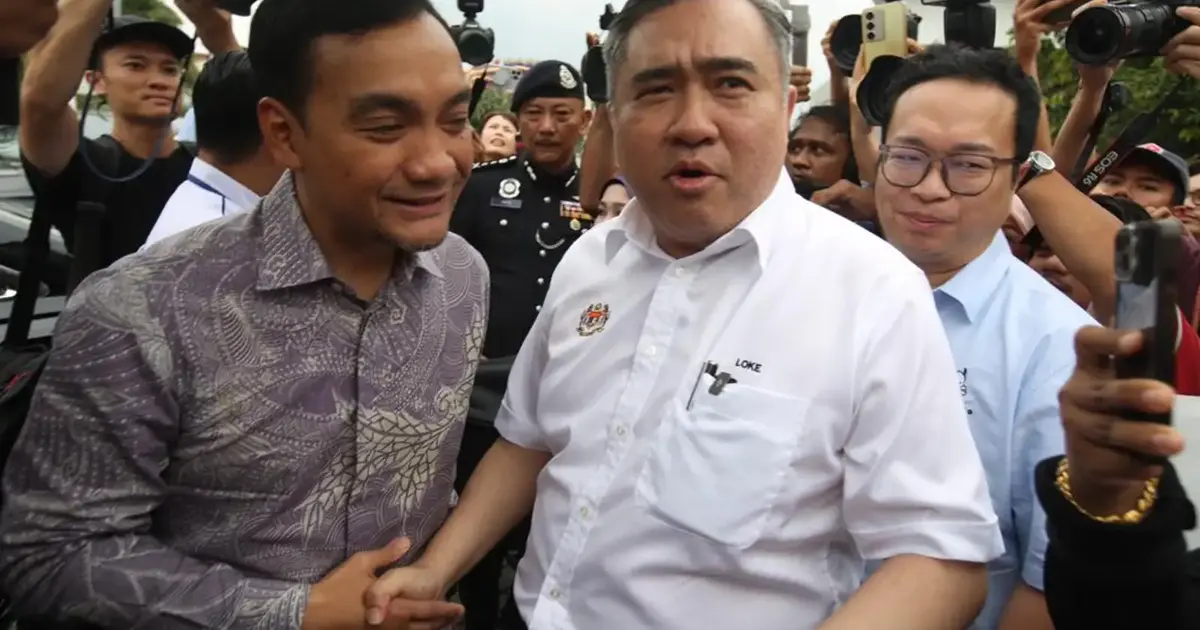
Transport Minister Loke Chua Tian Chang and Johor Menteri Besar Onn Hafiz Ghazi navigated their first face-to-face encounter since trading barbs online, with both men demonstrating measured restraint during an official engagement centred on transport and infrastructure matters. The meeting, conducted within a formal government setting, underscored the broader challenge of managing inter-party relations when personal friction occasionally surfaces in public forums.
Onn Hafiz used his remarks at the transport ministry event to deliver a subtle jab at the DAP political leader, referencing the compressed timeframe with which he had received the invitation. The Johor chief executive indicated that honouring the engagement had necessitated significant adjustments to his pre-existing commitments, a comment that appeared calibrated to acknowledge the logistical inconvenience while maintaining an outwardly professional demeanor. Such rhetorical moves are common in Malaysian political circles, where leaders often embed pointed observations within ostensibly cordial public appearances.
The online dispute that preceded this meeting represents a departure from the coordinated messaging typically expected between federal and state governments operating within the same coalition framework. Public disagreements, particularly those conducted through social media channels where tone can be difficult to modulate and audiences are diverse, carry reputational risks for both parties and can complicate collaborative efforts on shared policy objectives. The transport sector, which touches multiple jurisdictions and requires coordination between federal authorities and state administrations, is particularly sensitive to such tensions.
For Malaysian readers familiar with the complexities of coalition politics, this gathering illustrates how personal tensions and policy disagreements must ultimately be compartmentalised to maintain functional government operations. The Johor state administration and the federal transport ministry have numerous overlapping responsibilities, from road maintenance and public transportation networks to port operations and logistics infrastructure. Allowing interpersonal friction to disrupt these working relationships would impose tangible costs on citizens relying on these services.
The diplomatic choreography on display—where both officials maintained surface civility whilst allowing subtle critical commentary to surface—reflects broader patterns in Malaysian political culture. Leaders frequently employ carefully worded statements that permit them to register displeasure or assert their prerogatives without escalating confrontation to levels that would force public institutional responses. This approach preserves flexibility and allows for future collaboration whilst avoiding the appearance of capitulation.
The short notice characterisation offered by Onn Hafiz raises questions about coordination mechanisms within coalition government structures. When federal ministries extend invitations to state leaders at compressed timelines, it may indicate either genuine logistical necessity or, as the Johor MB's remark hints, insufficient advance planning. Either interpretation carries implications: genuine emergencies require flexibility and rapid response, whilst poor coordination suggests systemic inefficiencies that hamper effective governance. The transport ministry's decision to hold the event, regardless of the underlying cause for the abbreviated notice period, presumably reflected priorities deemed significant enough to warrant urgent participation from key state leaders.
For Southeast Asian observers, Malaysia's experience managing coalition tensions offers instructive lessons in how political systems accommodate multiple power centres operating under different party banners. Unlike more centralised governance models, Malaysian federalism requires constant negotiation between state and federal authorities, with transport policy serving as a touchstone for these interactions. The Johor state's geographic position and economic significance ensure that its Menteri Besar wields considerable influence in national deliberations.
The previous online exchange between Loke and Onn Hafiz had introduced uncertainty about whether personal grievances might begin to erode the coalition's functional coherence. Public quarrels between government figures can generate pressure from external critics seeking to exploit divisions, whilst simultaneously creating awkwardness for ministerial staff and technical experts who must collaborate across the institutional divide regardless of leadership tensions. By presenting a united front at this engagement, both men signalled that despite disagreements, fundamental commitment to coalition governance remained intact.
The transport sector's interdependencies make reconciliation particularly important. Major infrastructure projects, safety initiatives, and service improvements frequently require cooperation spanning multiple levels of government. Road safety campaigns, port efficiency improvements, and public transportation system enhancements all depend on shared commitment and resource coordination. When political leaders demonstrate willingness to move beyond temporary friction toward sustained cooperation, downstream impacts extend to ordinary Malaysians whose daily lives depend on functional infrastructure.
Onn Hafiz's reference to schedule rearrangement served multiple communicative purposes simultaneously. It registered the inconvenience experienced, established that the Johor MB's schedule possessed sufficient weight and importance to merit the consideration of ministry staff, and implicitly suggested that future invitations might benefit from more generous lead times. Yet the fact that he ultimately accepted and attended signalled pragmatic acceptance of the federal government's requirements, even when coordination might have been improved.
Looking forward, this encounter establishes a foundation for restored working relations, though observers will likely scrutinise future interactions between these two figures for evidence of either improving rapport or lingering tensions. The Malaysian political system depends substantially on such unofficial resolution mechanisms, where leaders manage disagreements through carefully calibrated public commentary and private dialogue rather than escalating disputes through formal institutional channels. This approach, whilst sometimes obscuring underlying frictions, permits government machinery to continue functioning despite interpersonal challenges.
The broader significance extends beyond these two individuals to encompass questions about coalition stability and the mechanics through which diverse political parties remain aligned despite competing interests and occasional public friction. Transport Minister Loke and Menteri Besar Onn Hafiz, whatever their differences, share institutional interests in demonstrating that coalition government remains viable and effective. Their cordial public demeanor, even when salted with subtle critical commentary, reinforces that message to both their supporters and sceptics observing Malaysia's political dynamics.

