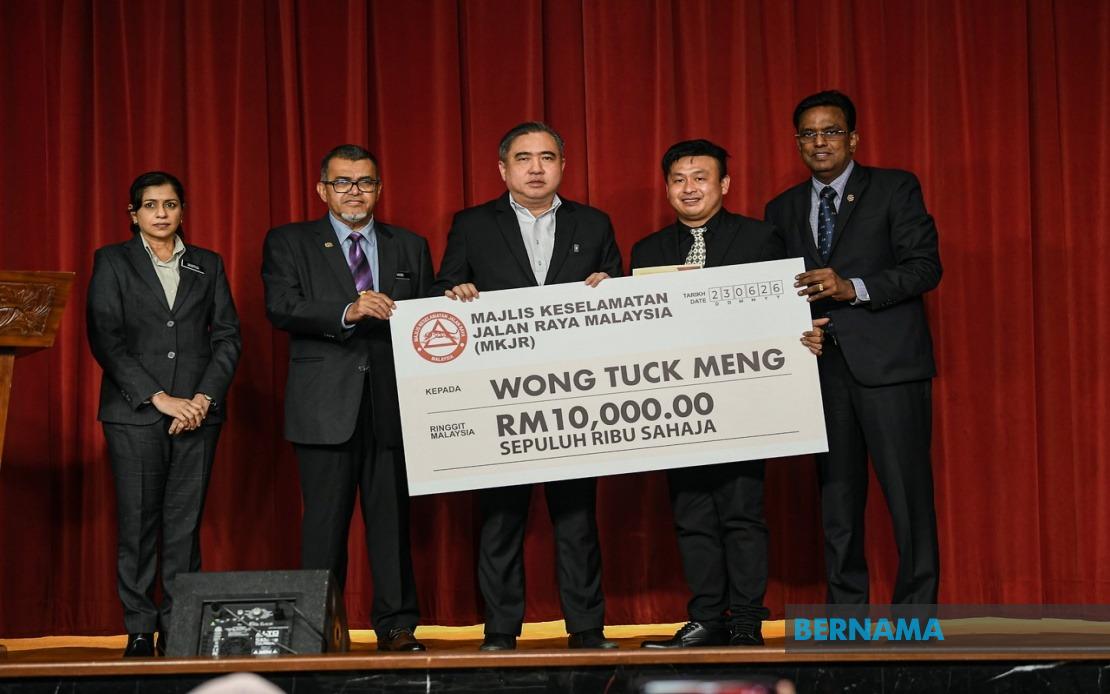
Wong Tak Ming, a lorry driver from Malaysia, has been honoured by the government for his exceptional bravery during a near-catastrophic incident involving an express bus on June 15 near the Menora Tunnel in Perak. The recognition came in the form of a Special Certificate of Appreciation and RM10,000 in recognition of his heroic actions that prevented what could have been a major tragedy. Transport Minister Anthony Loke presented the award during a special ceremony at the Parliament building on June 23, with the recognition funded by the Malaysian Road Safety Council (MKJR).
The incident unfolded when a coach operating between Kedah and Kuala Lumpur encountered mechanical difficulties on a downhill stretch approaching the Menora Tunnel. As the vehicle lost control due to technical failure, it collided with Wong's lorry travelling directly ahead. Rather than panic, Wong demonstrated exceptional composure and tactical awareness in managing an extremely dangerous situation that placed him at considerable personal risk. His decisive response converted what could have been a catastrophic pile-up into a controlled outcome that preserved the safety of all 21 passengers aboard the bus.
According to Transport Minister Loke, Wong's actions exemplified the kind of quick-thinking intervention that prevents fatalities on Malaysian highways. "His swift action prevented what could have been a tragic accident and saved many lives," Loke stated during the ceremony. The minister praised Wong as a hero whose instinctive response prioritised the safety of others despite the potential danger to himself. The incident highlighted both the risks inherent in highway travel and the critical importance of vigilance among road users.
Wong's response during the crisis demonstrated remarkable presence of mind under extreme pressure. Rather than simply absorbing the impact passively, he used his heavier vehicle strategically to help decelerate the out-of-control bus. He then manoeuvred his lorry closer to the guardrail, creating a controlled stopping corridor that allowed both vehicles to come to rest safely without tipping or sliding further down the incline. This sequence of actions, executed in mere seconds, required both mechanical understanding and nerves of steel.
When asked about his actions, Wong attributed his response to instinct rather than conscious heroism. He explained that his immediate priority was preventing loss of life and creating sufficient warning time for other motorists downstream to avoid the incident zone. "At that moment, I was only thinking about preventing any loss of life. There was still some distance between the bus and my lorry, so I had time to sound the horn to alert vehicles ahead," he recounted. This modest characterisation belied the complexity and danger inherent in his actions, as managing a collision while simultaneously alerting other traffic required coordinated decision-making under circumstances most drivers would find overwhelming.
The incident gained widespread attention after footage circulated through social media channels, where commenters universally praised Wong's composure and quick thinking. The video evidence captured the critical moments of the collision and recovery, providing visual confirmation of the dangerous circumstances from which Wong had extracted all parties to safety. The viral nature of the incident transformed it from a localised event into a national conversation about highway safety and exemplary conduct under pressure.
Parliament itself formally recognised Wong's contribution to public safety. During proceedings related to the second reading of the Road Transport (Amendment) Bill 2025, Deputy Speaker Datuk Dr Ramli Mohd Nor conveyed the legislature's formal appreciation for Wong's bravery. This parliamentary acknowledgement elevated the recognition beyond a government ministry award to a statement of national significance, acknowledging that individual citizens bear responsibility for maintaining safety standards on public roads.
The recognition of Wong's actions carries broader implications for Malaysia's road safety culture. Incidents involving large vehicles losing control on downhill stretches represent recurring hazards on the country's highway network, particularly on routes traversing Peninsular Malaysia's more mountainous terrain. The Menora Tunnel corridor, a critical transportation artery, handles substantial daily traffic volumes and hosts both commercial and passenger services. Technical failures in large vehicles on such routes can escalate rapidly from mechanical issue to multi-vehicle catastrophe without intervention.
Wong's award represents official acknowledgement that road safety extends beyond regulatory frameworks and vehicle maintenance to encompass the decisions and actions of individual drivers who share the highway. His RM10,000 reward, while financial recognition, pales in comparison to the value of 21 lives potentially saved and the averted social and economic costs of a major highway accident. The government's decision to fund the award through the Malaysian Road Safety Council underscores institutional commitment to recognising and encouraging the safety-conscious behaviour that prevents disasters.
The incident and subsequent recognition also spotlight maintenance and safety standards for long-distance coaches operating on Malaysian routes. That the bus experienced a technical problem severe enough to cause loss of control raises questions about pre-journey inspections and vehicle maintenance protocols. While Wong's heroic intervention prevented immediate tragedy, systemic improvements in vehicle safety and mechanical standards offer the prospect of preventing such incidents entirely rather than relying on fortunate intervention by alert fellow motorists.
For other Malaysian drivers, Wong's example demonstrates that highway safety depends on collective vigilance and the willingness to act decisively when danger emerges. His recognition serves as validation that such actions, while risky, receive social and governmental acknowledgement. This reinforcement may encourage other drivers to respond appropriately to emerging hazards rather than assuming that intervention lies outside their responsibility or capacity. The certificate and monetary award thus function not merely as recognition of singular heroism but as endorsement of an approach to road safety that privileges immediate human intervention when systems fail.
Moving forward, Wong's case provides instructive material for driver training programmes and road safety campaigns seeking to cultivate the kind of situational awareness and decisive action that transforms potential disasters into survivable incidents. His modest characterisation of his own heroism, emphasising instinctive response rather than calculated bravery, suggests that safety-conscious behaviour can become habitual through cultural reinforcement and normalisation within driving communities. The government's formal recognition contributes to building such a safety-conscious culture across Malaysia's diverse motoring population.

