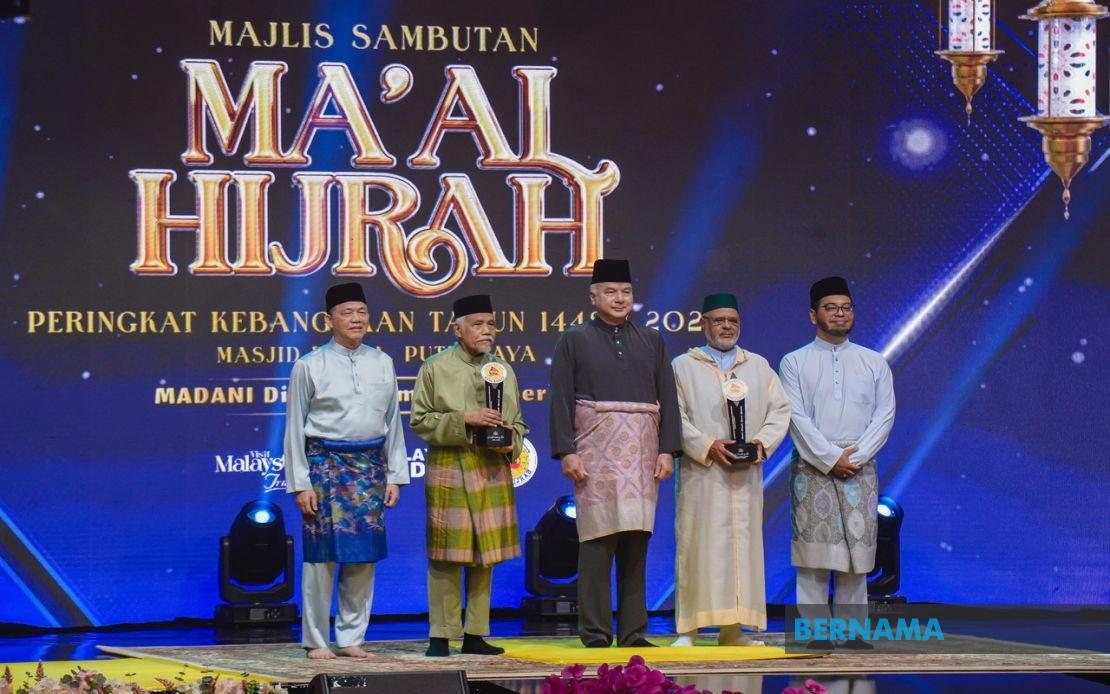
Across Malaysia on June 17, the Islamic calendar's new year provided a powerful occasion to reflect on hijrah—the concept of spiritual migration and positive change—with events held in multiple locations drawing thousands of participants and emphasising the interconnection between individual transformation and collective progress. The nationwide festivities centred on a vision of renewed ummah cohesion, with religious programmes including Quranic recitations, scholarly discourses and formal recognition ceremonies serving as platforms to discuss how principled leadership and moral integrity strengthen society.
The primary celebration, anchored by the theme "MADANI Dihayati, Ummah Diberkati" (Experiencing MADANI, Ummah Blessed), attracted approximately 5,000 attendees and featured prominent participation from Malaysia's political and religious establishment. Deputy Prime Minister Datuk Seri Fadillah Yusof and Minister in the Prime Minister's Department (Religious Affairs) Dr Zulkifli Hasan lent official weight to the proceedings, signalling the government's commitment to leveraging the hijrah narrative as a framework for discussing governance, community welfare and civilisational advancement in the Malaysian context.
The awarding of the National Tokoh Maal Hijrah honour to IIUM rector Prof Emeritus Datuk Dr Osman Bakar, presented by Sultan Nazrin, underscores the Islamic establishment's recognition of intellectual leadership within higher education. Dr Bakar's body of work in bridging Islamic thought with contemporary knowledge systems reflects the celebration's broader message that hijrah encompasses not merely personal piety but institutional and intellectual transformation capable of addressing modern challenges facing Muslim societies. This recognition carries particular significance in Southeast Asia, where educational institutions increasingly serve as crucibles for developing sophisticated Islamic perspectives relevant to pluralistic, developing economies.
The conferment of the International Tokoh Maal Hijrah Award upon Dr Ahmad Al-Raysuni, a prominent Moroccan Islamic jurisprudence scholar, demonstrates Malaysia's positioning as a convening space for Islamic intellectual dialogue across continents. The inclusion of foreign religious figures at domestically significant ceremonies signals a deliberate effort to situate Malaysian Islamic practice within broader transnational scholarly networks, particularly relevant as Muslim-majority nations navigate questions of religious interpretation in an interconnected world where theological debates span multiple jurisdictions and cultural contexts.
Within the Sabah contingent of celebrations, attended by approximately 1,000 participants, the state's Chief Minister Datuk Seri Hajiji Noor presided over local award ceremonies honouring community figures exemplifying the hijrah spirit. Community activist Datuk Ag Sharin Alimin and former state deputy secretary Datuk Masnah Matsalleh received recognition in male and female categories respectively, their honours reflecting the celebration's inclusive approach to identifying moral exemplars across gender lines and professional backgrounds. This regional participation demonstrates how the hijrah narrative circulates through Malaysia's federal structure, allowing individual states to contextualise the religious occasion within their specific community dynamics and leadership priorities.
Among the Sabah awardees was 95-year-old Quranic teacher Jusoh @ Muda Ismail, whose lifetime of Islamic education work and connection to the legacy of Tuan Guru Haji Mat Lintar grounds the celebration in Malaysia's own historical Islamic learning traditions. The honouring of such custodians of religious knowledge acknowledges the continuity between Malaysia's Islamic heritage and contemporary aspirations, recognising that the hijrah concept operates across generational timescales, with elderly scholars embodying decades of spiritual transmission that undergird community religious life. This intergenerational perspective enriches the celebration beyond abstract discussions of transformation, anchoring hijrah in the concrete lived experiences of educators, students and communities engaged in sustained religious practice.
The emphasis on quality leadership throughout the celebration's messaging reflects an underlying conviction that individual spiritual migration must translate into institutional and systemic improvements. When government ministers and religious authorities gather to discuss hijrah through the lens of governance, they implicitly argue that the Islamic calendar's new year offers an opportunity for public sector self-examination—an examination of whether Malaysian institutions embody the ethical standards and service orientation that Islamic principles demand. This integration of personal spirituality with institutional accountability represents a distinctive Southeast Asian interpretation of Islamic renewal, one cognisant that religious celebration gains meaning primarily through manifestation in improved public administration, equitable resource distribution and strengthened community resilience.
The nationwide scope of the celebrations, with simultaneous events across multiple states and participation from federal and regional authorities, illustrates how religious occasions in Malaysia function as coordinating mechanisms for transmitting political and social messages through spiritual frameworks. The consistent emphasis on ummah unity across these varied gatherings suggests underlying concerns about communal cohesion, whether rooted in anxieties about social polarisation, inter-generational disconnection or economic inequality. By channelling contemporary social concerns through the vocabulary of hijrah and spiritual renewal, organizers attempt to generate collective reflection on shared challenges while locating solutions within Islamic ethical traditions rather than secular policy frameworks.
For Malaysian and broader Southeast Asian observers, these celebrations illuminate how Muslim-majority societies in the region integrate Islamic calendrical observances with state-building and governance agendas. Unlike contexts where religious and political spheres operate in sharp separation, Malaysia's Maal Hijrah festivities demonstrate an institutional approach where senior government figures participate in explicitly religious ceremonies, leveraging occasions of spiritual significance to articulate policy priorities and vision statements. This integration reflects Malaysia's constitutional positioning of Islam as the federation's official religion while maintaining multiconfessional political structures, creating a distinctive space where Islamic religiosity and statecraft interpenetrate in ways instructive for understanding contemporary Southeast Asian Islam's relationship to nationalism, development and public ethics.

