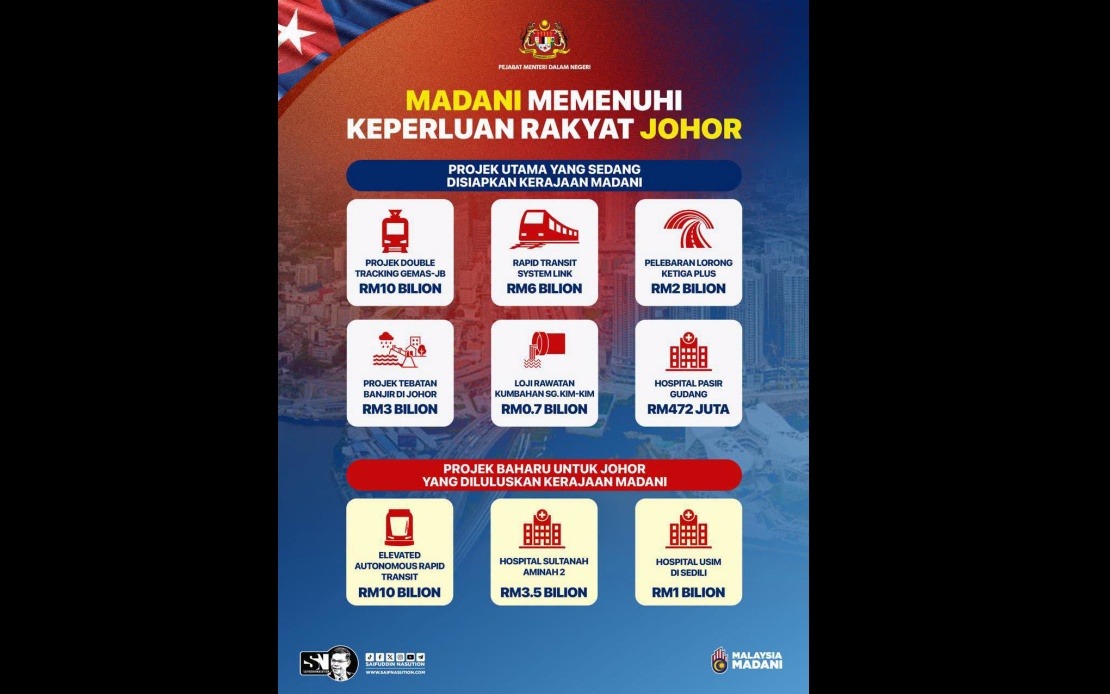
The federal government has reasserted its dedication to fostering equitable and sustainable development throughout Malaysia, with Johor emerging as a focal point for major capital investments and infrastructure modernisation. Datuk Seri Saifuddin Nasution Ismail, who serves as both Home Minister and secretary-general of Pakatan Harapan, underscored this commitment during recent remarks, positioning the MADANI Government's agenda as one centred on tangible improvements to citizens' everyday lives rather than headline-grabbing announcements alone.
Under Prime Minister Datuk Seri Anwar Ibrahim's oversight, the government has identified four primary pillars for regional advancement: infrastructure development, public transportation networks, healthcare accessibility, and disaster mitigation. This multi-sector approach reflects a recognition that sustainable progress cannot be achieved through isolated projects but rather through coordinated interventions that address interconnected social and economic needs. The emphasis on flood mitigation is particularly significant for Johor, a state historically vulnerable to monsoon-related inundation that has disrupted communities and hampered economic productivity.
Johor's development trajectory has entered what officials characterise as a consolidation phase, marked by the maturation of several cornerstone projects already underway. The Gemas-Johor Bahru Electrified Double Tracking Project represents a major step forward in rail connectivity, promising to enhance freight and passenger movement while reducing road congestion. Similarly, the Rapid Transit System Link is designed to integrate public transport networks more seamlessly, addressing mobility challenges that have long plagued the southern corridor and its growing urban centres.
Road infrastructure improvements form another critical element of the development roadmap. The third lane widening initiative on the PLUS Highway addresses capacity constraints on one of Southeast Asia's busiest commercial corridors, facilitating smoother movement of goods between Peninsular Malaysia and Singapore whilst reducing travel times for commuters. This project carries implications beyond Johor itself, as it supports the broader regional trade ecosystem that depends on efficient overland routes.
Healthcare expansion represents a particularly noteworthy dimension of the government's commitment. The existing Pasir Gudang Hospital serves a growing population in Malaysia's southernmost conurbation, yet capacity pressures have been evident for years. The forthcoming Sultanah Aminah Hospital 2 and USIM Hospital in Sedili signal a deliberate strategy to decentralise healthcare provision, reducing patient burdens on existing facilities whilst bringing tertiary-level services closer to communities in peripheral areas. This aligns with the government's broader vision of equitable access to quality medical care regardless of geographical location.
The proposed Elevated Autonomous Rapid Transit system warrants closer examination as an example of how the MADANI administration is attempting to marry technological innovation with practical urban mobility challenges. Such systems represent emerging global best practice in congested urban environments, and their deployment in Johor would position the state as a testbed for advanced transport solutions within Southeast Asia. Success here could generate valuable lessons applicable to other Malaysian urban centres grappling with similar congestion and environmental concerns.
Crucially, Saifuddin Nasution distinguished between development measured solely through monetary investment figures and development understood through its impact on ordinary Malaysians. This distinction carries ideological weight within the MADANI framework, signalling a pivot away from infrastructure projects pursued for their own sake towards those delivering concrete societal benefits. Job creation emerging from these initiatives, efficiency gains in transportation and healthcare delivery, and measurable improvements in quality of life metrics represent the true scorecard against which progress should be judged.
The sequencing and prioritisation of these projects reflect a government attempting to balance immediate relief with longer-term structural transformation. Flood mitigation addresses acute vulnerabilities affecting thousands of households annually, whilst transport and healthcare investments support sustained economic dynamism and population retention in the region. The sewage treatment facility at Sungai Kim Kim addresses an environmental legacy issue in Pasir Gudang, one of Malaysia's industrialised areas, demonstrating commitment to remedying past neglect.
For Malaysian observers and policymakers elsewhere in Southeast Asia, this Johor-focused development narrative offers insights into how federal governments attempt to build political coalitions across diverse regions whilst maintaining strategic coherence. By anchoring substantial capital investment in a state with mixed political demographics and longstanding infrastructure deficits, the MADANI Government signals intent to transcend partisan boundaries in delivering tangible improvements. The multiplier effects of such investments—through employment, business opportunities, and improved competitiveness—potentially create constituencies of support reaching beyond traditional party affiliations.
The regional context further amplifies the significance of Johor's development trajectory. As the gateway state to Singapore and a node within the broader Growth Triangle economic framework, Johor's infrastructure quality and service provision directly influence Malaysia's competitive positioning within regional supply chains and trade networks. Investments here therefore carry implications extending well beyond state boundaries, affecting how efficiently goods and services flow between Malaysia and its neighbours and how effectively the country integrates into regional economic structures.
Looking ahead, the success of these initiatives will depend substantially on implementation rigour, coordination between federal and state authorities, and sustained political commitment through electoral cycles. Regional governments across Southeast Asia face comparable development pressures, and the manner in which Malaysia navigates competing demands for capital allocation, maintenance of fiscal discipline, and environmental sustainability will generate lessons—positive and cautionary—for the broader region.

