The MADANI Government's commitment to serving vulnerable populations through its Ziarah Kasih initiative remains steadfast, with officials confirming the programme will continue as a cornerstone of the administration's people-centric governance agenda. The assistance initiative, which operates through identification mechanisms coordinated by the Department of Information and Komuniti MADANI, targets households facing acute hardship and represents a tangible expression of the Malaysia MADANI vision centred on prioritising citizen welfare.
Abdullah Izhar Mohamed Yusof, serving as political secretary to the Communications Minister, articulated the government's ongoing dedication to the scheme during an appearance at the Jiwa@Komuniti MADANI Sembang Santai World Cup Edition event held in Endau, Mersing. His presence at the engagement reflected the high-level political attention the programme receives within the MADANI administration. The visibility of such initiatives underscores how the government positions direct assistance as a policy vehicle for bridging the gap between state capacity and citizen need, particularly among populations that fall outside conventional welfare mechanisms.
The operational structure of Ziarah Kasih demonstrates a deliberate approach to identifying beneficiaries. Rather than relying solely on application-based systems that may exclude those with limited awareness of government programmes or digital access, the Department of Information works alongside Komuniti MADANI to conduct community assessments and identify households requiring intervention. This proactive identification methodology addresses a critical challenge in Malaysian social policy: ensuring that assistance reaches those most marginalised and least likely to navigate bureaucratic pathways independently. The approach recognises that genuine vulnerability often correlates with limited access to information infrastructure.
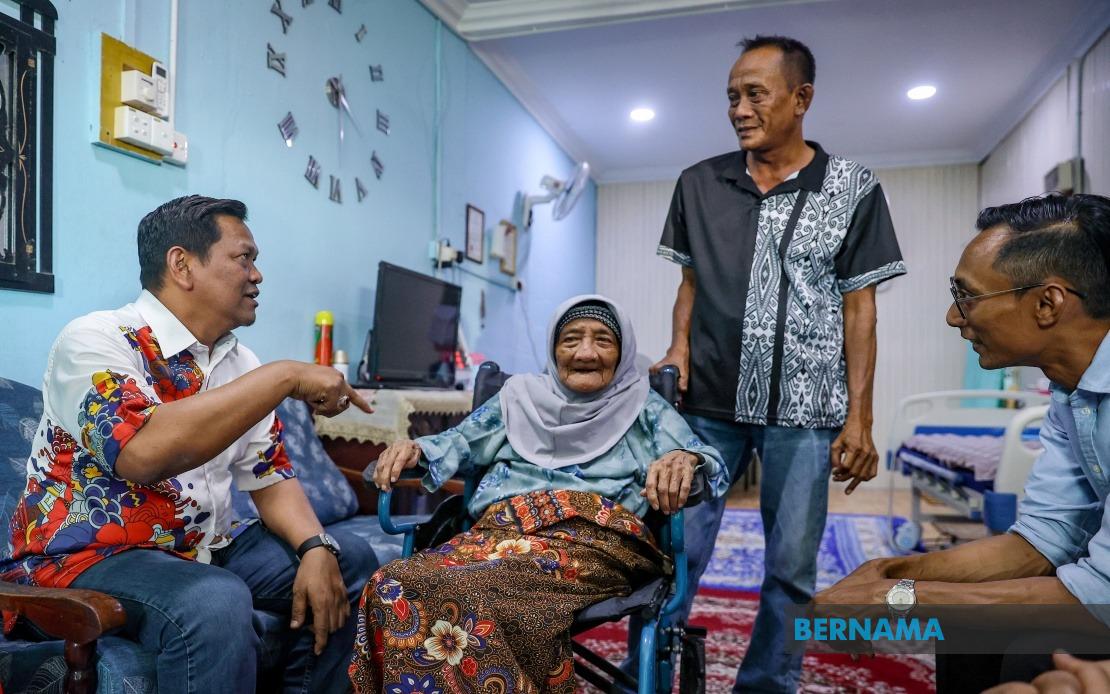
During the Mersing programme, Abdullah Izhar visited multiple recipients and distributed both financial contributions and healthcare equipment, illustrating how Ziarah Kasih extends beyond monetary assistance to address specific material deficits within vulnerable households. One beneficiary, 71-year-old Hamdan Abd Latif, represented a profile typical of many Ziarah Kasih recipients: individuals facing catastrophic health events that cascade into broader economic collapse. Hamdan's experience commenced with a fishing accident in 2011, just weeks before his intended retirement as a firefighter, an incident that exposed an underlying brain tumour and subsequently triggered a sequence of medical interventions and health deterioration.
Hamdan's case illuminates how individual accidents or illnesses can destabilise entire family structures in Malaysia's context, where social safety nets often prove inadequate. His wife, Meriam Abd Wahab, now 66, had previously supplemented household income through sewing work but abandoned this income source to provide full-time care following a stroke that left Hamdan bedridden. The assistance provided through Ziarah Kasih operates within this constraint: it cannot restore Hamdan's mobility or reverse Meriam's foregone earnings, but it materialises recognition of their predicament and provides breathing room within impossible household economics. For families in such circumstances, even modest government assistance carries disproportionate significance.
Another recipient, 91-year-old Zainon Ibrahim, exemplifies emerging demographic pressures within Malaysian society as populations age without corresponding expansion of institutional care capacity. Her son, Jamaluddin Ismail, terminated employment approximately two years prior to pursue full-time filial caregiving, a decision reflecting both cultural expectations around family responsibility and the practical inadequacy of formal aged care infrastructure. His siblings contribute support, yet the household remains vulnerable to economic shocks. That Jamaluddin, a former supervisor, describes the government assistance as helping meet basic daily needs rather than solving underlying insufficiency suggests the modest quantum of Ziarah Kasih allocations within the broader context of caregiving burdens.
The programme's continuation carries particular significance for Johor and the broader southern region, where Mersing's demographic composition reflects Malaysia's heterogeneous geography of vulnerability. Coastal and rural districts often experience constrained economic opportunities, with populations dependent on resource-extraction sectors vulnerable to commodity fluctuations and environmental degradation. The visible presence of the Communications Ministry's political secretary in Mersing signalled political attention to Johor constituencies, an important consideration in Malaysia's competitive electoral landscape and the government's need to demonstrate tangible delivery in constituencies where support remains fluid.
Ziarah Kasih operates within a broader Malaysian social policy framework that has historically relied heavily on targeted assistance rather than universal programmes. Unlike healthcare systems or pension schemes that operate on predictable rules applied equally, discretionary assistance initiatives depend on accurate identification and consistent resource allocation—both vulnerable to political fluctuation and implementation inconsistency across different administrations or officials. The MADANI Government's public reaffirmation of commitment to Ziarah Kasih thus carries policy messaging value, signalling to beneficiaries that the initiative will not be abruptly terminated while also projecting an image of responsive governance.
The engagement format itself—combining the World Cup-themed community seminar with direct assistance distribution—reflects contemporary Malaysian governance communication strategies that emphasise accessibility and informality. The "Sembang Santai" (casual conversation) framing suggests an attempt to position government assistance not as bureaucratic dispensation but as neighbourly support, though the structured nature of beneficiary identification and resource distribution necessarily maintains hierarchical power dynamics between state and recipient.
For vulnerable Malaysians like Hamdan and Zainon, Ziarah Kasih represents one of limited options for accessing government support outside formal employment-based schemes or means-tested programmes they may not have accessed independently. The programme's continuation therefore maintains a critical lifeline for populations experiencing compounding vulnerabilities—age, illness, caregiving responsibilities, and limited economic capacity. As Malaysia's population ages and economic pressures on lower-income households intensify, the adequacy and scope of such initiatives will likely become increasingly contested political questions. The government's reiterated commitment signals awareness of this reality, even as the quantum of assistance provided reflects fiscal and political constraints on welfare expansion.