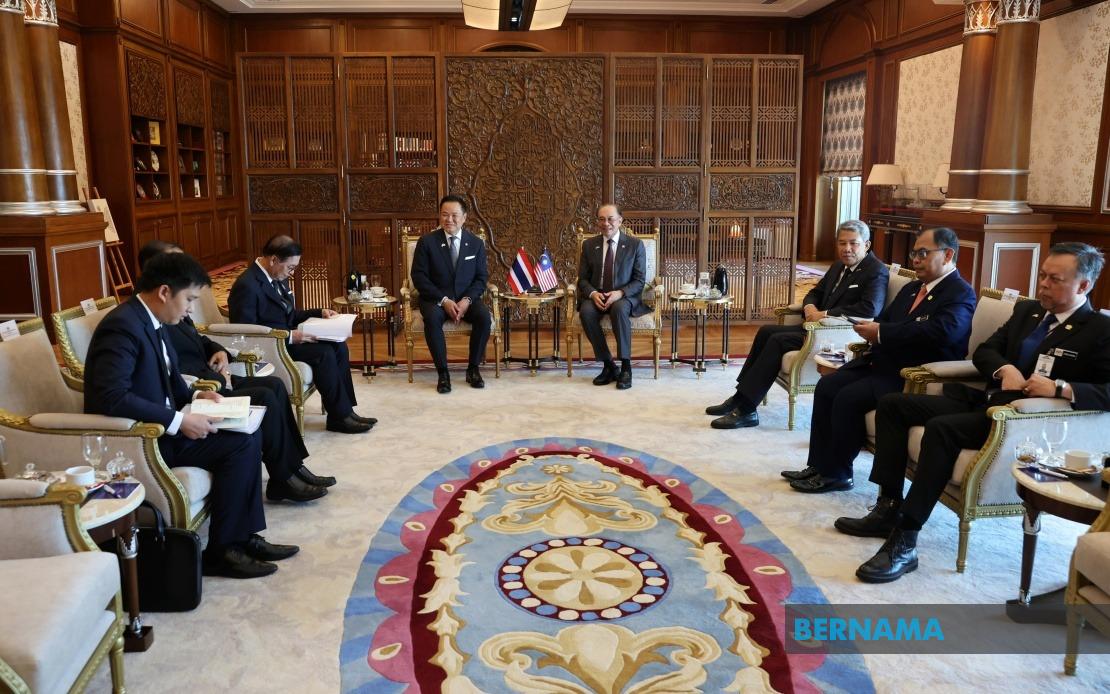
Malaysia continues to champion dialogue and negotiation as the pathway forward for resolving Myanmar's protracted political crisis, with Prime Minister Datuk Seri Anwar Ibrahim emphasising the importance of allowing Myanmar's people to shape their own destiny. Speaking during bilateral discussions with visiting Thai Prime Minister Anutin Charnvirakul in Putrajaya on Thursday, Anwar articulated Malaysia's conviction that effective engagement offers the most promising route out of the deadlock that has persisted since the military seizure of power in 2021. His comments underscored Kuala Lumpur's broader regional diplomacy strategy, which seeks to position ASEAN as a meaningful mediator in resolving conflicts that threaten the bloc's stability and cohesion.
The Malaysian Premier placed particular emphasis on Thailand's capacity to influence developments in Myanmar, given Bangkok's geographical proximity and established relationships with multiple stakeholders. Anwar characterised Thailand not merely as a neighbour but as an important friend capable of advancing reconciliation efforts and encouraging dialogue among parties to the conflict. This framing reflects recognition within Malaysian policymaking circles that progress on Myanmar will likely require active involvement from countries with leverage and credibility across the region. Thailand's position as Myanmar's immediate neighbour, combined with its ASEAN membership and historical ties, positions it uniquely to facilitate communication channels and encourage commitment to negotiated settlements.
The Myanmar question has remained contentious within ASEAN since the 2021 military coup, testing the bloc's consensus-based decision-making processes and commitment to non-interference doctrines. ASEAN's Five-Point Consensus, adopted in April 2021, sought to establish principles for addressing the crisis but implementation has proven challenging amid entrenched positions and competing regional interests. Malaysia has consistently advocated for sustaining diplomatic pressure while respecting Myanmar's sovereignty, a delicate balance that attempts to preserve both ASEAN unity and meaningful engagement on human rights and democratic principles.
Anwar's remarks also reflected broader frustration within Southeast Asian capitals regarding the limitations of current approaches to resolving Myanmar's political standoff. The continuation of the crisis affects regional stability, refugee flows, cross-border security, and economic connectivity across the Mekong region. Malaysia, as a country hosting significant Myanmar refugee populations and maintaining significant economic ties across the border, has direct interests in achieving sustainable resolution. The emphasis on Myanmar's people determining their future suggests Malaysia believes that any durable settlement must eventually incorporate inclusive political processes and voice from civil society, rather than solutions imposed through military force or external pressure alone.
During the same bilateral discussions, Anwar also addressed the Thailand-Cambodia border dispute, a separate source of regional tension that has periodically threatened ASEAN stability. The Malaysian Premier expressed appreciation for Thailand's dedication to maintaining peace along its frontier and commended what he characterised as Anutin's collaborative approach to managing the sensitive boundary issue. Anwar indicated Malaysia's willingness to facilitate dialogue and remain engaged with developments affecting regional peace, reflecting Malaysia's self-positioning as a neutral mediator capable of building consensus across contested issues. This multifaceted approach to regional diplomacy demonstrates how ASEAN members attempt to manage competing security challenges while preserving collective identity.
Anwar reiterated Malaysia's confidence in the wisdom and good faith of the leaders directly involved in border disputes, signalling trust in bilateral negotiation mechanisms whilst simultaneously affirming ASEAN's commitment to collective regional stability. The statement represents a careful diplomatic position that avoids appearing to favour either party whilst explicitly endorsing peaceful resolution modalities. For Southeast Asian watchers, such language indicates Malaysia's preference for incremental progress over confrontation, reflecting a diplomatic culture that emphasises saving face and preserving relationships as prerequisites for substantive negotiations.
Thailand's Prime Minister Anutin's two-day official visit to Malaysia, his first bilateral engagement with Kuala Lumpur since his reappointment in March 2026, underscores the importance Bangkok and Putrajaya place on bilateral coordination. The scheduling of the visit and its high-level nature suggest both governments view their partnership as foundational to regional stability efforts. Thailand's recent government formation and Anutin's consolidation of his position have created opportunity for renewed diplomatic engagement across Southeast Asia, with Malaysia positioned to strengthen ties and coordinate approaches on transnational issues.
A significant symbolic element of the bilateral visit involves the joint opening of border infrastructure connecting Bukit Kayu Hitam in Kedah with Sadao in Thailand. On Friday, Anwar and Anutin jointly inaugurated the road linking the Immigration, Customs, Quarantine and Security Complex in Bukit Kayu Hitam with its Thai counterpart, the Customs, Immigration and Quarantine Complex in Sadao. This infrastructure project represents practical cooperation addressing cross-border mobility and trade facilitation, demonstrating how bilateral partnerships extend beyond political dialogue into concrete economic and administrative cooperation. The ICQS and CIQ complexes represent modern border management approaches designed to streamline legitimate commerce whilst maintaining security screening.
For Malaysian stakeholders, improved border infrastructure with Thailand carries significant implications. Enhanced connectivity reduces trade friction and transportation costs for Malaysian exports transiting through Thailand to markets throughout mainland Southeast Asia. The facility also addresses historical inefficiencies that have constrained cross-border commerce and contributed to informal trading networks. From a security perspective, modern border facilities with integrated inspection capabilities support regional efforts to combat smuggling, trafficking, and illicit trade whilst facilitating legitimate economic activity. The joint opening ceremony itself signals both governments' commitment to practical, confidence-building measures that complement higher-level political dialogue.
The convergence of Myanmar diplomacy, border management, and bilateral cooperation reflects broader Southeast Asian patterns in which regional stability depends upon multiple simultaneous engagements rather than single-issue negotiations. Malaysia's engagement with Thailand demonstrates how middle-power diplomacy attempts to leverage partnerships with strategically positioned neighbours to advance collective interests. As Myanmar's political crisis persists and ASEAN grapples with challenges to regional consensus, such bilateral coordination between key member states becomes increasingly important for maintaining bloc cohesion and effectiveness. Anwar's articulation of Malaysia's Myanmar approach, combined with practical cooperation on border matters, illustrates how Southeast Asian diplomacy integrates political messaging with concrete institutional development.

