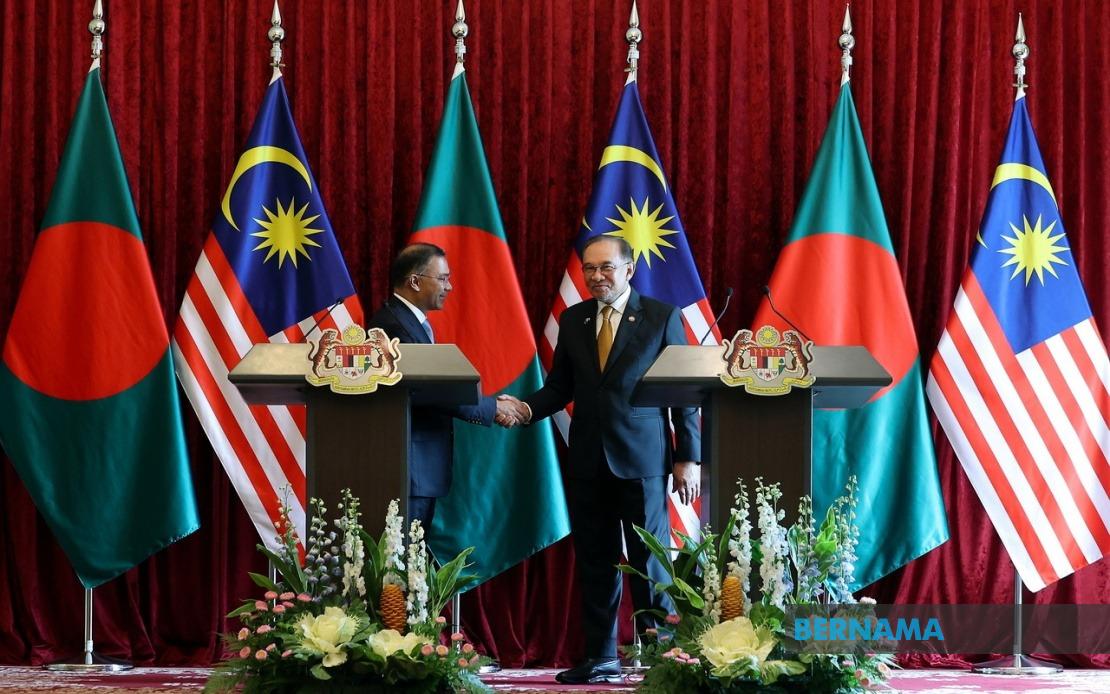
Prime Minister Datuk Seri Anwar Ibrahim and visiting Bangladesh Prime Minister Tarique Rahman have charted an ambitious course to deepen defence relations between the two nations, signalling a significant expansion of military and strategic cooperation that reflects broader regional security dynamics in South and Southeast Asia. The commitment to operationalise their existing Memorandum of Understanding on Defence Cooperation marks a transition from symbolic gestures to concrete institutional frameworks designed to foster tangible collaboration across multiple defence domains.
The two leaders, addressing the occasion of Tarique Rahman's official visit to Putrajaya, emphasised that the relationship between Malaysia and Bangladesh already benefits from a solid foundation of longstanding military ties. Regular high-level visits among defence officials, structured personnel training initiatives, and goodwill naval port calls have established institutional channels through which both nations maintain dialogue and mutual understanding. This existing architecture provides the scaffolding upon which the leaders intend to construct more ambitious collaborative ventures that address contemporary security challenges affecting the region.
Central to the expanded cooperation is the establishment of a bilateral Joint Committee on Defence Cooperation, tasked with developing a comprehensive strategic defence roadmap. This committee structure reflects international best practices in formalising defence partnerships and signals both nations' intent to move beyond ad-hoc engagements toward systematic, multi-year planning that aligns military capabilities and strategic objectives. The roadmap will presumably address priorities ranging from naval cooperation in shared maritime spaces to land-based defence challenges, creating a blueprint for decade-long collaboration.
A significant component of the partnership involves capacity enhancement through educational and training exchanges. Both countries have agreed to provide mutual seat allocations at their respective National Defence Colleges and Command and Staff Colleges, enabling senior military officers from each nation to gain exposure to different strategic thinking traditions and operational doctrines. Such exchanges foster personal relationships among military leadership while promoting cross-fertilisation of defence concepts, ultimately strengthening the professionalism and perspectives of officer corps in both nations.
The defence partnership explicitly addresses the increasingly complex global security environment by focusing on United Nations peacekeeping operations. Malaysia and Bangladesh, both active contributors to UN peacekeeping missions across Africa, Asia, and the Middle East, recognise mutual benefit in conducting joint tactical exercises and coordinating pre-deployment training. By harmonising their approaches to peacekeeping operations and sharing expertise gained from field experience, both nations can enhance their effectiveness in future UN-mandated missions while positioning themselves as reliable international security partners.
Counterterrorism and the prevention of violent extremism constitute another pillar of the defence cooperation agenda. The leaders reaffirmed their commitment to combating terrorism in all its manifestations, acknowledging that both Malaysia and Bangladesh face distinct but related security threats from extremist networks. Intelligence sharing, information exchange, and the dissemination of best practices in counterterrorism operations will enable both nations to enhance their security apparatus. This dimension is particularly relevant for Malaysia, which has long been concerned about the movement of fighters and financing networks connected to regional and international terrorist organisations.
Beyond the purely military dimension, the partnership extends into education and academic collaboration, reflecting recognition that long-term strategic alignment requires people-to-people connections and knowledge exchange. The presence of approximately 11,000 Bangladeshi students in Malaysian universities represents a significant educational investment and creates an alumni network that will maintain bilateral ties for decades. Both leaders acknowledged that these students contribute meaningfully to academic exchange while generating socio-economic linkages that extend beyond their time in Malaysia, as returning graduates often maintain professional and cultural connections to their host country.
The educational cooperation framework emphasises mutually recognised qualifications, joint degree programmes, and flexible learning pathways, particularly in technical and vocational education. This focus reflects both nations' understanding that graduate mobility and skills development are essential for economic competitiveness in an increasingly globalised labour market. By aligning academic programmes with priority sectors and labour market needs, Malaysia and Bangladesh can ensure that educational partnerships generate tangible economic benefits while addressing skills gaps in critical industries such as advanced manufacturing, healthcare, and information technology.
Tourism constitutes an unexpected but potentially lucrative dimension of the partnership, with both leaders expressing enthusiasm for expanding travel between the two countries. Malaysia's 2026 campaigns—Visit Malaysia 2026 and Malaysia Year of Medical Tourism 2026—provide concrete occasions for intensifying tourism promotion and cultural exchanges. The deliberate extension of a warm welcome to Bangladeshi travellers signals Malaysia's interest in diversifying its tourism market while generating economic activity in hospitality and service sectors. For Bangladesh, enhanced tourism cooperation offers opportunities to strengthen cultural understanding while providing recreational and educational opportunities for its growing middle class.
The scope and comprehensiveness of this partnership underscore the strategic importance both nations attach to deepening bilateral relations at a time of significant geopolitical flux in Asia. For Malaysia, strengthening ties with Bangladesh reinforces its position as a bridge between South and Southeast Asia while diversifying its security partnerships beyond traditional ASEAN-centric frameworks. For Bangladesh, deepening defence and educational cooperation with Malaysia offers access to regional security expertise and technological capacity while enhancing its international standing as a responsible stakeholder in regional affairs.
The partnership also reflects pragmatic recognition that neither nation can address contemporary security and development challenges in isolation. By institutionalising cooperation through formal committees, training exchanges, and intelligence sharing arrangements, Malaysia and Bangladesh create mechanisms for sustained engagement that transcend individual political administrations. The operationalisation of the defence MoU thus represents not merely a ceremonial commitment but a concrete investment in mechanisms designed to generate mutual benefits across military, educational, economic, and cultural domains for years to come.

