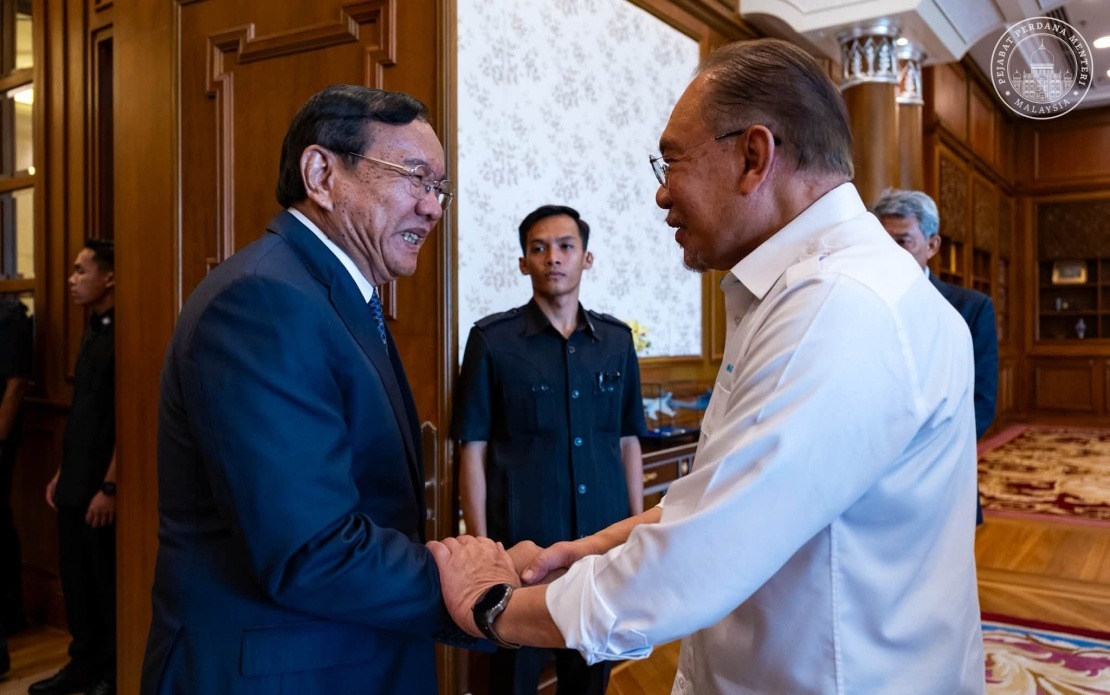
Prime Minister Datuk Seri Anwar Ibrahim has announced a significant expansion of Malaysia-Cambodia cooperation across multiple strategic sectors, marking a renewed commitment to deepening bilateral relations between the two Southeast Asian neighbours. The announcement came following discussions with Cambodian Deputy Prime Minister and Minister of Foreign Affairs and International Cooperation Prak Sokhonn, who arrived in Malaysia today for a two-day official visit that underscores the growing importance both nations place on their regional partnership.
The expanded cooperation framework addresses contemporary challenges and opportunities that reflect the evolving needs of both economies. Digital transformation and artificial intelligence have emerged as priority areas, reflecting broader regional efforts to harness technology for economic development and competitive advantage. Both countries recognise that technological advancement will be critical to positioning themselves within the evolving Southeast Asian economic landscape, particularly as the region competes globally for investment and talent in high-value digital sectors.
The halal industry represents another significant pillar of the renewed partnership, a sector where Malaysia maintains considerable expertise and market presence. Malaysia's established halal certification standards and supply chain networks position it as a natural partner for Cambodia's growing halal ecosystem. This cooperation extends beyond trade to encompass knowledge transfer, capacity building, and the development of halal-certified production facilities that can serve both domestic and regional markets. For Malaysian companies, particularly in food processing and manufacturing, expanded halal sector collaboration offers substantial commercial opportunities across Southeast Asia's growing Muslim consumer base.
Food security has gained prominence in bilateral discussions, reflecting regional vulnerabilities exposed by global supply chain disruptions and climate challenges. The cooperation agenda in this area likely encompasses agricultural technology sharing, agricultural research collaboration, and strategies for ensuring stable food supplies across both nations. Given Cambodia's significant agricultural production capacity and Malaysia's advanced farming technologies and distribution networks, such partnership creates complementary advantages that can enhance resilience across the region.
Human capital development constitutes a further dimension of the strategic framework, addressing skills training, educational exchanges, and workforce development initiatives. This reflects recognition that regional competitiveness ultimately depends on the quality and adaptability of human resources. Enhanced cooperation in this sphere may include tertiary education partnerships, vocational training exchanges, and professional development programmes that benefit workers in both countries while building deeper people-to-people connections.
Combating cross-border crime represents the security dimension of the partnership, addressing trafficking, smuggling, and organised criminal networks that operate across porous borders. The emphasis on this cooperation reflects shared concerns about transnational crime affecting both economies and populations. Enhanced intelligence sharing, joint enforcement operations, and coordinated border management protocols strengthen both nations' security apparatus while contributing to broader regional stability objectives.
The bilateral visit occurs in conjunction with the Third Malaysia-Cambodia Joint Commission for Bilateral Cooperation meeting scheduled for August 4, providing a formal institutional mechanism for translating these commitments into actionable programmes. The JCBC framework offers structured processes for implementing agreements, monitoring progress, and adjusting cooperation frameworks based on evolving circumstances and priorities. This institutional scaffolding distinguishes aspirational declarations from concrete policy implementation.
Timing the visit ahead of the 70th anniversary of diplomatic relations in 2027 carries symbolic significance beyond mere commemorative value. The acknowledgment of this milestone signals commitment to a long-term relationship extending well into the future. For Malaysia particularly, strengthening Cambodia ties aligns with broader regional diplomacy objectives within ASEAN, where constructive bilateral relationships support collective regional goals and enhance the bloc's overall coherence and effectiveness.
Both nations share responsibility as ASEAN member states for preserving regional peace and strengthening the unity necessary for realising ASEAN Community Vision 2045. Malaysia's emphasis on these shared regional responsibilities reflects understanding that bilateral partnerships serve broader collective interests. Cambodia's strategic location and development trajectory make it an important partner for Malaysia's regional influence and for realising pan-ASEAN objectives that require cooperation among member states of varying economic development levels and capacities.
The expansion of Malaysia-Cambodia cooperation comes against a backdrop of shifting geopolitical dynamics in Southeast Asia, where bilateral and regional partnerships have assumed heightened strategic importance. Enhanced economic interdependence through expanded cooperation in digital sectors, food security, and trade creates stakeholder constituencies in both countries with vested interests in stable, prosperous relations. Such mutual economic interest provides more durable foundations for partnership than diplomatic gestures alone.
For Malaysian businesses and investors, the expanded cooperation framework opens pathways into the Cambodian market whilst positioning Malaysia as a preferred partner for technology transfer, halal sector development, and agricultural modernisation. Conversely, Cambodian opportunities in these sectors align with Malaysia's growth ambitions and regional investment strategies. The formalisation of cooperation commitments provides business communities with greater certainty and institutional support for cross-border ventures.
The bilateral partnership also demonstrates Malaysia's approach to regional engagement: deepening ties with immediate neighbours through issue-specific cooperation frameworks that address shared challenges whilst creating mutual benefits. Rather than grand strategic declarations, the focus on concrete sectoral cooperation reflects pragmatic diplomacy oriented toward tangible outcomes that improve lives and expand economic opportunities in both countries.

