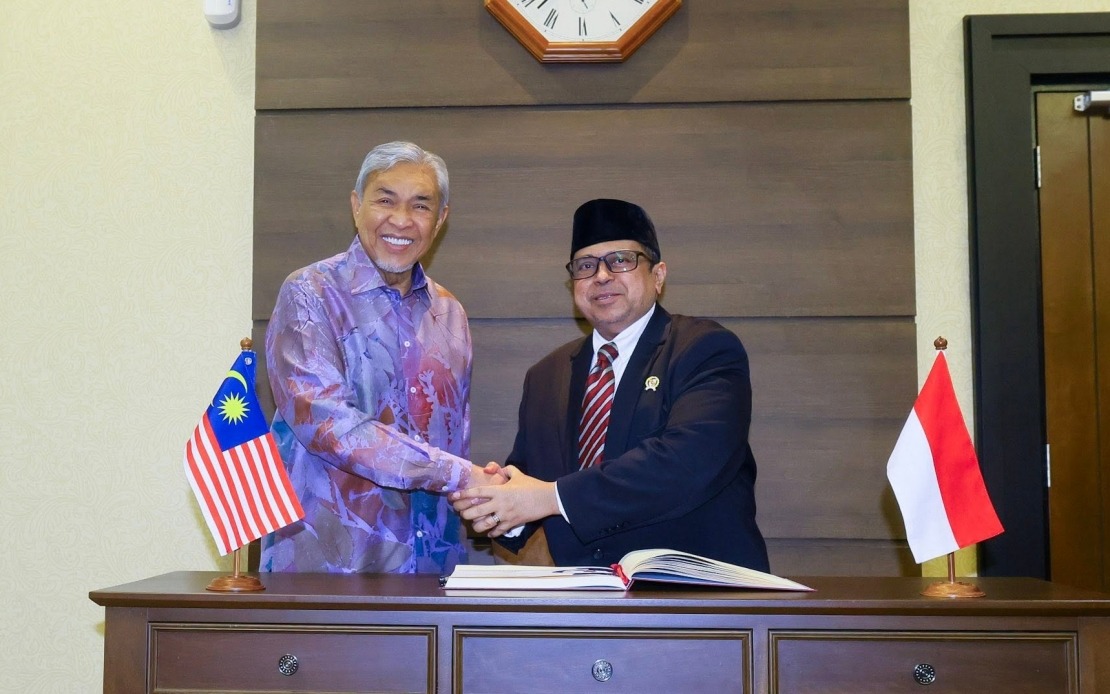
Malaysia and Indonesia are set to intensify their partnership across the halal industry, building on longstanding bilateral relations to create a more integrated regional halal ecosystem. Deputy Prime Minister Datuk Seri Dr Ahmad Zahid Hamidi outlined the expansion during a meeting with Indonesia's Ambassador to Malaysia, Raden Datuk Mohammad Iman Hascarya Kusumo, and Dr Ahmad Haikal Hassan, head of Indonesia's Halal Product Assurance Organising Body (BPJPH), at the Parliament building this week. The discussions reflected a shared commitment between the nations to leverage their respective strengths in Islamic commerce and certification standards.
Beyond halal development, Ahmad Zahid indicated that the two countries remain focused on broadening cooperation across multiple fronts including conventional trade, agricultural advancement and workforce development. This multi-sectoral approach underscores how halal industry initiatives are being positioned not as isolated initiatives but as part of a comprehensive economic partnership. For Malaysia, which has long positioned itself as a global halal hub, the collaboration offers opportunities to standardise practices across the region and reduce trade friction. Indonesia, as the world's most populous Muslim-majority nation with significant production capacity, brings complementary assets to such an alliance.
Central to the bilateral agenda is the proposed establishment of three interconnected institutional frameworks designed to harmonise halal certification and expand market opportunities. The Malaysia-Indonesia Halal Council (MIHC) would serve as a bilateral platform for direct coordination on standards and mutual recognition of certifications. Above this sits the envisioned ASEAN Halal Council, which would extend the framework to encompass the ten-member regional grouping, creating economies of scale for halal trade across Southeast Asia. Ahmad Zahid also referenced aspirations for a World Halal Development Council, signalling ambitions to shape global halal governance beyond the region.
The potential creation of these bodies addresses a long-standing challenge in international halal commerce: the fragmentation of standards and certification requirements across different markets. Currently, manufacturers and exporters operating in both Malaysian and Indonesian markets must navigate distinct regulatory regimes and obtain separate certifications, increasing compliance costs and slowing time-to-market for products. Harmonisation through these councils could streamline processes and make the region more competitive against other halal-certified export destinations. This is particularly significant for small and medium enterprises (SMEs), which constitute the backbone of both nations' halal sectors but often lack resources to manage multiple certification pathways.
Malaysia's existing infrastructure and expertise position it favourably within such arrangements. The country hosts the Halal Development Institute (HDI) and maintains globally recognised standards through the Department of Islamic Development Malaysia (JAKIM). Indonesian producers have increasingly sought Malaysian halal certification, recognising its international standing, even as Indonesia strengthens its own halal assurance mechanisms. The proposed councils would formalise knowledge transfer and create mutual recognition frameworks that benefit both parties while elevating regional competitiveness.
From an economic perspective, deeper halal sector integration holds significant implications for trade flows and investment patterns across Southeast Asia. The global halal market, currently valued at over US$2 trillion annually, continues expanding as Muslim consumer populations grow and awareness of halal compliance spreads beyond traditionally Islamic regions. Malaysia and Indonesia, combined, account for a substantial share of this market. By aligning standards and expanding bilateral investment in halal-certified production facilities, supply chains and distribution networks, both nations can capture larger portions of export opportunities in Middle Eastern, Asian and increasingly Western markets where halal products command premium prices.
Ahmad Zahid, in his capacity as chairman of the Malaysia Halal Industry Development Council, emphasised that strengthened cooperation between the two neighbours would generate tangible economic benefits beyond bilateral trade. The development of a more robust regional halal ecosystem attracts multinational corporations, technology providers and logistics operators to establish regional hubs in Malaysia or Indonesia. This clustering effect generates employment, spurs innovation and increases the sophistication of halal supply chains. SMEs gain access to shared infrastructure, training programmes and market intelligence that would be prohibitively expensive to develop independently.
The timing of these discussions reflects broader strategic considerations within Southeast Asia. As global supply chains reconfigure following pandemic disruptions and geopolitical shifts, regional economies are seeking ways to consolidate competitive advantages. The halal sector represents one arena where Malaysia and Indonesia possess distinct advantages rooted in their majority Muslim populations, established institutional frameworks and growing technical expertise. Unlike sectors where they might compete directly, halal industry development creates opportunities for complementary rather than zero-sum competition.
Implementation of these proposed councils will require substantial coordination across multiple government agencies, industry bodies and private sector participants in both nations. Technical standards must be negotiated and aligned; mutual recognition agreements require legal frameworks; capacity building initiatives need adequate funding. The involvement of BPJPH at the ambassadorial level signals that Indonesia is treating these discussions seriously at the highest governmental levels. Similarly, Ahmad Zahid's personal engagement reflects Malaysia's strategic prioritisation of this portfolio.
For Malaysian businesses, the significance extends beyond traditional halal manufacturers. Financial institutions are developing Islamic banking and insurance products tailored to support halal enterprise growth. Logistics providers are building cold chain and storage facilities meeting halal specifications. Technology companies are developing certification tracking systems and supply chain transparency tools. Deeper cooperation with Indonesia potentially unlocks these ancillary sectors alongside direct production benefits.
The collaborative framework also positions Malaysia and Indonesia to shape international halal standards rather than passively adopting standards set by other jurisdictions. This is particularly important as non-Muslim-majority countries increasingly regulate halal claims and consumers demand greater transparency about production methods. By establishing authoritative regional standards through MIHC and the broader ASEAN Council, the two nations can ensure that international best practices incorporate their perspectives and operational realities.
Stakeholders across both nations' halal industries will be watching closely for concrete deliverables from these discussions. The establishment of formal councils requires clear mandates, governance structures and funding mechanisms. Success will be measured not merely by the creation of institutional shells but by tangible outcomes such as mutual certification recognition, reduced compliance costs for exporters, expanded market access and increased bilateral trade volumes in halal products. The coming months will reveal whether these aspirations translate into actionable roadmaps with specific timelines and resource commitments.

