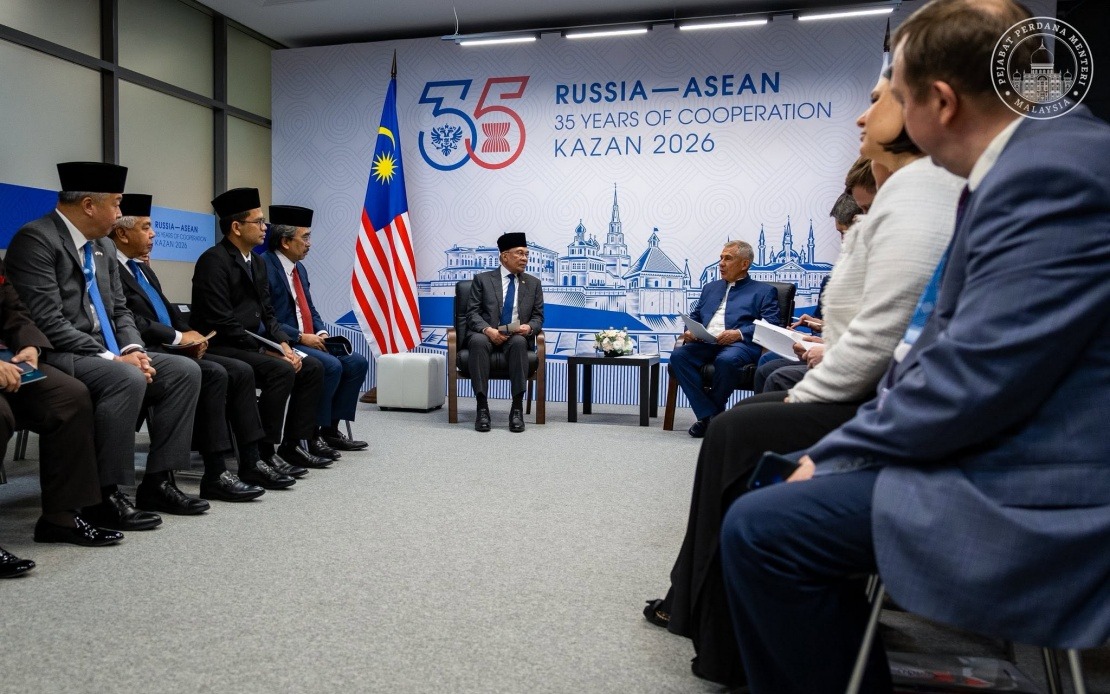
Prime Minister Datuk Seri Anwar Ibrahim has identified substantial scope for Malaysia to expand its bilateral engagement with the Republic of Tatarstan across multiple economic and cultural domains. During a bilateral meeting with Tatarstan's leader Rustam Minnikhanov shortly after arriving in Kazan on Tuesday, the two sides explored cooperation frameworks that span trade and investment, education, tourism, halal industry development, technology advancement and human capital development. The discussion signals Malaysia's strategic interest in establishing deeper connections with one of Russia's most economically dynamic regions, particularly at a time when Southeast Asian nations are seeking to strengthen ties with Moscow beyond traditional geopolitical alignments.
The energy sector emerged as a central focus of the dialogue, reflecting Tatarstan's significance as one of Russia's premier petroleum-producing regions. Anwar highlighted that Malaysia and Tatarstan possess complementary interests in the broader hydrocarbon value chain, extending beyond simple crude extraction to encompass downstream operations, petroleum refining and petrochemical manufacturing. This positioning is particularly relevant for Malaysia, which maintains significant refining and petrochemical capabilities and could serve as a conduit for Tatarstan's energy products into Southeast Asian markets. The emphasis on downstream integration suggests both countries recognise the limited value of raw commodity exchange and are contemplating more sophisticated industrial partnerships.
Beyond energy, the Malaysian delegation expressed keen interest in leveraging the Kazan Forum as a vehicle for catalysing commercial relationships and identifying investment opportunities. The bilateral discussions specifically referenced innovation ecosystems, digital economy development and strategic capital allocation as priority areas for future collaboration. This reflects a broader Malaysian strategy to position itself as a bridge between Russia and the Islamic world whilst simultaneously tapping into Tatarstan's technological and entrepreneurial capacities. The digital economy dimension carries particular significance, as both jurisdictions are navigating their respective digital transformation agendas and could benefit from shared expertise and investment flows.
Anwar's recognition of Kazan's designation as Islamic World Cultural Capital 2026 by the Islamic World Educational, Scientific and Cultural Organisation underscores Malaysia's appreciation of Tatarstan's unique position within the global Islamic world. This status reflects Kazan's historical prominence as a centre of Islamic learning, cultural production and innovative thinking within the Russian context. For Malaysia, which positions itself as a hub of Islamic finance, trade and technology, this convergence of interests creates opportunities for educational exchanges, cultural programmes and the development of Islamic-compliant financial instruments and commercial frameworks. The halal industry cooperation specifically mentioned by Anwar taps into Malaysia's established expertise in halal certification and supply chain management, sectors where Tatarstan could serve as both a market and a production hub.
Anwar also acknowledged President Vladimir Putin's establishment of the Strategic Vision Group, characterising this institution as a crucial mechanism for bridging Russia and the Islamic world. This framing situates Malaysia's bilateral engagement within a broader Russian diplomatic architecture designed to deepen Moscow's connectivity with Muslim-majority nations and communities. By endorsing this institutional framework, Anwar signals Malaysia's alignment with Russian efforts to forge substantive partnerships with Islamic societies, potentially opening pathways for Malaysia to participate in Russian-led initiatives across Central Asia and beyond.
The Prime Minister's visit to Kazan for the two-day ASEAN-Russia Commemorative Summit represents the highest-level diplomatic engagement between the regional bloc and Moscow. The summit itself underscores the evolution of ASEAN-Russia relations from their establishment in 1991 to Russia's elevation to full Dialogue Partner status in 1996 and subsequent designation as a Strategic Partnership in 2018. This historical progression demonstrates both parties' commitment to expanding cooperation across political, security, economic and socio-cultural dimensions, notwithstanding geopolitical complexities elsewhere. The Malaysian delegation's composition—including Investment, Trade and Industry Minister Datuk Seri Johari Abdul Ghani and Economy Minister Akmal Nasrullah Mohd Nasir—reflects the economic priority accorded to these discussions.
Kazan's geographical position and demographic character render it an appropriate venue for such engagement. Located approximately 800 kilometres east of Moscow at the confluence of the Volga and Kazanka rivers, the city functions as Russia's cultural and economic bridge to its Asian hinterland and Muslim communities. With a population exceeding 1.3 million, Kazan ranks as Russia's third-largest metropolitan centre after Moscow and Saint Petersburg. The city's millennia-spanning history and recognised status as a principal centre of Russian Islamic culture position it as a natural meeting point for dialogue between Russia and Muslim-majority Southeast Asian nations, facilitating conversations that transcend narrow energy diplomacy or geopolitical positioning.
For Malaysian policymakers and businesses, the bilateral framework established during this visit carries several implications. The emphasis on halal industry cooperation aligns with Malaysia's stated objective of becoming a global halal hub, potentially leveraging Tatarstan's position within the Russian and Central Asian markets. Educational and talent development initiatives could facilitate knowledge exchange in fields ranging from petroleum engineering to digital technologies, strengthening Malaysian institutional capabilities. Investment flows into Malaysian entities from Tatarstan's capital markets, though likely modest in absolute terms, could signal broader Russian diversification away from European markets toward Asian partners, a strategic reorientation with longer-term significance.
The bilateral agenda also reflects Malaysia's broader diplomatic strategy of maintaining balanced engagement across major powers whilst building substantive economic relationships. Rather than viewing Russia primarily through the lens of geopolitical competition or alignment, Malaysia approaches Moscow as a nation with specific regional assets—energy resources, technological capacity, strategic location—that merit focused bilateral engagement. This pragmatic approach contrasts with Western-centric frameworks and enables Malaysia to pursue its economic interests whilst building bridges between distant regions and civilisations. The Kazan meeting exemplifies this approach, prioritising tangible commercial and cultural outcomes over ideological positioning or geopolitical point-scoring.
Moving forward, the success of Malaysia-Tatarstan cooperation will depend upon translating bilateral dialogue into concrete institutional mechanisms and capital flows. The identification of potential collaboration areas must evolve into memoranda of understanding, business-to-business linkages and, ultimately, material commercial relationships. Energy sector engagement may prove most readily negotiable given existing Malaysian expertise in petroleum processing and regional demand for refined products. Halal industry cooperation could differentiate Malaysia's offering within the Russian and Central Asian markets, creating value-added services beyond commodity trading. Educational and technological partnerships require longer-term commitment but offer substantial spillover benefits for Malaysian human capital development and industrial upgrading. The coming months will reveal whether the diplomatic groundwork laid in Kazan translates into sustained economic engagement or remains largely symbolic.

