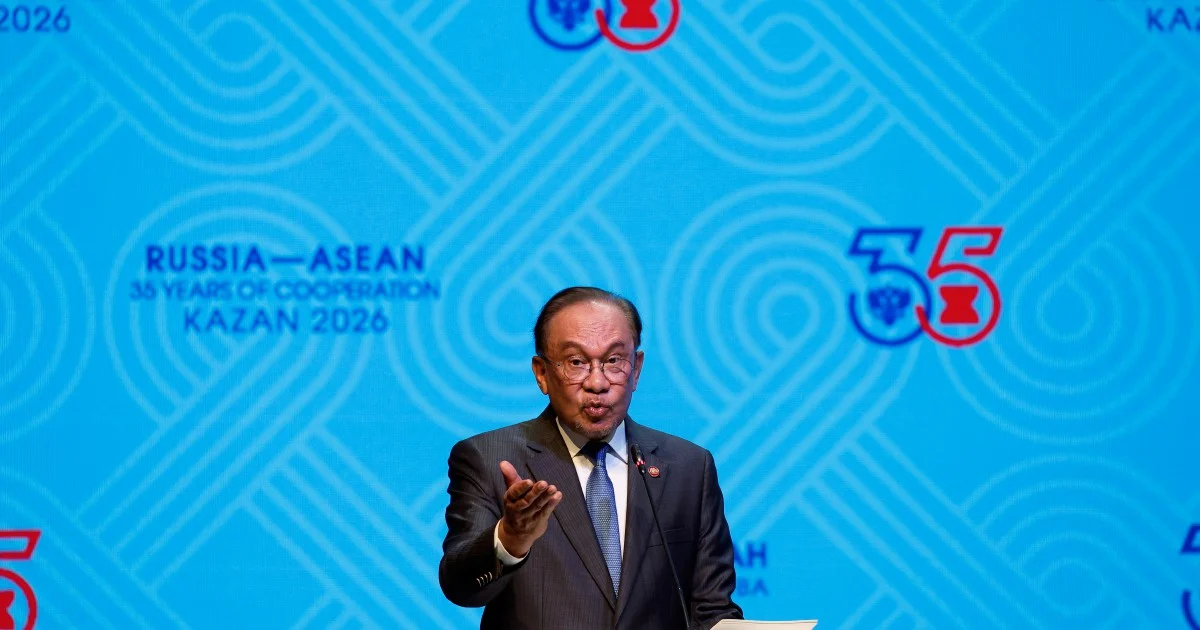
Prime Minister Datuk Seri Anwar Ibrahim has welcomed the completion of the Asean-Russia Strategic Programme on Trade and Investment Cooperation 2026-2035 as a foundational step toward strengthening economic partnerships across the region. Speaking in Kazan, Malaysia's top leader characterised the agreement's finalisation as providing momentum for the next phase of deepening ties between the 10-member Southeast Asian bloc and Russia, signalling both governments' commitment to broadening their commercial engagement in coming years.
The strategic programme represents a carefully negotiated framework designed to guide bilateral and multilateral trade flows, investment decisions, and economic cooperation activities over the next decade. By establishing clear parameters and shared objectives, the agreement aims to reduce barriers to commerce and create clearer pathways for businesses seeking to operate across Asean and Russian markets. For Malaysia specifically, such structured frameworks provide predictability and lower transaction costs for enterprises exploring opportunities in Russia and post-Soviet markets.
However, Anwar's remarks underscored a crucial reality that often separates successful trade initiatives from merely symbolic ones: ambitious roadmaps require tangible supporting conditions to deliver genuine economic benefits. His emphasis on the need for an enabling environment suggests awareness that trade frameworks alone cannot overcome persistent challenges such as infrastructure gaps, regulatory inconsistencies, sanctions-related complications, and currency instability that have historically hindered Asean-Russia commerce.
The timing of this programme reflects broader geopolitical repositioning within Southeast Asia. As regional nations navigate great-power competition and seek economic diversification beyond traditional Western markets, deepening ties with Russia offers an alternative avenue for trade, investment, and technological exchange. For Malaysia, which maintains careful diplomatic balance across competing global powers, such initiatives reinforce the country's non-aligned foreign policy stance while creating space for genuine commercial opportunity.
Asean-Russia trade relations have remained underdeveloped compared to the bloc's engagement with China, the United States, Japan, and Europe, despite significant potential. Russian natural resources, particularly energy products, and Asean's growing manufacturing and services sectors could complement each other more extensively. The new programme tacitly acknowledges this untapped potential and positions both sides to accelerate bilateral flows systematically over the coming decade.
Investment cooperation forms a particularly strategic pillar of the new framework. Russian capital in Asean and Southeast Asian investment in Russian ventures remain limited, constrained by geopolitical tensions, sanctions regimes affecting certain sectors, and unfamiliarity between business communities. A comprehensive cooperation programme can help address these information asymmetries and create institutional channels through which investors gain confidence in cross-border ventures.
Yet the practical implementation of such roadmaps depends heavily on the specifics of how both sides operationalise their commitments. Establishing dedicated bilateral business councils, streamlining customs procedures, harmonising technical standards, and resolving disputes expeditiously all require sustained attention from government and private sector actors. Malaysia, as a strong advocate for regional integration and an influential Asean voice, will likely play a key role in ensuring the programme translates from diplomatic language into concrete economic activity.
The programme's ten-year horizon also signals recognition that rebuilding trust and deepening engagement requires patience and consistent effort. Economic relationships fractured by geopolitical events cannot be restored overnight; the extended timeframe permits gradual confidence-building and allows both Asean and Russia to address structural obstacles systematically. For Malaysian businesses, this extended commitment provides reassurance that their investments in understanding and accessing Russian markets will be supported by stable governmental frameworks.
Anwar's acknowledgement that an enabling environment remains essential also reflects pragmatism about external constraints beyond Asean and Russian control. International sanctions, global supply chain disruptions, and technology restrictions imposed by Western powers continue to complicate business activity involving Russia. The programme cannot override these obstacles, but participating nations can work within them—developing alternative logistics routes, identifying non-sanctioned sectors for cooperation, and building resilience through diversification.
From a Malaysian perspective, the programme opens specific opportunities in sectors where the country possesses competitive advantages. Malaysian expertise in palm oil, rubber, petrochemicals, and financial services could find ready demand in Russian and Central Asian markets. Conversely, Russian technological capabilities and natural resources could support Malaysian industrial development and energy security objectives.
The finalisation of this strategic programme also carries symbolic importance for Asean's strategic autonomy. By developing comprehensive frameworks with non-Western powers, the bloc demonstrates its commitment to genuine multi-alignment rather than defaulting to Western-dominated regional arrangements. This reinforces Asean's capacity to shape its own economic destiny and resist pressure toward exclusive geopolitical camps.
Moving forward, the success of the Asean-Russia Strategic Programme 2026-2035 will ultimately depend on execution. Malaysian policymakers and business leaders should monitor implementation progress closely, identify sector-specific opportunities aligned with national development goals, and ensure that regulatory frameworks domestically support rather than hinder engagement. The roadmap provides the blueprint; translating it into sustained trade and investment growth requires sustained commitment from all stakeholders.

