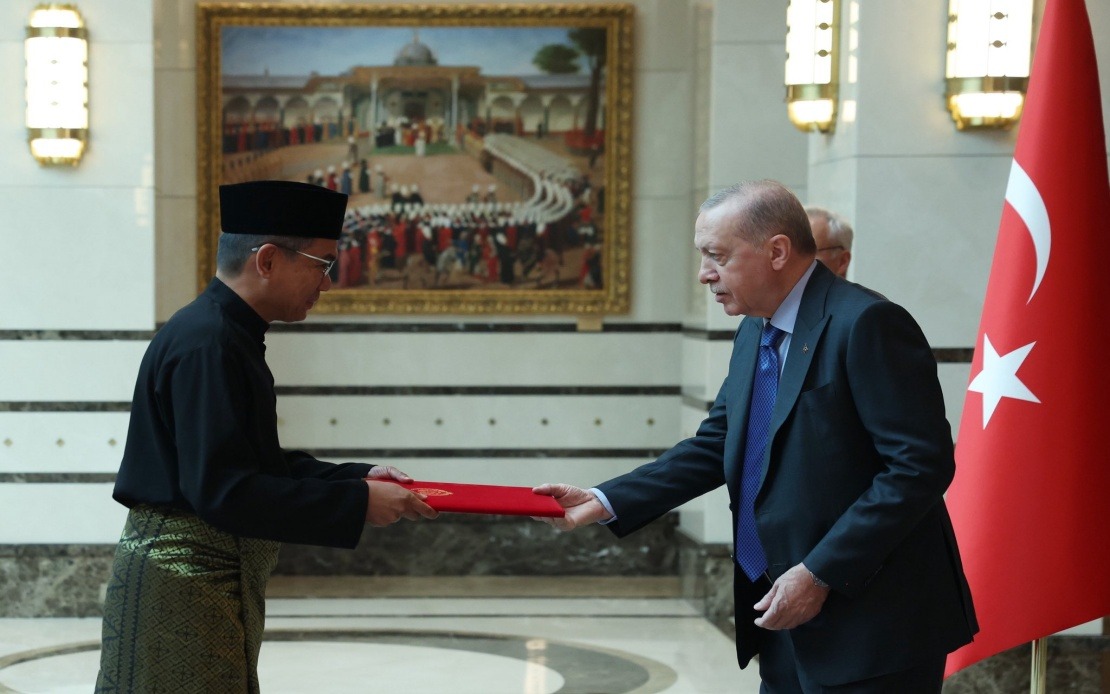
Malaysia has thrown its backing behind Türkiye's push to secure Dialogue Partner status within the ASEAN framework, signalling renewed diplomatic momentum between the two Muslim-majority nations. The endorsement came during a high-profile diplomatic ceremony in Ankara on June 17, when Malaysian Ambassador Adlan Mohd Shaffieq formally presented his credentials to Turkish President Recep Tayyip Erdoğan at the Presidential Complex.
The timing of this declaration reflects deepening ties between Malaysia and Türkiye, which have increasingly aligned on regional and global issues affecting the Muslim world. Ambassador Shaffieq used the formal occasion to underscore Malaysia's conviction that Türkiye deserves a more elevated role within the ASEAN architecture, having demonstrated substantive commitment to Southeast Asian affairs through expanding bilateral engagements. The ambassador's characterisation of Türkiye as an "increasingly important partner" for the region acknowledges Ankara's strategic pivot towards Southeast Asia, a shift that carries implications for the region's geopolitical balance and economic architecture.
Türkiye's pursuit of Dialogue Partner status represents a deliberate strategy to deepen its footprint in Southeast Asia at a time when major powers are competing for influence in one of the world's most dynamic regions. Dialogue Partner designation, while not conferring full membership, grants enhanced participation in ASEAN deliberations and mechanisms, allowing Türkiye to shape discussions on matters ranging from terrorism and trade to regional security architecture. For ASEAN, accepting Türkiye would expand the bloc's network of strategic partners and reinforce its centrality in regional diplomacy.
The relationship between Malaysia and Türkiye extends across multiple domains that reflect mutual interests in Islamic affairs, defence capabilities, and halal industry development. Malaysia's explicit acknowledgment of cooperation in these three sectors indicates a pragmatic partnership built on complementary strengths—Türkiye's defence manufacturing and Islamic institutional expertise aligns well with Malaysia's regional market access and halal certification authority. These partnerships create tangible economic benefits and reinforce soft power dynamics that serve both nations' broader geopolitical objectives.
Ambassador Shaffieq conveyed formal greetings from His Majesty Sultan Ibrahim, King of Malaysia, and Prime Minister Datuk Seri Anwar Ibrahim to President Erdoğan, injecting high-level political weight into the announcement. This courtesy reflects Malaysia's diplomatic protocol but also underscores the seriousness with which Kuala Lumpur views the relationship. The personal rapport between Prime Minister Anwar and President Erdoğan has become a cornerstone of bilateral relations, with both leaders sharing progressive visions for their respective nations' development trajectories.
Türkey's ambitions within the ASEAN framework must be understood against the backdrop of the country's broader foreign policy reorientation under Erdoğan's leadership. Ankara has systematically cultivated relationships across the Muslim world, investing heavily in economic partnerships and diplomatic presence across Asia, Africa, and the Middle East. Southeast Asia, with its substantial Muslim populations, strategic location astride global trade routes, and growing economic clout, represents a natural focal point for Turkish strategic engagement. ASEAN Dialogue Partner status would formalise what is already an increasingly substantive relationship.
President Erdoğan's publicly expressed confidence in the trajectory of bilateral trade relations signals Turkish optimism about the partnership's commercial potential. The stated aspiration to reach a US$10 billion trade target reflects ambition on both sides to transform the relationship from primarily political to increasingly economic in character. Current trade volumes likely fall considerably short of this figure, suggesting substantial room for growth in goods and services exchanges, investment flows, and technological cooperation.
Malaysia's vocal support carries particular weight because of its standing within ASEAN as both a founding member and a nation with considerable diplomatic influence. Malaysian backing provides political cover for other ASEAN members considering Türkiye's application and signals that accepting Türkiye would not create regional divisions. This is significant given that ASEAN's consensus-based decision-making process requires all ten members to acquiesce to new Dialogue Partner designations, making Malaysia's endorsement an important piece of the diplomatic puzzle.
The halal industry dimension of Malaysia-Türkiye cooperation deserves particular attention, as it represents an area where both nations can establish standards that influence global Muslim consumer markets. Malaysia's role as a halal certification hub and Türkiye's substantial food and pharmaceutical manufacturing base create natural complementarities. Deepening cooperation in this sector could position both countries as quality arbiters for the global halal economy, which exceeds US$2 trillion annually and continues expanding rapidly.
For Southeast Asia more broadly, welcoming Türkiye as a Dialogue Partner reflects a deliberate expansion of the region's diplomatic aperture beyond traditional great power relationships. ASEAN has consistently pursued a strategy of binding major powers and emerging influential states into the regional architecture as a means of managing great power competition and maintaining Southeast Asian agency. Adding Türkiye to this constellation of Dialogue Partners reinforces ASEAN's position as a pivotal platform for addressing issues of concern to a diverse array of states.
The defence and security dimensions of Malaysia-Türkiye cooperation also merit consideration. Türkiye possesses advanced defence capabilities and has become a significant arms exporter to multiple Southeast Asian nations. Formalising Türkiye's relationship with ASEAN through Dialogue Partner status could facilitate more structured defence cooperation, technology transfer arrangements, and military-to-military exchanges that enhance Malaysia's and other Southeast Asian nations' security capabilities.
Moving forward, Malaysia's backing for Türkiye's aspiration sets the stage for broader ASEAN consideration of the application. The diplomatic choreography surrounding Ambassador Shaffieq's credential presentation demonstrates how formal ceremonies serve as vehicles for conveying substantial policy messages and advancing strategic objectives. As ASEAN deliberates Türkiye's status, Malaysia's public endorsement will likely influence the calculus of other member states, potentially accelerating Ankara's path toward Dialogue Partner recognition and cementing Southeast Asia's evolving role as a theatre of great power and emerging state competition.

