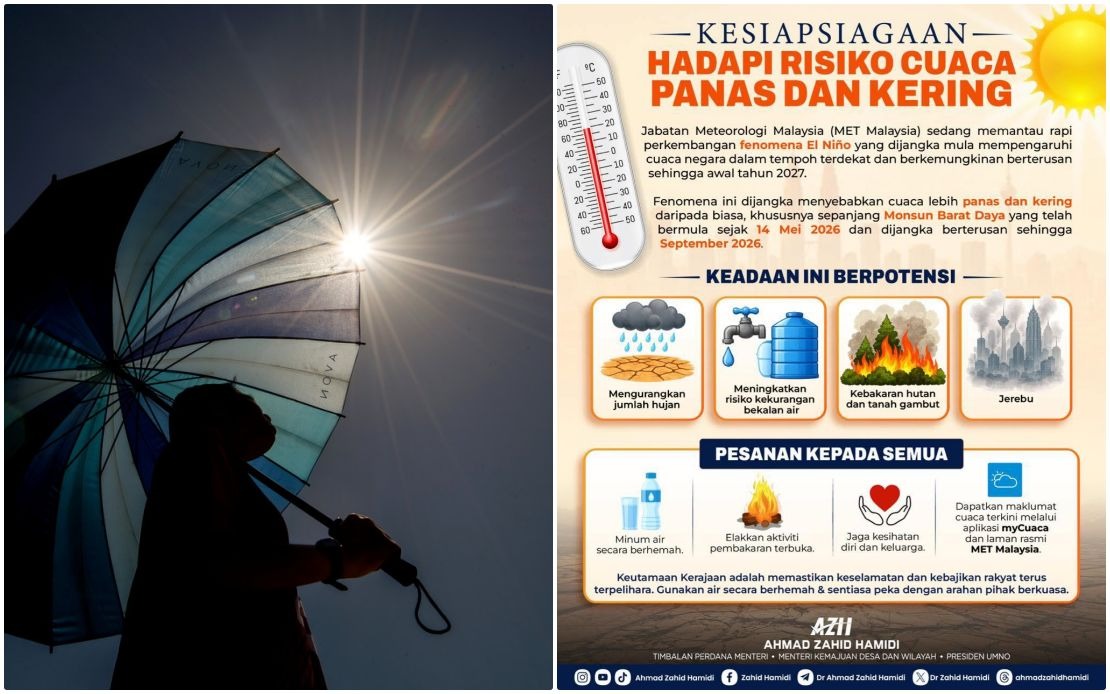
Malaysia faces an extended period of hotter and drier than normal weather conditions as the El Niño phenomenon is expected to take hold across the region and linger until the beginning of 2027, according to Deputy Prime Minister Datuk Seri Dr Ahmad Zahid Hamidi. Speaking in his capacity as chairman of the Central Disaster Management Committee, Ahmad Zahid issued a public advisory urging all Malaysians to take proactive steps in readying themselves and their households for the climatic challenges ahead. The timing of this announcement underscores growing governmental concern about the cascading effects that prolonged drought conditions could impose on water availability, agricultural productivity, and environmental stability across the nation.
The El Niño pattern is particularly significant because of its interaction with the Southwest Monsoon, which commenced on May 14 and is projected to continue through September. This convergence of seasonal wind patterns and oceanic warming is expected to suppress rainfall in multiple regions throughout the country, fundamentally altering precipitation regimes that communities have historically depended upon. The combination creates a compounding meteorological stress that extends beyond merely uncomfortable temperatures to encompass genuine infrastructure and resource management challenges. For a nation where water security and forest conservation remain pressing policy concerns, the prospect of sustained dry conditions carries measurable economic and environmental implications.
The ramifications of reduced rainfall extend well beyond inconvenience. Ahmad Zahid specifically flagged the heightened risk of water shortages, which could strain both urban supply systems and agricultural operations dependent on consistent moisture availability. Additionally, the drier atmospheric conditions and ground moisture deficits substantially elevate the danger of uncontrolled forest fires and peatland combustion—particularly acute concerns in a region where transboundary haze episodes have repeatedly disrupted air quality across Southeast Asia and created public health crises. Previous El Niño events have demonstrated the region's vulnerability to these cascading environmental impacts, making the current forewarning an opportunity for preventative action rather than reactive crisis management.
In his statement disseminated through social media, Ahmad Zahid articulated a multi-faceted response strategy centred on public vigilance and responsible individual behaviour. He specifically encouraged citizens to monitor weather developments closely, employ water conservation measures in their daily activities, and refrain from open burning practices that could ignite fires in drought conditions. The advisory also emphasised protecting vulnerable populations—the elderly, children, and those with pre-existing respiratory or cardiovascular conditions—from heat-related health complications. This layered approach recognises that climate resilience depends not solely on government infrastructure investments but equally on collective behavioural shifts that reduce overall demand and minimise unnecessary risk factors.
To facilitate informed decision-making among the public, Ahmad Zahid directed Malaysians toward the myCuaca mobile application and official meteorological department communications as authoritative sources for weather intelligence. The Malaysian Meteorological Department, under the direction of Dr Mohd Hisham Mohd Anip, serves as the primary technical authority on these phenomena. The emphasis on accessing verified information through official channels represents a deliberate effort to counter misinformation while ensuring that emergency preparedness efforts are grounded in reliable scientific data rather than speculation or rumour. In an era of rapid information dissemination through social networks, maintaining public trust in institutional weather forecasting remains essential for coordinated societal response.
The government has committed to sustained monitoring of meteorological conditions and implementation of proportionate contingency measures designed to safeguard population welfare throughout the forecast period. This ongoing surveillance posture suggests that various agencies—from water utilities to forestry services to health authorities—are being mobilised to strengthen defensive capabilities across multiple sectors. The coordination across emergency management, agricultural policy, environmental protection, and public health domains reflects recognition that climate phenomena of this magnitude generate interconnected challenges requiring integrated governance responses. Malaysian authorities appear intent on avoiding the reactive, crisis-driven approaches that have characterised previous environmental emergencies in the region.
The extended timeline until early 2027 represents a notably long forecast horizon, indicating that Malaysian planners should anticipate sustained operational adjustments rather than temporary emergency measures. Water management authorities may need to implement demand-side efficiency programmes, invest in storage infrastructure improvements, and establish inter-sector allocation priorities. Forest and peatland management agencies require adequate resourcing for preventative vegetation management, early warning systems, and rapid response capability. Agricultural sectors dependent on rainfall will benefit from information enabling crop selection and irrigation planning aligned with anticipated moisture availability. This extended timeframe creates opportunity for systematic preparation that can significantly reduce vulnerability.
For Malaysian residents accustomed to high humidity and reliable precipitation, the psychological and practical transition to genuinely arid conditions requires cultural and behavioural adaptation. Water conservation—from residential consumption patterns to industrial usage—demands shifting mindsets about resource abundance that have characterised a relatively water-secure nation. Public education campaigns demonstrating practical conservation techniques, explaining the science underlying the forecast, and building community-level preparedness networks can meaningfully enhance collective resilience. The Deputy Prime Minister's emphasis on individual responsibility complements top-down governance measures, creating potential for synergistic impact when both institutional and household-level actions align toward common objectives.
Regionally, Malaysia's El Niño vulnerability must be understood within the broader Southeast Asian context, where similar climatic stresses simultaneously affect neighbouring nations. Thailand, Indonesia, and other regional economies face comparable challenges, potentially constraining cross-border resource flows and amplifying competition for scarce commodities. This regional dimension adds strategic importance to Malaysia's preparatory efforts, as water security and agricultural stability cannot be viewed through a purely national lens. Coordinated regional approaches to drought management, fire suppression, and transboundary haze mitigation could prove more effective than purely national strategies, potentially requiring diplomatic engagement and resource-sharing frameworks.
The announcements from Ahmad Zahid and MetMalaysia represent the opening phase of what will likely be an extended engagement with climate variability and environmental management challenges. Success in weathering the El Niño period through 2027 will depend fundamentally on whether public advisories translate into sustained behavioural change, whether institutional preparedness translates into operational readiness, and whether the nation's water, agricultural, and environmental infrastructure proves adequately resilient. For Malaysian policymakers, this extended forecast window offers an invaluable opportunity to stress-test systems, identify vulnerabilities, and implement adaptive measures that strengthen societal climate resilience—benefits that will extend well beyond the current El Niño episode.