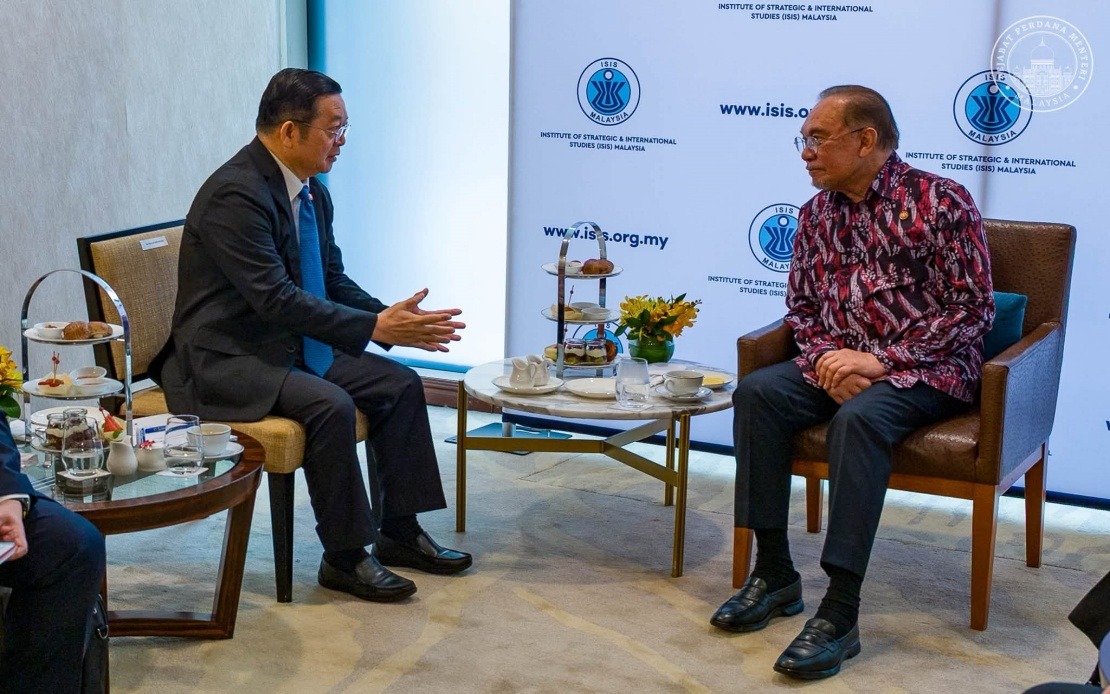
Prime Minister Datuk Seri Anwar Ibrahim has reaffirmed Malaysia's commitment to playing a constructive role in bolstering ASEAN as a cohesive, inclusive community that can deliver on the aspirations of its 650 million citizens. Speaking following a meeting with ASEAN Secretary-General Dr Kao Kim Hourn at the 39th Asia-Pacific Roundtable in Kuala Lumpur, Anwar underscored Malaysia's dedication to strengthening the bloc at a time when regional stability faces mounting pressures from multiple fronts.
The encounter between the Prime Minister and the ASEAN chief came after Anwar delivered the roundtable's keynote address and engaged in substantive discussions with regional and international participants. The timing of the meeting reflects Malaysia's ongoing efforts to position itself as a reliable voice within ASEAN's leadership architecture, particularly as the bloc navigates an increasingly fractious international environment characterised by strategic competition between major powers and shifting economic dynamics.
During their discussion, both officials examined the full spectrum of contemporary challenges confronting Southeast Asia. The Myanmar crisis—now in its fourth year since the military coup—continues to dominate ASEAN's agenda, with Malaysia previously taking vocal positions on democratic restoration and humanitarian concerns. The South China Sea remains another flashpoint, with competing maritime claims and military activities creating persistent tensions that threaten freedom of navigation and regional peace. These territorial and political issues directly affect Malaysian interests, given the country's own maritime claims and desire for a rules-based regional order.
The conversation extended to emerging technological and geopolitical dimensions reshaping the region's future. Artificial intelligence development has become increasingly central to ASEAN's strategic thinking, as member states recognise both the opportunities and risks posed by rapid AI advancement. How the bloc harnesses AI capabilities while protecting its interests against external manipulation represents a critical policy frontier. Anwar's inclusion of AI in the discussion signals Malaysia's awareness that technological leadership, not merely military or diplomatic posturing, will determine influence in coming decades.
Timor-Leste's full accession to ASEAN, finalised in 2002 but now entering a new phase of deepening integration, also featured prominently. The post-accession period presents opportunities for enhanced regional cooperation in maritime security, economic integration, and people-to-people exchanges. However, it also introduces complexities around resource management, institutional capacity, and ensuring equitable benefit-sharing across the enlarged membership. Malaysia's engagement with this phase reflects broader commitment to inclusive regionalism rather than exclusive club-building.
A central theme emerging from the discussion concerns the ASEAN Community Vision 2045, the bloc's strategic blueprint for the next two decades. This framework encompasses economic integration targets, sustainable development goals, and institutional reforms designed to enhance ASEAN's collective capacity and global standing. Implementation challenges abound, particularly around narrowing development gaps between member states, harmonising standards, and mobilising the financial resources necessary for transformative projects. Malaysia's continued emphasis on this vision suggests patience with the incremental progress inherent in consensus-based regional cooperation.
The geopolitical implications of the West Asian conflict—particularly Israel-Hamas tensions and broader Middle Eastern instability—have ripple effects throughout Southeast Asia. The region hosts significant Muslim populations, maintains important economic ties to Middle Eastern states, and depends on stable energy supplies from the region. Anwar's discussion of these implications demonstrates Malaysia's recognition that Asian regionalism operates within a broader global context, and that Southeast Asian peace cannot be isolated from developments elsewhere.
Anwar stressed throughout the encounter that ASEAN must anchor itself to three foundational principles: unity among member states despite their differences, ASEAN's centrality in regional architecture and diplomacy, and close cooperation both internally and with external partners. These principles have guided ASEAN for decades, but maintaining them has grown increasingly challenging as member states face divergent pressures from competing powers and pursue sometimes conflicting national interests. Myanmar's isolation, Cambodia's closer alignment with Beijing, and the Philippines' security pivot toward Washington all test the principle of unity.
For Malaysia specifically, this reaffirmation of commitment serves multiple purposes. Domestically, it demonstrates the government's focus on regional stability and economic cooperation—crucial for a trading nation dependent on regional prosperity and security. Regionally, it positions Malaysia as a stabilising force and moderate voice, counterbalancing more assertive actors within ASEAN. Internationally, it signals to major powers that ASEAN's smaller and mid-sized members remain committed to autonomous regional institution-building rather than alignment with any single power.
The dialogue between Anwar and Secretary-General Kao Kim Hourn also reflects Malaysia's confidence in its diplomatic engagement at the highest levels. ASEAN's institutional mechanisms—from regular summits to working groups—depend on sustained high-level political commitment. Malaysia's active participation in such exchanges ensures its perspectives shape the bloc's agenda and decision-making processes.
Looking forward, the success of Malaysia's constructive engagement will be measured by concrete outcomes on specific issues rather than rhetorical commitments alone. Progress on Myanmar's political trajectory, effective management of South China Sea tensions, and meaningful advancement on ASEAN Community Vision 2045 implementation will test whether regional cooperation can overcome entrenched national interests and external pressures. Malaysia's continued emphasis on these fronts suggests the country intends to remain an active architect of regional order rather than a passive participant.

