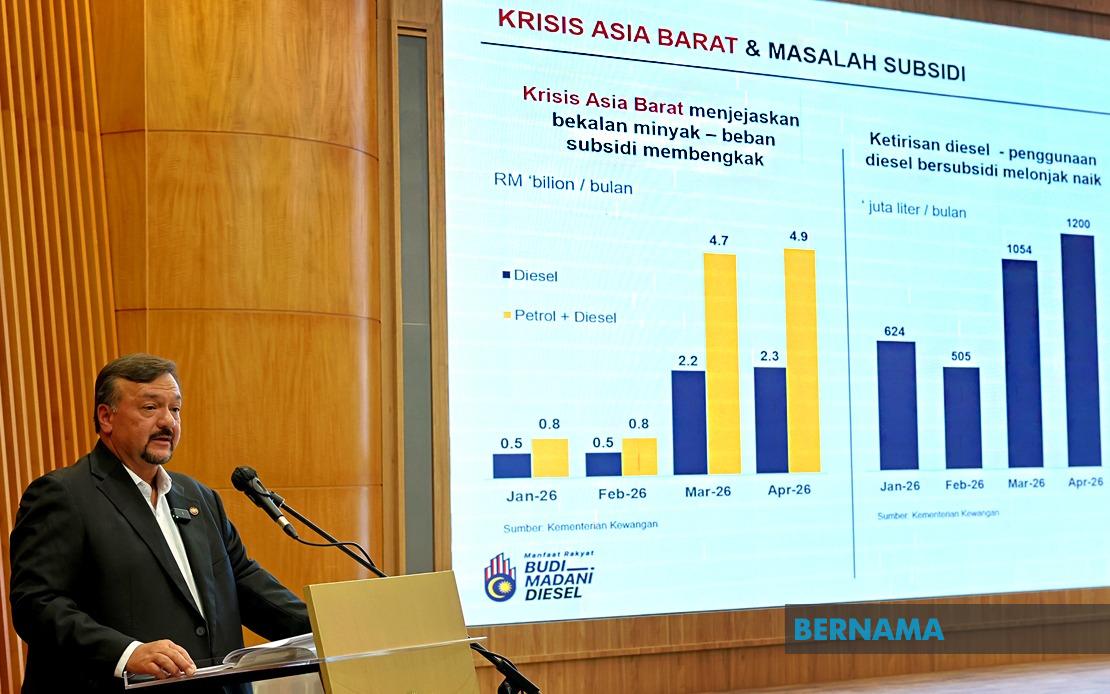
The Malaysian government will hold its monthly BUDI MADANI RON95 (BUDI95) petrol subsidy quota at 200 litres while closely tracking developments in West Asia and their ramifications for global crude oil markets. Finance Minister II Datuk Seri Amir Hamzah Azizan announced that the administration remains in a holding pattern, unwilling to rush decisions about potentially increasing the limit back to its previous threshold of 300 litres per person monthly until critical international negotiations produce tangible clarity.
The cautious stance reflects ongoing geopolitical tensions and a pivotal agreement signed between the United States and Iran last week. Amir Hamzah explained during a press briefing in Putrajaya that the preliminary ceasefire arrangement requires 60 days of further diplomatic engagement between Washington and Tehran before any conclusive outcomes emerge. This extended negotiation window creates too much uncertainty for the government to confidently predict how global energy costs will evolve, making it premature to alter Malaysia's domestic fuel assistance framework.
Prime Minister Datuk Seri Anwar Ibrahim had expressed qualified optimism regarding the preliminary accord, viewing it as potentially laying groundwork for broader regional peace. The agreement, reportedly containing 14 key points jointly endorsed by US President Donald Trump and Iranian President Masoud Pezeshkian, represents a significant diplomatic breakthrough after months of heightened tensions. However, international media coverage emphasises that both nations must finalise comprehensive terms within 60 days, leaving substantial scope for negotiations to falter or produce limited results.
The government's decision prioritises consumer protection despite the reduced subsidy envelope. Amir Hamzah stressed that maintaining BUDI95 remains the administration's commitment, noting that the drop from 300 to 200 litres produces manageable consequences for most Malaysians. His ministry's data indicates that approximately 80 per cent of BUDI95 beneficiaries consume fewer than 200 litres monthly anyway, suggesting the quota reduction primarily affects heavy commercial users rather than ordinary motorists.
This statistical reality underscores a broader policy narrative emphasising shared responsibility between government and citizens. While authorities continue subsidising fuel for ordinary drivers, officials simultaneously encourage voluntary consumption restraint through initiatives such as flexible working arrangements that reduce commuting needs. The government frames this partnership approach as necessary for sustaining assistance programmes amid volatile international energy markets.
For Malaysian motorists and households, the implications centre on predictability and budgeting. The 200-litre ceiling represents a binding commitment rather than a temporary measure, providing certainty even as policymakers evaluate whether circumstances permit future increases. This structured approach contrasts with reactive fuel pricing that would shift volatility directly onto consumers. Families dependent on vehicles for rural access or small business operations face the most tangible constraints, though the targeting mechanism attempts to shield those genuinely unable to reduce consumption.
The regional dimension adds complexity to Malaysia's calculations. Crude oil price movements increasingly reflect Middle Eastern geopolitical risk premiums, meaning that West Asian peace agreements could materially lower global petroleum costs within months. Should US-Iran negotiations succeed and stabilise regional tensions, Malaysian import costs could decline substantially, creating fiscal space for the government to restore or expand subsidies. Conversely, should diplomatic efforts stall after the initial 60-day window, prices might spike unexpectedly, validating the cautious approach.
Malaysia's energy policy dilemma reflects broader Southeast Asian challenges in balancing fiscal sustainability with social equity. Other regional economies—including Thailand, Vietnam, and Indonesia—similarly grapple with domestic fuel subsidy frameworks while exposed to identical international market forces. Malaysia's decision to pause at 200 litres rather than either dramatically cutting support or maintaining unsustainable 300-litre allotments positions the country as taking a middle path that many analysts consider fiscally prudent.
The governance architecture surrounding BUDI95 also reveals lessons about targeted assistance design. By restricting the programme to smaller quotas suited to ordinary usage patterns, policymakers discourage large-scale hoarding or resale into parallel markets while concentrating benefits on households most dependent on affordable fuel access. The statistical finding that four-fifths of recipients use less than 200 litres monthly suggests programme designers successfully calibrated thresholds to reflect genuine consumer needs rather than hypothetical maximum demand.
Looking forward, the government's monitoring posture establishes clear decision triggers. Should the US-Iran ceasefire transition into a durable peace framework within the 60-day window, oil markets will likely react positively, potentially prompting Malaysian policymakers to revisit quota levels. Conversely, if negotiations falter or new Middle Eastern crises emerge, sustaining the 200-litre limit becomes increasingly defensible on both fiscal and stabilisation grounds. This contingency thinking demonstrates strategic planning rather than ad-hoc responses to energy market shocks.
The petroleum subsidy question ultimately reflects competing pressures faced by Malaysia's economic policymakers. Maintaining assistance protects household living standards and social cohesion, particularly among lower-income groups vulnerable to transport cost increases. Yet perpetually expanding subsidies in response to international price fluctuations creates fiscal vulnerabilities and distorts market signals. The 200-litre threshold, combined with an explicit commitment to reassess as geopolitical circumstances clarify, represents an attempt to thread this needle by providing near-term security while preserving flexibility for longer-term adjustment.

