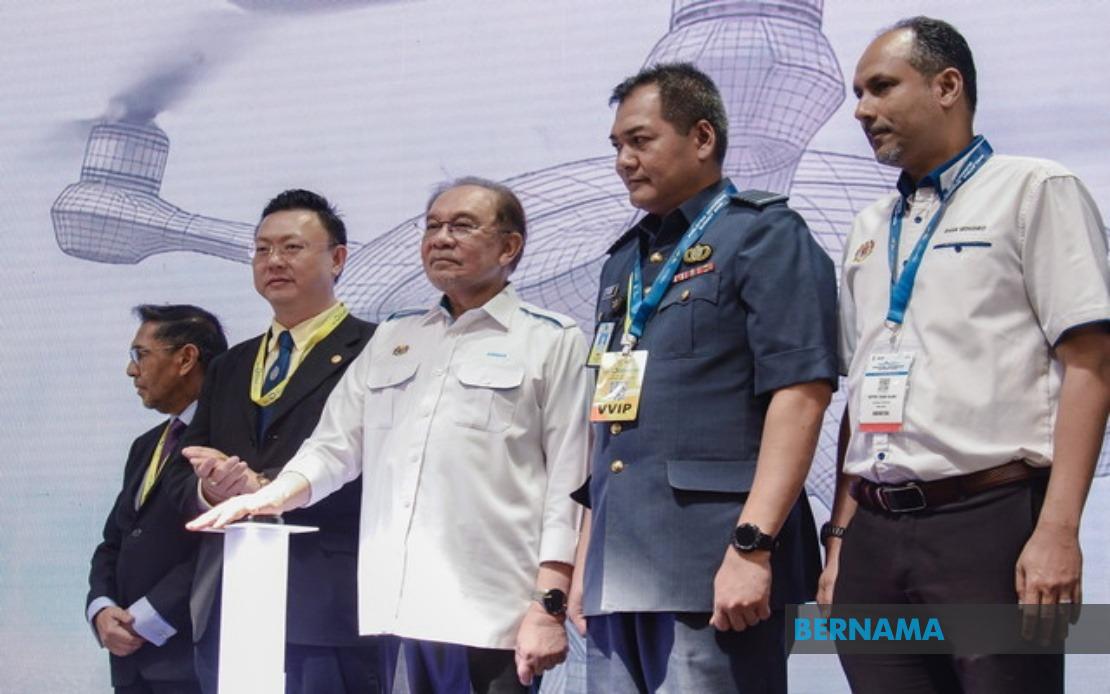
Prime Minister Datuk Seri Anwar Ibrahim has emphasised the urgent need for Malaysia to move swiftly in developing unmanned aerial vehicle technologies and related sectors, warning that the country risks losing ground in the global economy if it fails to keep pace with emerging innovations. Speaking at the closing ceremony of MyDrone Expo 2026 in Sepang, Anwar framed the drone industry not as a niche technology but as a convergence point between artificial intelligence, digital transformation, and practical economic applications that can reshape national competitiveness.
The three-day expo demonstrated significant industry momentum, drawing participation from more than 100 exhibitors and thousands of visitors and delegates representing 46 nations. This international attendance underscores the event's positioning as a serious gathering for the global aerospace and technology sectors, rather than a purely domestic showcase. The scale of attendance suggests that Malaysia is already attracting meaningful attention from international players keen to explore partnerships and business opportunities in the region.
Anwar highlighted the transformative potential embedded in the low-altitude economy, a sector that captures economic activity conducted by aircraft and drones operating below traditional commercial aviation altitudes. He pointed to projections indicating the global unmanned aerial vehicle market will surpass USD55 billion by 2030, a figure that contextualises the financial stakes for countries that successfully develop competitive domestic industries. For Malaysia, where manufacturing and technology sectors remain significant economic engines, capturing a meaningful share of this expanding market could translate into substantial employment and revenue generation.
The Prime Minister's remarks reflected a strategic recognition that drone technology transcends traditional industrial boundaries. Beyond defence and military applications—historically the primary focus of aerospace development—drones now offer transformative possibilities for agriculture, forestry, urban planning, logistics, and environmental monitoring. Malaysia's landscape of rubber and palm plantations, combined with its tropical geography and infrastructure development challenges, presents particular use cases where drone technology could enhance productivity and efficiency. Civil applications therefore represent perhaps the most immediate opportunity for market expansion within Southeast Asia.
To translate ambition into reality, Anwar has directed Cabinet ministers, policymakers, research institutions, and regulatory agencies to provide comprehensive support for the industry's expansion. This encompasses not merely passive approval but active facilitation through improved regulatory frameworks, enhanced research funding, and streamlined testing and certification processes. The directive signals that government commitment extends beyond rhetorical support to tangible policy action, though implementation timelines remain to be clarified.
A critical element of Anwar's vision involves building a functional ecosystem that balances innovation with responsible governance. He acknowledged that drone development and deployment require suitable regulatory structures and operational frameworks—a recognition that the technology's transformative potential must be coupled with safeguards addressing safety, privacy, and security concerns. This balanced approach reflects lessons learned globally, where rapid technological adoption without adequate regulatory foundations has sometimes created public backlash and policy uncertainty.
The emphasis on collaboration between private enterprises, government research institutions, and universities represents an attempt to replicate successful technology sector models already established in Malaysia. The Prime Minister explicitly referenced existing faculties and programmes in artificial intelligence and quantum computing as templates for developing a robust talent pipeline in drone technologies. This comparative approach acknowledges that technological competitiveness depends not merely on infrastructure and capital but on sustained access to skilled personnel capable of advancing the field.
For Malaysian and Southeast Asian economies, the timing of this push carries particular significance. Global supply chain reorganisation, growing regional investment in digital infrastructure, and increasing automation across industries create windows of opportunity for nations willing to position themselves as technology hubs. Malaysia's existing strengths in manufacturing, its relatively advanced digital infrastructure compared to neighbouring countries, and its strategic geographic location make it a plausible location for drone technology research and production facilities serving Asia-Pacific markets.
However, realising this vision requires sustained political will and coordinated action across government agencies that historically have not always operated in seamless coordination. Export regulations, airspace management, telecommunications licensing, and intellectual property protection all intersect with drone development and deployment. Success depends on these regulatory domains functioning coherently rather than creating conflicting requirements that frustrate industry participants. The government's challenge lies not merely in setting ambitious targets but in aligning bureaucratic processes to support them.
The international composition of MyDrone Expo 2026 also highlights regional competitive dynamics. Southeast Asian neighbours including Singapore, Thailand, and Vietnam have made significant investments in drone and aerospace technologies. Singapore's established position as a technology and finance hub gives it particular advantages in attracting investment and talent. Thailand has developed meaningful drone manufacturing capabilities. Vietnam has positioned itself in the global supply chain for aerospace components. Malaysia's entry into serious competition therefore requires differentiation through distinctive advantages—whether in manufacturing costs, talent availability, regulatory clarity, or specific technological specialisation.
Anwar's framing of drone technology as integral to Malaysia's economic future reflects broader recognition that traditional manufacturing and resource extraction will not sustain the nation's long-term prosperity. Advanced technology sectors offer pathways to higher-value economic activity and employment. However, successfully developing competitive advantages in such fields demands not merely government announcements but substantial investment in research infrastructure, education systems, and industry partnerships capable of translating technological potential into commercial reality.
Looking forward, the government's commitment to drone sector development will be assessed through concrete indicators: regulatory frameworks actually enacted, research funding disbursed to institutions and private companies, certified training programmes launched, and ultimately, the emergence of viable Malaysian drone manufacturers and technology firms capable of competing in global markets. The enthusiasm displayed at MyDrone Expo 2026 must translate into sustained momentum beyond the expo's closing ceremony for Malaysia to genuinely position itself as a regional innovation leader in this strategically important technology domain.

